OPS
OPS is a management platform for orchestras, bands, and music schools, with tools for scores, members, instruments, accounting, and documents.
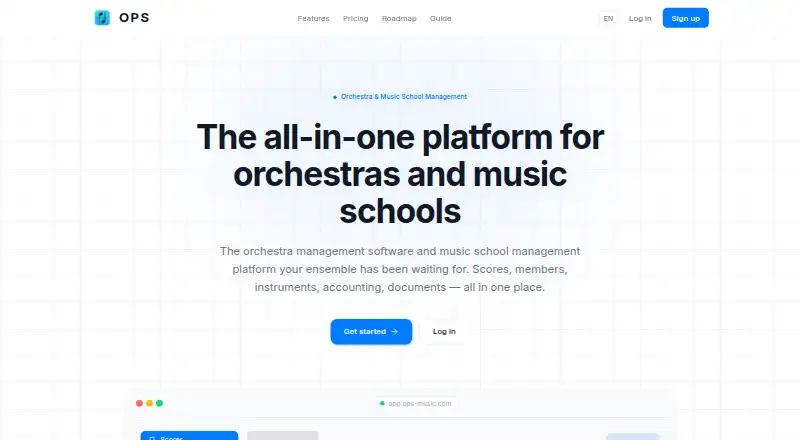
What OPS is
OPS is a management platform for orchestras, bands, and music schools, with tools for scores, members, instruments, accounting, and documents. Its score library uses OCR to identify scanned scores and produce a separate PDF for each instrument part. Member management supports custom fields, groups, bulk import and export, and optional user accounts. Instrument records can cover loan contracts, repairs, maintenance, QR labels, photos, and waiting lists. The music school module includes enrolments, courses, attendance, grades, report cards, and a parent portal. Accounting follows the French Plan Comptable Général for associations and includes FEC export. Setlists can be shared by public link or embedded on a website, while scores can be shared with other ensembles through the Mediathek. OPS Scores is an iPad app with Apple Pencil annotations, offline access, and Bluetooth page-turn pedal support; OPS Mobile for iPhone adds QR scanning, score browsing, inventory and loan management, member lookup, and an accounting overview. Events, calendars, and in-product communication are marked as coming soon.
Good
- OCR separates scanned scores into instrument-part PDFs.
- Inventory tracks loans, repairs, and maintenance.
- Music school tools include attendance and report cards.
- iPad score reading supports offline access.
Watch out
- Events and calendar features are marked coming soon.
- In-product communication is marked coming soon.
- The listed Full organisation plan supports up to 100 members and pupils.
Who it suits
OPS suits orchestras, bands, and music schools, including amateur and semi-professional ensembles. Its free and paid plans cover individual musicians as well as organisations, with plan-specific limits on pieces, setlists, accounts, or members.
Verdict
OPS combines ensemble administration with score, inventory, school, and accounting features. Check plan-specific limits and note that events, calendars, and in-product communication are not yet available.
Plans and prices
From OPS's own pricing page, checked 9 Oct 2026.
| Plan | Price | What it gives you |
|---|---|---|
| Individual musicians — Free | Free | Score library up to 15 pieces · Up to 3 setlists · 1 user account · OPS Scores app · Free |
| Organisations — Free | Free | Score library up to 20 pieces · Up to 3 setlists · 2 user accounts · OPS Scores app · Free |
| Individual musicians — Standard | €10 a month | Unlimited pieces and setlists · Members management up to 15 · Exports and imports · OPS Scores app · 100 € / year Save 17% |
| Individual musicians — Full | €15 a month | Everything in Standard · Music school and document management · Up to 50 members and pupils · OPS Scores app · OPS Mobile app · 150 € / year Save 17% |
| Organisations — Standard | €20 a month | Unlimited pieces and setlists · Members management up to 40 · Instrument inventory · Exports and imports · OPS Scores app · 200 € / year Save 17% |
| Organisations — Full | €30 a month | Everything in Standard · Accounting (PCG, FEC) · Music school management · Document management · Up to 100 members and pupils · OPS Mobile app · 300 € / year Save 17% |
The facts
Each one read from OPS's own pages, with the date it was checked.
What it does
- Accounting
- Accounting follows the French Plan Comptable Général for associations and includes FEC export.checked 9 Oct 2026
- Hosting and privacy
- The maker says data is hosted on OVH servers in Strasbourg, France, stays in Europe and is GDPR-compliant.checked 9 Oct 2026
- Integrations and sharing
- Setlists can be shared by public link or embedded on a website, and scores can be cross-shared with other ensembles through the Mediathek.checked 9 Oct 2026
- Intended users
- The maker describes OPS as built for orchestras, bands and music schools, including amateur and semi-professional ensembles.checked 9 Oct 2026
- Inventory
- Instrument inventory supports loan contracts, repair and maintenance tracking, QR code labels, photos and waiting lists.checked 9 Oct 2026
- Large ensembles
- The orchestra page says the Full plan supports up to 100 members and pupils, and advises larger ensembles to contact the maker.checked 9 Oct 2026
- Member directory
- Member management includes custom fields, groups, bulk import and export, and optional user accounts.checked 9 Oct 2026
- Music school
- The music school module includes enrolments, courses, attendance, grades, report cards and a parent portal.checked 9 Oct 2026
- Not yet available
- Events and calendar features and in-product communication are marked “Coming soon.”checked 9 Oct 2026
- Purpose
- OPS is an all-in-one management platform for orchestras and music schools, with scores, members, instruments, accounting and documents.checked 9 Oct 2026
- Score OCR
- The score library uses OCR to identify scanned scores and extract each instrument part as a separate PDF.checked 9 Oct 2026
- Support contact
- The site lists [email protected] for pricing questions and custom plans.checked 9 Oct 2026
Where it runs
- iPad app
- OPS Scores is an iPad app for reading scores that supports Apple Pencil annotations, offline access and Bluetooth page-turn pedals.checked 9 Oct 2026
- iPhone app
- OPS Mobile for iPhone supports instrument QR scanning, score browsing, inventory and loan management, member lookup and accounting overview.checked 9 Oct 2026
The full review of OPS
OPS brings repertoire, roster management and operational records together for orchestras, bands and music schools. It suits amateur and semi-professional groups that want scores alongside ensemble administration; its broad toolkit is compelling, though events, calendars and in-product communication are still marked as coming soon.
Overview
OPS combines a score library with member records, instrument inventory and, on higher plans, accounting, music-school administration and document management. That range can reduce the need to keep ensemble records and repertoire in separate tools. It also means the right plan depends on which modules the group needs and how many members or pupils it manages.
Score OCR identifies scanned scores and extracts instrument parts as separate PDFs. Setlists can be shared through public links or embedded on a website, and ensembles can share scores with one another through the Mediathek. Those options make the score library useful for distributing repertoire, not simply storing it.
Key features
Scores, members and instruments
Member records support custom fields, groups, bulk import and export, and optional user accounts. This gives organisations room to structure their roster around their own needs. Instrument inventory tracks loan contracts, repairs and maintenance, with QR labels, photos and waiting lists. Those tools are valuable for groups responsible for lending and maintaining equipment; ensembles with no instrument pool may find that part of OPS less relevant.
Music-school administration
The school module covers enrolments, courses, attendance, grades, report cards and a parent portal. Student records, recurring lessons and attendance tracking are supported, making OPS a plausible option for a school that also needs ensemble scores and member administration. Events and calendar features remain marked as coming soon, however, so groups needing those capabilities now should look elsewhere for that part of their workflow.
Accounting and mobile use
Accounting follows the French Plan Comptable Général for associations and includes FEC export. That is a specific fit for associations working with that accounting framework, rather than a general promise of accounting suitability in every country. OPS Scores is an iPad app with offline access, Apple Pencil annotations and Bluetooth page-turn pedal support. The iPhone OPS Mobile app adds QR instrument scanning, score browsing, inventory and loan management, member lookup and an accounting overview.
The maker says data is hosted on OVH servers in Strasbourg, remains in Europe and is GDPR-compliant. Groups weighing where their records are held may find that relevant.
Pricing
OPS has free tiers for both organisations and individual musicians, plus paid monthly plans with annual billing at a stated 17% saving. The monthly prices below are paired with the annual amounts shown for each plan.
| Plan | Price | Included features and limits |
|---|---|---|
| Organisations — Free | free | Score library up to 20 pieces, up to 3 setlists, 2 user accounts and OPS Scores app |
| Individual musicians — Free | free | Score library up to 15 pieces, up to 3 setlists, 1 user account and OPS Scores app |
| Individual musicians — Standard | €10 a month; billed 100 € / year, save 17% | Unlimited pieces and setlists, member management up to 15, exports and imports, OPS Scores app |
| Individual musicians — Full | €15 a month; billed 150 € / year, save 17% | Everything in Standard, music school and document management, up to 50 members and pupils, OPS Scores app and OPS Mobile app |
| Organisations — Standard | €20 a month; billed 200 € / year, save 17% | Unlimited pieces and setlists, member management up to 40, instrument inventory, exports and imports, OPS Scores app |
| Organisations — Full | €30 a month; billed 300 € / year, save 17% | Everything in Standard, accounting (PCG, FEC), music-school and document management, up to 100 members and pupils, OPS Mobile app |
The free options are useful for trying the score workflow or managing a small collection, but their piece, setlist and account caps make them narrow fits for a full organisation. Individual Standard adds broader repertoire and member management but caps the roster at 15 and omits the school and document modules. Individual Full raises that cap to 50 and adds those modules and OPS Mobile. For organisations, Standard is the entry point for inventory and supports up to 40 members; Full adds accounting and school and document management, with room for up to 100 members and pupils. Larger ensembles are advised to contact OPS, and pricing questions or custom plans can be directed to [email protected].
A free trial is offered.
Platforms
OPS is available on the web and iOS. OPS Scores is specifically an iPad app, while OPS Mobile is for iPhone. The free plans include OPS Scores; OPS Mobile is included in the Full plans.
Who it's for
OPS is strongest for orchestras, bands and music schools that want to manage repertoire alongside people, instruments or teaching records. An organisation with an equipment pool may get particular value from the inventory tools, while a school can use enrolments, attendance, grades and parent access. The Full organisation plan is sized for up to 100 members and pupils; larger ensembles should contact the maker. Groups that chiefly need calendars or internal communication should wait for those features or choose another tool for those jobs.
Pros and cons
- Pros: OCR separates scanned scores into instrument PDFs, reducing the manual work of preparing parts.
- Pros: Member management and instrument inventory cover practical ensemble administration, including imports, loan contracts and maintenance.
- Pros: School records, accounting and documents are available within the same product on Full plans.
- Pros: iPad score reading supports offline access, Pencil annotations and Bluetooth page-turn pedals.
- Cons: Free plans cap scores, setlists and user accounts, limiting their usefulness for ongoing group operations.
- Cons: Plan selection is tied to both feature access and roster size, with the organisation Full plan capped at 100 members and pupils.
- Cons: Events, calendars and in-product communication are not yet available.
- Cons: Accounting follows the French association framework, which may not suit organisations using a different system.
Alternatives
If the priority is dedicated lesson scheduling, browse Music Lesson Scheduling Software. For individual tools, Adagio is another freemium option available on Android, iOS and web. Nova Music may suit a small teaching studio that wants scheduling, calendars, group lessons, attendance, messaging and a student portal, with a free plan capped at 10 students. Clefwise offers a free plan for three students with scheduling, invoicing and online payments, a parent portal and lesson notes. CogNote is a self-hosted and web alternative described as built by a working piano studio for its own daily use. DuetStudio is another web-based freemium option. Harness is a web option with a free Hobby plan for up to five students. Shinnpad has an always-free Studio plan for up to 10 students. Trio offers a free web plan for one teacher and up to 10 students, with 50 SMS reminders per month.
Verdict
Choose OPS if your orchestra, band or music school wants score handling and ensemble administration in one place, especially if it manages instruments or needs school records and French association accounting. Its OCR, roster and inventory tools give it a clear role beyond a basic score library. Look elsewhere if calendars and in-product communication are essential now, or if the plan caps and accounting framework do not fit your organisation.
Getting started
- Open https://www.ops-music.com/en
- Create an account on the web platform
- Choose an Organisations or Individual musicians plan
- Start with a free plan or use the available free trial
- Install OPS Scores on iPad for score access
- Install OPS Mobile on iPhone when included with your plan
- Import members
Limits worth knowing
Free organisations accounts allow up to 20 score-library pieces, three setlists and two user accounts. Free individual accounts allow up to 15 pieces, three setlists and one user account. Paid plans limit members or pupils to 15, 40, 50 or 100 depending on plan.
Questions
What does OPS cost?
Free plans are available.
Which platforms does OPS support?
OPS provides a web platform, OPS Scores for iPad and OPS Mobile for iPhone.
Is there a free trial?
Yes, OPS lists a free trial and also provides free plans.
Which plan includes accounting?
Accounting is included in the Organisations — Full plan, with PCG and FEC support.
How many members can plans support?
Individual Standard supports up to 15 members; Individual Full up to 50; Organisations Standard up to 40; Organisations Full up to 100.
Where is OPS data hosted?
The maker says data is hosted on OVH servers in Strasbourg, France, remains in Europe and is GDPR-compliant.