OpenMVG
OpenMVG is a multiple-view geometry library for 3D computer vision and structure-from-motion work.
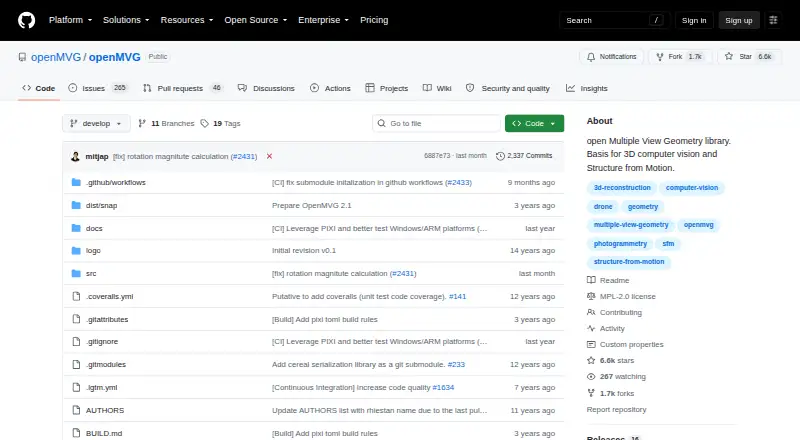
What OpenMVG is
OpenMVG is a multiple-view geometry library for 3D computer vision and structure-from-motion work. It provides a framework for reconstructing 3D scenes from images, using libraries, binaries, and pipelines. The libraries cover image manipulation, feature description and matching, feature tracking, camera models, multiple-view geometry, robust estimation, and structure-from-motion algorithms. Its binaries support scene initialization, feature detection and matching, reconstruction, and export to other multiple-view-stereo frameworks. Those frameworks can then be used to produce dense point clouds or textured meshes. OpenMVG is written in C++ and released under the Mozilla Public License 2.0. The project says it aims to support reproducible research with readable implementations of classic and state-of-the-art algorithms. It is designed to be read, learned, modified, and used, and includes test-driven development and samples. Tutorials cover its data structures, library use, and processing an image dataset. The project is free and open source, with desktop deployment listed and platforms including Windows, macOS, Linux, iOS, and Android.
Good
- Free and open source under MPL-2.0.
- Provides image-based 3D reconstruction pipelines.
- Exports scenes for other multiple-view-stereo frameworks.
- Tutorials cover library use and image datasets.
Watch out
- Implementation is in C++.
- Listed deployment is desktop.
- Point clouds and textured meshes require other frameworks.
Who it suits
OpenMVG may suit developers and researchers working on 3D reconstruction from images or reproducible computer-vision research. Its libraries, binaries, and tutorials provide distinct ways to engage with the project.
Verdict
OpenMVG is a focused library and pipeline toolkit for image-based 3D reconstruction. Users seeking dense point clouds or textured meshes should account for the need to use other multiple-view-stereo frameworks.
Plans and prices
From OpenMVG's own pricing page, checked 9 Oct 2026.
| Plan | Price | What it gives you |
|---|---|---|
| OpenMVG | Free | Open source library · MPL-2.0 |
The facts
Each one read from OpenMVG's own pages, with the date it was checked.
What it does
- Build prerequisites
- Official build instructions require CMake, Git and a C or C++ compiler; optional Qt support is version 5.4 or newer.checked 15 Oct 2026
- Camera localization
- The project provides image-localization functionality for estimating poses against an existing reconstruction.checked 15 Oct 2026
- Community footprint
- The GitHub repository page showed about 6.6 thousand stars and 1.7 thousand forks when accessed.checked 15 Oct 2026
- Compiler baseline
- The build guide calls for C++11-capable toolchains including Visual Studio 2015 or newer, GCC 4.8.1 or newer, or Clang 3.3 or newer.checked 15 Oct 2026
- Conan packages
- ConanCenter provides openmvg 2.0 packages for Linux, Windows, macOS, macOS Apple Silicon and Windows ARM64.checked 15 Oct 2026
- Core capabilities
- Its libraries include image manipulation, feature description and matching, feature tracking, camera models, multiple-view geometry, robust estimation, and structure-from-motion algorithms.checked 9 Oct 2026
- Core libraries
- The library includes image, numeric, feature, camera, multiview, linear-programming, robust-estimation, geometry, geodesy and SfM modules.checked 15 Oct 2026
- Design and testing
- The project describes OpenMVG as designed to be easy to read, learn, modify, and use, with test-driven development and samples.checked 9 Oct 2026
- Documentation
- The project links to tutorials covering its data structures, library use, and processing an image dataset.checked 9 Oct 2026
- Documentation depth
- The Read the Docs material documents individual binaries, data structures, camera models, solvers, pipelines and export tools, while marking some modules as incomplete.checked 15 Oct 2026
- GPU feature library
- POPART lists PopSIFT, a GPU SIFT implementation reported at 25 frames per second on HD images with recent graphics cards.checked 15 Oct 2026
- Ground-control workflows
- The release history records support for ground-control-point registration and geodesy-related workflows.checked 15 Oct 2026
- Implementation
- OpenMVG is developed in C++.checked 9 Oct 2026
- Independent praise: capability
- An independent photogrammetry tester described the resulting OpenMVG/OpenMVS reconstruction as good and substantially complete.checked 15 Oct 2026
- Independent praise: quality
- The same test produced a textured model the author called very pleasing, with OpenMVG taking 6 minutes 43 seconds for its own processing on that test.checked 15 Oct 2026
- Latest release
- Release v2.1 Sablefish was published on 28 December and recorded 42 pull requests and 45 issue or feature enhancements.checked 15 Oct 2026
- Licence
- The repository distributes the software under the Mozilla Public License 2.0.checked 15 Oct 2026
- License
- The repository identifies the project license as Mozilla Public License 2.0.checked 9 Oct 2026
- Limit: algorithm complexity
- A NAVER Labs tutorial said OpenMVG combines many pre-existing algorithms in ways that are impressive but make the resulting algorithm difficult to understand.checked 15 Oct 2026
- Limit: command-line workflow
- The same user noted that OpenMVG consists of many command-line tools and is easier to operate through custom scripts.checked 15 Oct 2026
- Limit: dense reconstruction dependency
- The tester reported that dense reconstruction was the difficult stage and encountered OpenMVS crashes when GPU memory demand became too high.checked 15 Oct 2026
- Limit: installation effort
- An independent user reported that openMVG had no prepackaged installation at the time and required manual compilation.checked 15 Oct 2026
- Limit: speed
- A comparative test found OpenMVG feature extraction and reconstruction slower than COLMAP for that dataset, although final model quality was similar.checked 15 Oct 2026
- Marker integration
- The related CCTag library detects concentric-circle markers designed for sub-pixel accuracy under blur, occlusion and poor lighting.checked 15 Oct 2026
The full review of OpenMVG
OpenMVG is a C++ toolkit for building image-based 3D reconstruction workflows, aimed chiefly at developers and researchers. Its open-source libraries cover geometry and structure from motion, but producing dense point clouds or textured meshes means taking the reconstructed scene into another framework.
Overview
OpenMVG brings together libraries, command-line binaries, and pipelines for multiple-view geometry and structure from motion. Its scope runs from image manipulation and feature processing through camera models and robust estimation to reconstruction and scene export. That breadth is useful when you need control over how a workflow is assembled; it is less suitable if you want a ready-made scanning app with a consumer capture experience.
The project is written in C++ and targets reproducible research through readable implementations of classic and state-of-the-art algorithms. Test-driven development and samples support learning and modification, while tutorials cover data structures, library use, and processing an image dataset. Those are meaningful advantages for technical users, though the emphasis on libraries and pipelines assumes more development involvement than a turnkey tool.
Key features
From images to a reconstructed scene
OpenMVG’s libraries cover image manipulation, feature description and matching, feature tracking, camera models, multiple-view geometry, robust estimation, and structure-from-motion algorithms. Its binaries handle scene initialization, feature detection and matching, reconstruction, and export. Together, these pieces provide a substantial base for custom image-to-scene workflows rather than locking users into one reconstruction step.
Export for dense reconstruction
OpenMVG can export reconstructed scenes to other multiple-view-stereo frameworks, which can then compute dense point clouds or textured meshes. That separation is a practical boundary: OpenMVG supplies the geometry and reconstruction pipeline, but users seeking those dense outputs must bring another framework into their process.
Research and adaptation
Readable implementations, samples, and test-driven development make the project a reasonable choice for studying or adapting reconstruction methods. Tutorials address both library use and dataset processing, and the project points users to its wiki and a contact email for usage resources and support. The research orientation is a strength for people who want to understand or change the underlying methods, not a substitute for a packaged end-user interface.
Pricing
OpenMVG is free and open source under the Mozilla Public License 2.0. Its OpenMVG plan costs nothing and includes an open-source library under MPL-2.0. There is no paid tier to unlock the core toolkit, making it suitable for users who can work directly with the software rather than pay for a managed scanning service.
Platforms
OpenMVG is categorized for Android, iOS, Linux, macOS, self-hosted use, and Windows, with desktop deployment. Its C++ library and pipeline orientation makes it a software development choice rather than a mobile-first capture app.
Who it's for
Choose OpenMVG if you are a developer or researcher who wants to build, inspect, or modify image-based reconstruction workflows, or needs a free foundation for structure-from-motion work. It is a weaker fit for people who need dense point clouds or textured meshes directly from a single app, or who prefer a finished capture-and-export experience without assembling a pipeline.
Pros and cons
- Pros: A broad set of geometry, feature-processing, and structure-from-motion components supports custom workflows from image inputs through scene export.
- Pros: Free access under MPL-2.0 removes a software subscription cost for developers and researchers.
- Pros: Readable implementations, samples, and tutorials give technical users material for learning and adapting the algorithms.
- Cons: Dense point clouds and textured meshes require another multiple-view-stereo framework, adding a dependency for users who need those outputs.
- Cons: Its library-and-pipeline focus is a poor match for users seeking a ready-made scanning interface rather than a toolkit to work with.
Alternatives
Photogrammetry Software and AI 3D Scanning Software are useful category pages for comparing other approaches.
- COLMAP is another free option for users comparing image-based reconstruction software.
- MicMac is a free, open-source photogrammetric suite for readers seeking a broader photogrammetry-oriented alternative.
- WebODM is free to install and use locally and offline, making it a better alternative for users who want a locally run mapping workflow.
- MagiScan offers a freemium option for people looking for a scanning-oriented alternative across mobile and desktop platforms.
- PIX4Dcatch is a freemium capture alternative with LiDAR 3D capture, GPS georeferencing, point measurement, and GCP creation in its free Discovery license.
- KIRI Engine offers a free Basic plan with up to 150 photos, a 2 GB per-scan limit, unlimited scans, and free exports, suiting users who want defined scan limits and exports in a freemium tool.
- MetaScan has a free tier capped at five scans in the library and one HD reconstruction per month, an option for users who can work within those limits.
- Polycam offers a free tier with limited space, object, and AI captures, plus GLTF exports and public link sharing, for users who want a capture-focused alternative.
Verdict
OpenMVG is a strong choice for developers and researchers who want a free, adaptable foundation for image-based 3D reconstruction and value access to the underlying algorithms. Look elsewhere if your priority is a finished scanning app or dense point clouds and textured meshes without adding a separate multiple-view-stereo framework.
Alternatives to OpenMVG
- 1

WebODM
Free planOpen sourceWebAPILinuxmacOS8.3From $24 a month - 2

KIRI Engine
Free planAndroidiOSWebAPI8.1From $79.99 a year - 3

Polycam
Free planAndroidiOSWeb7.5From $150 a year - 4
OpenReco
Free planOpen sourceWebAPILinuxmacOS7.4Free plan - 5
RealityScan
Free planAndroidiOSLinuxWindows7.4From $1,250 a year - 6
Scaniverse
Free planAndroidiOSWeb7.4From $20 a month