
COLMAP
COLMAP is a free pipeline for reconstructing scenes in 3D from ordered or unordered image collections.
What COLMAP is
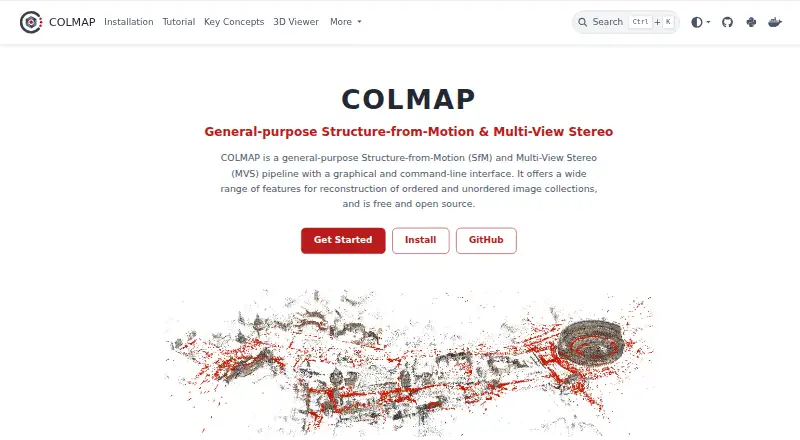
COLMAP is a free pipeline for reconstructing scenes in 3D from ordered or unordered image collections. Its Structure-from-Motion stage estimates camera poses and sparse 3D structure; its Multi-View Stereo stage uses PatchMatch stereo and stereo fusion to produce dense point clouds and meshes. Users can work through a graphical interface or command line. The GUI's automatic reconstruction tool takes an image folder and writes sparse and dense results to a workspace folder. For development, PyCOLMAP offers Python bindings for most functionality, and COLMAP can be built as a library for C++ code. Feature extraction options include SIFT, ALIKED and LoMa; ALIKED and LoMa require ONNX support at build time. It supports a wide range of camera models and multi-camera rigs. Users can install pre-built binaries or build from source; macOS users also have a Homebrew formula, and a pre-built Docker image includes CUDA support. The library uses the new BSD license, while third-party dependencies have separate licenses. The project describes COLMAP as research software that may occasionally exit ungracefully when constraints are not met. Windows binaries are not officially signed and may trigger a Defender warning.
Good
- Offers both graphical and command-line interfaces.
- Produces sparse and dense reconstructions.
- PyCOLMAP provides Python bindings for most functionality.
- Pre-built Docker image includes CUDA support.
Watch out
- Windows binaries are not officially signed.
- Some feature extractors require ONNX support at build time.
- May exit ungracefully when constraints are not met.
Who it suits
COLMAP is suited to researchers and developers reconstructing 3D scenes from image collections, whether they prefer a GUI, command line or code integration. Users should be comfortable with research software and its installation options.
Verdict
COLMAP provides a free route from image collections to sparse and dense 3D results, with options for GUI use and software integration. Its research-software status and unsigned Windows binaries are worth considering before installation.
Plans and prices
From COLMAP's own pricing page, checked 30 Sep 2026.
| Plan | Price | What it gives you |
|---|---|---|
| COLMAP | Free | — |
The facts
Each one read from COLMAP's own pages, with the date it was checked.
What it does
- Automatic reconstruction
- The GUI automatic reconstruction tool takes a folder of input images and produces sparse and dense reconstructions in a workspace folder.checked 30 Sep 2026
- Camera support
- COLMAP supports a wide range of camera models and multi-camera rigs.checked 30 Sep 2026
- C++ integration
- COLMAP can be built as a reusable library that can be included and linked against C++ source code.checked 30 Sep 2026
- Dense reconstruction
- Its Multi-View Stereo pipeline uses PatchMatch stereo and stereo fusion to produce dense point clouds and meshes.checked 30 Sep 2026
- Docker
- COLMAP provides a pre-built Docker image with CUDA support.checked 30 Sep 2026
- Feature algorithms
- COLMAP supports SIFT, ALIKED, and LoMa feature extraction, with ALIKED and LoMa requiring ONNX support at build time.checked 30 Sep 2026
- Installation
- Users can install pre-built binaries or build from source, and Homebrew provides a macOS formula.checked 30 Sep 2026
- Interfaces
- COLMAP provides both a graphical user interface and a command-line interface.checked 30 Sep 2026
- License
- The COLMAP library is licensed under the new BSD license, while third-party dependencies are separately licensed.checked 30 Sep 2026
- Purpose
- COLMAP is a general-purpose Structure-from-Motion and Multi-View Stereo pipeline for reconstructing ordered and unordered image collections.checked 30 Sep 2026
- Python integration
- PyCOLMAP provides Python bindings for most of COLMAP's functionality, including reconstruction and robust geometric estimators.checked 30 Sep 2026
- Research software
- The tutorial describes COLMAP as research software that may rarely exit ungracefully when some constraints are not fulfilled.checked 30 Sep 2026
- Security
- The provided Windows binaries are not officially signed and may trigger a Windows Defender security warning.checked 30 Sep 2026
- Sparse reconstruction
- Its incremental Structure-from-Motion pipeline recovers camera poses and sparse 3D structure.checked 30 Sep 2026
- Support
- The project directs users to GitHub Discussions for questions and the GitHub issue tracker for bug reports and feature requests.checked 30 Sep 2026
Money
- Free plan
- Yeschecked 20 Sep 2026
The full review of COLMAP
COLMAP is a photogrammetry pipeline that turns ordered or unordered image collections into 3D reconstructions. It suits technically minded users who want to work locally through a GUI or command line, or build reconstruction into Python and C++ projects. Its strongest case is a free pipeline spanning sparse and dense results; the trade-off is research-software reliability and some extra care on Windows.
Overview
COLMAP combines Structure-from-Motion (SfM) and Multi-View Stereo (MVS) in one workflow. Incremental SfM estimates camera poses and sparse 3D structure, while MVS can turn image information into dense point clouds and meshes. That range makes it useful when a project needs more than camera positions or a sparse preview, and point cloud export supports taking results beyond the pipeline.
The GUI's automatic reconstruction tool accepts an image folder and produces sparse and dense reconstructions in a workspace folder. Users can also work through the command line for a more scriptable workflow. The project describes COLMAP as research software and cautions that it may sometimes exit ungracefully when constraints are not met. That is a meaningful drawback for production pipelines where predictable error handling matters.
Key features
Reconstruction workflow
COLMAP's paired SfM and MVS stages cover sparse and dense reconstruction, with PatchMatch stereo and stereo fusion used for dense output. This gives technically capable users a broad set of reconstruction stages in one application, but the research-software caveat makes it less suitable when a workflow depends on highly predictable recovery from invalid inputs or unmet constraints.
Integration and algorithms
PyCOLMAP exposes most functionality through Python bindings, including reconstruction and robust geometric estimators. COLMAP can also be built as a reusable library for C++ projects, making it a stronger fit for developers who need reconstruction inside their own software than a standalone-only tool. Feature extraction supports SIFT, ALIKED, and LoMa; ALIKED and LoMa require ONNX support at build time, an implementation consideration for users selecting those options.
A wide range of camera models and multi-camera rigs helps accommodate varied capture setups. The library uses the new BSD license, while third-party dependencies have their own licenses, so projects embedding it should account for those separate terms.
Pricing
COLMAP is free: the COLMAP plan costs nothing. The free plan includes the software's reconstruction capabilities and API access, so there is no paid tier to unlock the core workflow. That makes it an unusually straightforward choice for individuals and developers who can install and operate it themselves; the cost is the technical responsibility of setup and a less polished reliability profile, rather than a subscription.
Users can install pre-built binaries or build from source. macOS users also have a Homebrew formula, and a pre-built Docker image with CUDA support offers another deployment route. The library's new BSD license applies to COLMAP itself; third-party dependencies remain separately licensed.
Platforms
COLMAP is listed for Linux, macOS, Windows, and web, with desktop deployment. Installation options include binaries and source builds, plus Homebrew on macOS and the CUDA-enabled Docker image. Windows users should note that the provided binaries are not officially signed and may trigger a Windows Defender warning. Questions go to GitHub Discussions, while bug reports and feature requests belong in the GitHub issue tracker.
Who it's for
Choose COLMAP if you need a free, locally operated SfM and MVS pipeline, want to move from image collections to sparse and dense outputs, or plan to integrate reconstruction into Python or C++ software. Its support for camera models and multi-camera rigs also suits varied capture configurations.
Look elsewhere if graceful handling of unmet constraints is essential, or if you want a less technical, more consumer-oriented scanning workflow. COLMAP offers a GUI, but its research-software status and multiple installation paths favor users comfortable with technical setup.
Pros and cons
- Pros: Free access to both sparse and dense reconstruction makes the full pipeline available without a paid upgrade.
- Pros: GUI, command line, Python bindings, and a reusable C++ library support both standalone work and software integration.
- Pros: Camera-model and multi-camera-rig support, plus point cloud and mesh output, give it breadth across capture and reconstruction needs.
- Cons: The research-software caveat of occasional ungraceful exits makes it a weaker choice for workflows requiring dependable failure handling.
- Cons: Unsigned Windows binaries may prompt a Defender warning, adding friction and caution at installation.
- Cons: ALIKED and LoMa require ONNX support at build time, so using those feature extractors involves an additional build requirement.
Alternatives
Photogrammetry Software is a useful category to compare if you want to weigh COLMAP against other reconstruction tools. For AI-led scanning, browse AI 3D Scanning Software; for shaping or editing 3D assets, see 3D modeling software.
- WebODM is another free option that runs locally and offline, with support for Linux, macOS, Windows, web, and self-hosted use; choose it if that deployment mix better fits your workflow.
- Polycam offers a free tier with limited space, object and AI captures, GLTF exports, and public link sharing, plus a paid Basic plan at $150 a year; consider it if those capture and sharing features suit your needs.
- RealityScan is a freemium alternative with free and trial options across Android, iOS, Linux, and Windows.
- KIRI Engine has a free Basic plan supporting up to 150 photos, a 2 GB maximum per scan, unlimited scans, and free exports; it is worth considering if those stated limits and export terms fit your projects.
- OpenReco is a free alternative for Linux, macOS, and Windows.
- 3DF Zephyr offers a perpetual free personal-use plan capped at 50 photos or video frames, with one GPU and limited exports and editing; choose it if that smaller personal-use scope is sufficient.
- 3Dsurvey is a paid alternative with a free plan and free trial, and offers Android, iOS, Linux, web, and Windows support.
- Agisoft Metashape is a paid alternative with a free trial, no free plan, and Linux, macOS, web, and Windows support.
Verdict
COLMAP is a strong choice for technically capable users who want a free route from image collections to sparse and dense 3D results, especially when Python or C++ integration matters. Its range of interfaces and reconstruction stages is the main reason to choose it. If your work cannot tolerate occasional ungraceful exits, or you want a simpler scanning experience, another tool is the safer fit.
Getting started
- Visit the COLMAP website.
- Install a pre-built binary or build COLMAP from source.
- On macOS, use the Homebrew formula if preferred.
- Alternatively, use the pre-built Docker image with CUDA support.
- For automatic GUI reconstruction, select a folder of input images and use a workspace folder for results.
Limits worth knowing
COLMAP is free. Its project notes that the research software may rarely exit ungracefully when some constraints are not fulfilled.
Questions
Does COLMAP cost anything?
COLMAP is free, with a listed plan at no cost.
What platforms are listed?
Linux, macOS, web, and Windows.
Is COLMAP open source?
The COLMAP library is licensed under the new BSD license. Third-party dependencies are licensed separately.
Can I use COLMAP from Python or C++?
PyCOLMAP provides Python bindings for most functionality. COLMAP can also be built as a library and linked with C++ source code.
How can I install it?
Options include pre-built binaries, building from source, a macOS Homebrew formula, and a pre-built Docker image with CUDA support.
Are the Windows binaries signed?
The provided Windows binaries are not officially signed and may trigger a Windows Defender security warning.
Alternatives to COLMAP
- 1
WebODM
Free planOpen sourceWebAPILinuxmacOS8.3From $24 a month - 2

KIRI Engine
Free planAndroidiOSWebAPI8.1From $79.99 a year - 3
OpenMVG
Free planOpen sourceAndroidiOSAPILinux7.8Free plan - 4

Polycam
Free planAndroidiOSWeb7.5From $150 a year - 5
OpenReco
Free planOpen sourceWebAPILinuxmacOS7.4Free plan - 6
RealityScan
Free planAndroidiOSLinuxWindows7.4From $1,250 a year