OpenGTM
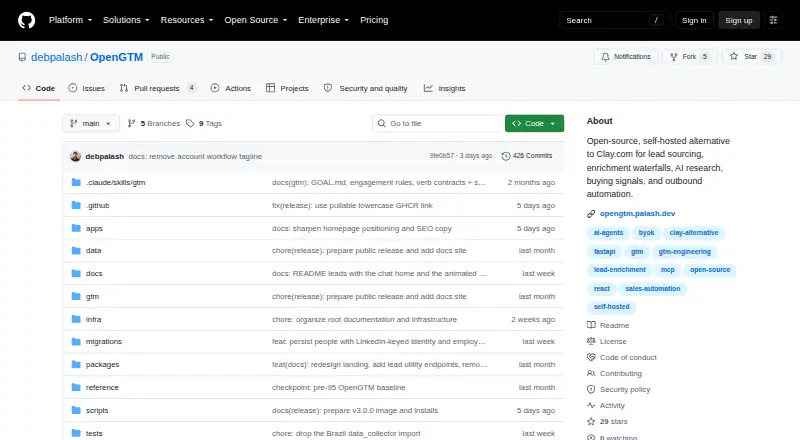
OpenGTM is an open-source, self-hosted workspace for go-to-market teams and their agents.
What OpenGTM is
OpenGTM is an open-source, self-hosted workspace for go-to-market teams and their agents. It supports lead sourcing and enrichment, AI research with cited answers, buying-intent tracking, and sending qualified records to other tools. Workbooks combine lead imports, formulas, HTTP columns, enrichment waterfalls, AI research and output columns; estimated spend is shown before a run. Teams can create live audiences, monitor hiring and buying signals, and schedule refreshes and automations.
Integrations listed include HubSpot, Salesforce, Slack, Sheets, Airtable, Instantly, Smartlead, webhooks, warehouses and consent-gated ad audiences. The same workspace is accessible through REST, webhooks and an auditable MCP server with scoped read and write capabilities. The project says data stays on the user's infrastructure and third-party calls use provider keys chosen by the user. Teams can set a workbook budget to stop paid calls before exceeding its ceiling, though third-party provider costs may apply. Installation requires Git, Docker with Compose v2 and roughly 4 GB of available RAM. The project describes itself as pre-1.0; public multi-tenant hosting needs more work beyond team-controlled Compose deployment.
Good
- Shows estimated spend before workbook runs.
- Workbook budgets can stop paid calls at a ceiling.
- Connects to listed CRM, messaging and spreadsheet destinations.
- Offers REST, webhooks and scoped MCP access.
- Self-hosted plan is free.
Watch out
- Third-party provider costs may apply.
- Setup requires Git, Docker Compose v2 and roughly 4 GB RAM.
- Project is pre-1.0.
- Public multi-tenant hosting needs additional work.
Who it suits
It suits GTM teams that want to manage lead sourcing, enrichment, research and outbound automation on infrastructure they control. Teams should be prepared to set up Docker and manage provider costs and production security requirements.
Verdict
OpenGTM brings lead workflows, enrichment and agent access into a self-hosted workspace, with estimates and budget ceilings for paid calls. Its pre-1.0 status and setup and hosting requirements are important considerations for teams evaluating it.
Plans and prices
From OpenGTM's own pricing page, checked 3 Oct 2026.
| Plan | Price | What it gives you |
|---|---|---|
| OpenGTM (self-hosted) | Free | Open-source AGPL-3.0 · run on your own infrastructure · third-party provider costs may apply |
| OpenGTM self-hosted | Free | self-hosted deployment · user supplies infrastructure and provider costs · AGPL-3.0 |
The facts
Each one read from OpenGTM's own pages, with the date it was checked.
What it does
- Agent access
- The same workspace is accessible through REST, webhooks, and an auditable MCP server with scoped read and write capabilities.checked 3 Oct 2026
- AI research
- Research and agent columns fetch cited sources and keep source URLs alongside generated answers.checked 15 Oct 2026
- AI tools
- The MCP guide says the server supports Claude, Codex, OpenCode, Pi, Cursor, Windsurf, and other stdio MCP clients.checked 3 Oct 2026
- API
- A generated REST reference exposes endpoints for leads, workbooks, audiences, automations, CRM, outreach, signals, governance, and other operations.checked 15 Oct 2026
- Buying signals
- The system can watch hiring and buying signals and trigger scheduled refreshes and automations.checked 15 Oct 2026
- Chrome extension
- The 3.0.0 release lists a Chrome capture extension among the shipped components.checked 15 Oct 2026
- Data control
- The project says data stays on the user's infrastructure and third-party calls use provider keys chosen by the user.checked 3 Oct 2026
- Documentation
- The documentation site includes getting-started guides, concepts, provider and LLM guides, integrations, self-hosting, architecture, CLI material, and a generated REST reference.checked 15 Oct 2026
- Enrichment waterfalls
- Provider waterfalls run enrichment attempts in cost-aware order and show estimated spend before execution.checked 15 Oct 2026
- Installation
- Docker Compose v2, Git, about 4 GB of RAM, and roughly two CPUs are documented for a comfortable single-node installation.checked 15 Oct 2026
- Integrations
- Documented destinations include HubSpot, Salesforce, Slack, Google Sheets, Airtable, Instantly, Smartlead, webhooks, warehouses, and consent-gated ad audiences.checked 15 Oct 2026
- Intended users
- The README describes OpenGTM as an open-source, self-hosted alternative to Clay.com for lead sourcing, enrichment, AI research, buying signals, and outbound automation.checked 3 Oct 2026
- Launch news
- A LinkedIn launch post dated about ten months before the October 15, 2026 research date presented OpenGTM as an AI and GTM research lab focused on open data models and standards.checked 15 Oct 2026
- Lead sourcing
- The product can search for companies and people using industry, geography, and keyword criteria.checked 15 Oct 2026
- Lead workflow
- It sources companies and people, enriches rows through cost-ordered provider waterfalls, researches questions with cited agents, tracks buying intent, and sends qualified records to other tools.checked 3 Oct 2026
- License
- The software is released under the GNU Affero General Public License version 3.0.checked 15 Oct 2026
- Limit: hosted multi-tenancy
- The project states that public multi-tenant hosting still needs additional egress, identity, custody, restore, and security-review work.checked 15 Oct 2026
- Limit: product breadth
- The project says its provider catalog is still growing and that it is not a pixel-for-pixel Clay clone.checked 15 Oct 2026
- Limit: production hardening
- Skillget records remaining work for an outbound egress proxy, managed key custody, SSO and audit export, restore drills, and external security review before hosting mutually hostile tenants.checked 15 Oct 2026
- Maturity and hosting limit
- The security policy describes OpenGTM as pre-1.0, while the README says public multi-tenant hosting needs additional work beyond team-controlled Compose deployment.checked 3 Oct 2026
- MCP and agents
- An auditable MCP server provides scoped read and write access, with setup examples for agent clients and HTTP transport.checked 15 Oct 2026
The company
- Company activity
- Crunchbase says the company develops go-to-market data infrastructure, software, and research for AI agents and revenue teams.checked 15 Oct 2026
- Company listing
- Crunchbase describes OpenGTM as a private, active, for-profit company headquartered in San Francisco, California.checked 15 Oct 2026
Money
- Limit: billing scope
- Skillget states that billing primitives exist, but taxes, refunds, subscriptions, and customer-lifecycle operations are not implemented.checked 15 Oct 2026
The full review of OpenGTM
Overview
OpenGTM puts prospecting, enrichment, research and outbound handoffs in a self-hosted workspace for go-to-market teams. Its combination of workbooks, agent access and spend controls is compelling for teams that want to keep data and provider credentials on infrastructure they manage; operating that infrastructure is part of the deal.
Workbooks bring imported leads, formulas, HTTP columns, enrichment waterfalls, AI research and output columns together, with estimated spend shown before a run. Teams can also set a budget ceiling to stop paid calls before it is exceeded, a useful safeguard when workflows call third-party providers whose costs may apply.
Live audiences can segment records, monitor hiring and buying signals, and trigger scheduled refreshes and automations. Qualified records can go to destinations including HubSpot, Salesforce, Slack, Sheets, Airtable, Instantly, Smartlead, webhooks and warehouses; ad audiences require consent.
Key features
- Lead sourcing and enrichment: OpenGTM sources companies and people, with enrichment for email, phone, firmographic, technographic, hiring, social and identity data. Provider waterfalls ordered by cost can help manage which services are called, but provider costs may still apply.
- Agent research: Agents research questions and return cited findings. The same workspace is accessible through REST, webhooks and an auditable MCP server with scoped read and write capabilities, making it suited to teams integrating agent workflows rather than treating research as a standalone chat.
- Spend controls: Reviewing estimated spend and setting a workbook ceiling gives teams a way to govern paid calls before a run. These controls do not make external provider usage free.
- Data control: The project says data stays on the user's infrastructure and third-party calls use provider keys chosen by the user. That suits organizations that want operational control, but also means they take on deployment and maintenance.
Pricing
OpenGTM (self-hosted): free. The AGPL-3.0 open-source plan runs on your own infrastructure and includes API access, CRM sync and waterfall enrichment. There is no free trial because the plan is free; however, third-party provider costs may apply. The zero software price is therefore not a guarantee of zero operating cost.
There are no paid OpenGTM tiers or seat and quota limits described. Its trade-off is infrastructure responsibility: teams must install and host the software themselves, rather than paying for a managed OpenGTM service.
Platforms
OpenGTM supports API, Linux, macOS, self-hosted, web and Windows. Installation requires Git, Docker with Compose v2 and roughly 4 GB of available RAM. Laptop installation is documented for macOS, Linux and Windows, with Docker Desktop for Windows; the demo can be used without provider keys.
Production deployment requires more care than a local demo. The production checklist calls for production secrets, changed default passwords, TLS termination and backups of both PostgreSQL and the data volume. The security policy asks for private vulnerability reports through GitHub or [email protected], with maintainers aiming to acknowledge reports within 72 hours. OpenGTM is pre-1.0, and public multi-tenant hosting needs more work beyond team-controlled Compose deployment.
Who it's for
OpenGTM is best for technically capable GTM teams that want to assemble lead sourcing, enrichment, cited agent research, buying signals and outbound automation in one self-managed workflow. It is a poor fit for teams seeking a turnkey hosted service, or for those unwilling to handle deployment, production security and backups.
Pros and cons
- Pro: Workbooks combine imports, enrichment, research and outputs, so a team can build a connected workflow instead of stitching together each stage manually.
- Pro: Estimated spend and a budget ceiling help teams control paid provider calls before a run.
- Pro: REST, webhooks and auditable MCP access with scoped permissions offer several ways to connect software and agents.
- Con: Self-hosting requires Git, Docker Compose v2 and about 4 GB of RAM, plus production secrets, TLS and backups for a serious deployment.
- Con: Third-party provider charges may apply, so free software does not mean free enrichment or research.
- Con: Pre-1.0 maturity and unfinished support for public multi-tenant hosting make it less suitable for teams expecting a mature hosted service.
Alternatives
For a broader directory, see Data Enrichment Software.
Choose Clay if you prefer a freemium service with a 500-actions-per-month free plan, 100 data credits and up to 200 rows per table, rather than running OpenGTM yourself. Coresignal is worth considering for API- or web-based data access: its free tier has 2,000 credits, a 5 req/s limit and a 7-day trial.
TargetWise offers a free plan with 20 work emails and five business-phone results, plus dashboard, API and MCP access; consider it if those limits suit your needs and you do not want to self-host. B2BEnrich has a free plan with 50 monthly credits for person and company enrichment, making it an option for testing or small projects.
The other Clay entry is a free editable site on a name.clay.site address, not a substitute for OpenGTM's lead workflow. BetterContact is a paid alternative with a Starter plan at $15 a month for 200 credits, including 20 mobile phones or 200 valid emails. Precisely EnterWorks is another option, with custom pricing and an active entitlement required for downloads. People Data Labs offers freemium IP enrichment API tiers.
Verdict
Choose OpenGTM if your GTM team wants an open-source workspace connecting lead workflows, enrichment and agent access, and can operate it on infrastructure it controls. Its strongest advantage is the combination of flexible workflows and explicit spend limits; look elsewhere if you need managed hosting, a more mature product, or predictable costs that include third-party data.
Getting started
- Visit the OpenGTM GitHub repository.
- Install Git and Docker with Compose v2.
- Set aside roughly 4 GB of available RAM.
- Use Docker Desktop for Windows if installing on Windows.
- Run the demo without provider keys, or configure provider keys chosen by your team for third-party calls.
- For production, configure production secrets, change default passwords, terminate TLS, and back up PostgreSQL and the data volume.
Limits worth knowing
The self-hosted plan costs nothing, but third-party provider costs may apply. Workbook budgets stop paid calls at the configured ceiling; the project is pre-1.0, and public multi-tenant hosting requires additional work beyond team-controlled Compose deployment.
Questions
Is OpenGTM free?
The self-hosted plan is free. Third-party provider costs may apply.
Is OpenGTM open source?
Yes. The self-hosted plan identifies it as open-source AGPL-3.0 software.
Which platforms are supported?
The listed platforms are API, Linux, macOS, self-hosted, web, and Windows.
What does setup require?
Installation requires Git, Docker with Compose v2, and roughly 4 GB of available RAM. The README documents laptop installation on macOS, Linux, and Windows using Docker Desktop for Windows.
Which destinations can receive records?
Listed destinations include HubSpot, Salesforce, Slack, Sheets, Airtable, Instantly, Smartlead, webhooks, warehouses, and consent-gated ad audiences.
Does OpenGTM work with AI coding and agent tools?
Its auditable MCP server supports Claude, Codex, OpenCode, Pi, Cursor, Windsurf, and other stdio MCP clients.
Alternatives to OpenGTM
- 1

HubSpot CRM
Free planAndroidiOS7.9From $15 a month - 2

Leadspace
Free planWebAPIExtension7.7From $49 a month - 3

People Data Labs
Free planWebAPISelf-hosted7.5Free plan - 4

PredictLeads
Free planWebAPIExtensionSelf-hosted7.5From $0.01 a month - 5
Elvesora Enrichment
Free planWebAPI7.4From $30 a month - 6

Enrich Layer
WebAPILinuxmacOS7.3From $588 a year