
OpenEMM
OpenEMM is free, web-based open-source software for email marketing and marketing automation, including newsletters and transactional or date-driven messages.
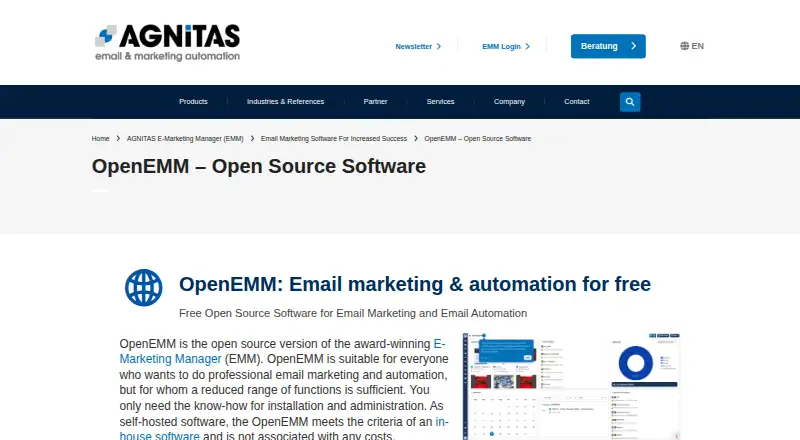
What OpenEMM is
OpenEMM is free, web-based open-source software for email marketing and marketing automation, including newsletters and transactional or date-driven messages. It includes email automation, audience segmentation, landing pages, and A/B testing, alongside a campaign manager, calendar reminders, comments, and responsive templates. Teams can view recipient status history and enrich profiles from recipient reactions. Other tools include bounce management, real-time opener and click statistics, behavior-based target groups, web forms, a multiqueue mail backend, web services, and a plugin interface. Integrations include Make and n8n, with HTTP request endpoints and import/export options also available. OpenEMM is self-hosted: it can run on a user's premises, with a hosting provider, or in a data center. The free plan has no listed limits on recipients, mailing lists, or dispatches. The software's versions from OpenEMM 2019 Spring use the GNU AGPLv3 license. Installation requires SSH access with root rights; the maker lists at least 4 GB of server RAM and recommends 8 GB. A three-day demo account is available, but it cannot send mailings.
Good
- Free plan has no recipient limit.
- No listed cap on mailing lists or dispatches.
- Includes segmentation, landing pages, and A/B testing.
- Supports Make and n8n integrations.
- Offers FAQs, manuals, tutorials, and forum help.
Watch out
- Requires SSH access with root rights for installation.
- At least 4 GB server RAM is listed.
- Demo account access lasts three days.
- Demo account cannot send mailings.
Who it suits
OpenEMM may suit SMEs, associations, and clubs that want email marketing and automation and can work with its reduced feature range. It is also suited to users able to handle self-hosting and the stated server requirements.
Verdict
OpenEMM provides a broad set of email campaign tools without listed recipient, list, or dispatch caps on its free plan. Its self-hosted setup and server requirements are important considerations before choosing it.
Plans and prices
From OpenEMM's own pricing page, checked 21 Oct 2026.
| Plan | Price | What it gives you |
|---|---|---|
| OpenEMM | Free | No limit on recipients, mailing lists, or dispatch · Self-hosted · Installation, configuration, maintenance, and administration are the user's responsibility · Permanently free; unlimited usage period |
The facts
Each one read from OpenEMM's own pages, with the date it was checked.
What it does
- A/B testing
- Yeschecked 20 Sep 2026
- API
- The documentation describes SOAP and REST APIs for remote management and a callback API for sending event notifications to third-party systems.checked 21 Oct 2026
- Audience segmentation
- Yeschecked 20 Sep 2026
- Bounce management
- The product includes automated bounce management.checked 21 Oct 2026
- Campaign features
- It includes a campaign manager, calendar reminders and comments, responsive templates, recipient status history, and profile enrichment from recipient reactions.checked 12 Oct 2026
- Campaigns
- A graphical workflow manager supports planning and running multi-stage email campaigns.checked 21 Oct 2026
- Demo
- AGNITAS offers a demo account with access for three days, but that account cannot send mailings.checked 21 Oct 2026
- Development news
- The GitHub project says a 26.11 release was planned for November 2026 with an OpenAPI 3 REST API, an MCP API, verified Make and n8n connectors, redesigned statistics, and PostgreSQL support.checked 21 Oct 2026
- Documentation
- AGNITAS provides user manuals, installation and administration guides, context-sensitive help, and documentation for REST, SOAP, webhooks, and Velocity scripting.checked 21 Oct 2026
- Downloads
- The download page lists Runtime 26.05 and OVA 25.11 packages, and provides the manual as a separate download.checked 21 Oct 2026
- Email automation
- Yeschecked 20 Sep 2026
- Email types
- It supports newsletters, transactional and service emails, autoresponders, and action- or date-triggered messages.checked 21 Oct 2026
- Extensibility
- A plugin interface and scripting for custom triggers are listed as ways to extend the software.checked 21 Oct 2026
- Forms
- The platform provides a visual web form builder and recipient self-service forms.checked 21 Oct 2026
- Hosting
- OpenEMM is self-hosted and can run on the user's own premises, with a hosting provider, or in the user's own data center.checked 12 Oct 2026
- Independent review coverage
- OMR Reviews shows zero OpenEMM reviews on the page opened.checked 21 Oct 2026
- Integrations
- The documentation identifies Make and n8n connectors, while the platform also supports data exchange through web services, HTTP endpoints, and imports or exports.checked 21 Oct 2026
- Landing pages
- Yeschecked 20 Sep 2026
- License
- OpenEMM releases from version 2019 Spring onward use the GNU Affero General Public License version 3 (AGPLv3).checked 21 Oct 2026
The company
- Company
- The maker is AGNITAS AG, a privately held software development company.checked 21 Oct 2026
- Company size
- LinkedIn lists AGNITAS AG in the 11–50 employee range.checked 21 Oct 2026
- Founded
- LinkedIn states that Martin Aschoff founded AGNITAS in 1999.checked 21 Oct 2026
- Headquarters
- LinkedIn lists AGNITAS AG's headquarters in Munich, Germany.checked 21 Oct 2026
Money
- Free plan
- Yeschecked 20 Sep 2026
The full review of OpenEMM
OpenEMM is open-source software for email campaigns and marketing automation, including newsletters and transactional or date-driven messages. It suits organizations able to manage their own server and wanting control over deployment and mailing volume. Its free plan has no recipient, list, or dispatch limits, but root-level installation access and ongoing hosting make it a poor fit for teams seeking a hosted service.
Overview
AGNITAS, based in Munich and founded in 2006, develops OpenEMM as web-based software that can run on an organization's own premises, with a hosting provider, or in its own data center. That flexibility is a meaningful advantage for teams with deployment or privacy requirements; it also means server administration is part of the cost of choosing the product.
Versions from OpenEMM 2019 Spring onward are licensed under GNU AGPLv3. AGNITAS describes OpenEMM as GDPR-compliant and cites user-selected hosting, source-code access for inspection, and customization. Those controls may help organizations govern their deployment, but they do not eliminate the work of securing and operating it.
Key features
The campaign manager includes calendar reminders and comments, responsive templates, and recipient status history. Real-time opener and click statistics, profile enrichment from recipient reactions, and behavior-based target groups give marketers ways to learn from engagement and refine follow-up. Segmentation, automation, A/B testing, and landing pages support broader campaign workflows.
Bounce management, web forms, a multiqueue mail backend, web services, and a plugin interface extend the core tools. Make and n8n integrations, HTTP request endpoints, and import/export options provide connection paths for other systems. This is a substantial toolkit for a free product, though organizations should weigh the breadth against the infrastructure and technical access it requires.
Pricing
| Plan | Price | What it includes |
|---|---|---|
| OpenEMM | free | Unlimited usage period; no limit on recipients, mailing lists, or dispatch; no costs for use. |
The lack of recipient, list, and dispatch caps is compelling for organizations with substantial or growing mailing needs. The plan is free to use, but self-hosting is not cost-free in practice: users need suitable server capacity and must handle installation and operation. The maker's demo account lasts 3 days and cannot send mail, so it is useful for exploring the interface but not for evaluating live delivery.
AGNITAS lists a minimum of 4 GB of server RAM, recommends 8 GB, and requires SSH shell access with root rights for installation. Free help includes FAQs, a forum, manuals, online help, and tutorials; paid support and setup services are also offered.
Platforms
OpenEMM is web-based and self-hosted. The download page lists Linux servers and Windows or Mac servers running through VirtualBox as runtime options. The platform listing also includes API access. This range gives technically equipped organizations deployment choices, but it is not a conventional plug-in hosted email service.
Who it's for
OpenEMM is a sensible fit for SMEs, associations, and clubs that want professional email marketing and automation, can run server software, and find its feature range sufficient. It is especially attractive when mailing volume and control over hosting matter more than avoiding maintenance. Teams without root-level server access, or those that want a managed service rather than a self-hosted installation, should look elsewhere.
Pros and cons
- Pro: No usage cost and no caps on recipients, lists, or dispatch make it viable for large mailing programs without per-volume plan limits.
- Pro: Automation, segmentation, A/B testing, landing pages, behavior-based targeting, and engagement statistics cover more than basic newsletter sending.
- Pro: Self-hosting and AGPLv3 source access give organizations more control over deployment and the ability to inspect or customize the software.
- Con: Installation requires SSH access with root rights, and the server needs at least 4 GB of RAM, with 8 GB recommended; that is a real operational hurdle.
- Con: The 3-day demo does not permit mailings, limiting its usefulness for assessing delivery in a real campaign.
Alternatives
Choose AWeber if a hosted option better fits your workflow and its free plan's limits of 500 subscribers and 3,000 monthly emails are sufficient. Mailchimp may suit teams preferring a hosted service across web, iOS, and Android, provided 250 contacts, 500 emails per month, 250 emails per day, one audience, and one seat are enough. For an API- or web-based option with a defined free allowance, Mailjet includes 6,000 emails per month, 200 per day, and 1,000 contacts on its free plan.
phpList is another self-hosted option, with a Forever Free plan that allows 300 messages and unlimited subscribers. If you want push notifications instead of email marketing, consider Firepush. Direct Mail is a Mac and iOS alternative whose free plan includes 150 emails per month and unlimited contacts. Twilio Segment is another alternative. Zoho Campaigns offers a hosted alternative with a free allowance of up to 2,000 contacts, 6,000 emails per month, and five users.
Browse the Email Marketing Software category for more options.
Verdict
OpenEMM is a strong choice for organizations with server expertise that want open-source email marketing tools and no recipient, list, or dispatch caps on a free plan. Its campaign and automation features are broad, and self-hosting gives meaningful deployment control. Choose a hosted alternative if avoiding server setup, root-level access, and ongoing administration matters more than those advantages.
Getting started
- Open the OpenEMM website
- Choose a self-hosted location for operation
- Prepare a server with at least 4 GB RAM
- Ensure SSH shell access with root rights
- Install on a Linux server or Windows or Mac server through VirtualBox
- Use the three-day demo account to explore the software
Questions
Is OpenEMM free?
Yes. The OpenEMM plan costs nothing for an unlimited usage period, with no costs for use.
Are there limits on recipients or sends?
The plan lists no limit on recipients, mailing lists or dispatches.
Which platforms are supported?
OpenEMM lists API, Linux, macOS, self-hosted, web and Windows platforms. Runtime options include Linux servers and Windows or Mac servers through VirtualBox.
Can OpenEMM be self-hosted?
Yes. It can run on your premises, with a hosting provider or in your own data center.
Is there a demo?
AGNITAS offers a demo account with access for three days, but mailings cannot be sent from that account.
What license does OpenEMM use?
Versions from OpenEMM 2019 Spring are released under the GNU Affero General Public License version 3.
Alternatives to OpenEMM
- 1

Mailchimp
Free planAndroidiOSWebAPI8.3From $13 a month - 2

SendPulse
Free planAndroidiOSWebAPI8.2From $9.60 a month - 3

Substack
Free planAndroidiOSWebAPI8.2$50 one-time - 4

Zoho Campaigns
Free planAndroidiOSWebAPI8.2From $4 a month - 5

Brevo Conversations
Free planAndroidiOSWebAPI8.1From $15 a month - 6

E-goi
Free planAndroidiOSWebAPI8.1From $11.75 a month