
Open3D
Open3D is a free, open-source library for building software that works with 3D data.
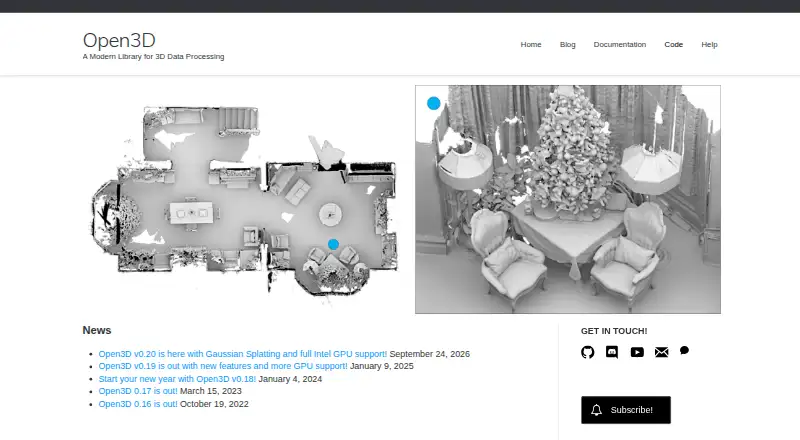
What Open3D is
Open3D is a free, open-source library for building software that works with 3D data. It provides C++ and Python interfaces for data structures and processing algorithms, including scene reconstruction and surface alignment, and supports physically based rendering. Open3D-ML adds tools for tasks such as semantic point-cloud segmentation, pretrained models, and training pipelines, with PyTorch and TensorFlow support. The project also offers a standalone viewer for Debian/Ubuntu, macOS, and Windows, plus web visualization from C++ or Python servers. Browser viewing can use WebRTC, and visualizations can be embedded in Jupyter Notebook or JupyterLab. Listed inputs include Intel RealSense cameras, Azure Kinect, RGB-D sequences, bag files, point clouds, and meshes; export options include XYZ, PLY, PCD, STL, OBJ, GLTF, GLB, and other formats. Current Python packages support Python 3.10 through 3.14 on Ubuntu 22.04+, macOS 10.15+, and 64-bit Windows 10+. Other systems can use a source build. The web visualizer uses HTTP by default, so sensitive remote visualization requires suitable server configuration and SSL certificates.
Good
- Provides C++ and Python interfaces.
- Open3D-ML supports PyTorch and TensorFlow.
- Includes GPU acceleration for core operations.
- MIT-licensed for research and commercial use with attribution.
- Supports point-cloud and mesh workflows.
Watch out
- Linux PyPI wheels lack native TensorFlow support from v0.18 onward.
- Web visualizer uses HTTP by default.
- Sensitive remote visualization needs SSL configuration.
Who it suits
Open3D suits developers and researchers building 3D data applications, including visualization and machine-learning workflows. It may also fit projects that need a standalone viewer or browser-based visualization.
Verdict
Open3D offers a broad toolkit for processing, visualizing, and learning from 3D data, with viewer and web options. Linux users relying on TensorFlow through the PyPI wheel and teams visualizing sensitive remote data should account for the stated limitations.
The facts
Each one read from Open3D's own pages, with the date it was checked.
What it does
- 3D processing
- Core features include 3D data structures and processing algorithms, scene reconstruction, and surface alignment.checked 30 Sep 2026
- Core capabilities
- Core features include 3D data structures, processing algorithms, scene reconstruction, surface alignment, physically based rendering, machine-learning support, and GPU acceleration.checked 1 Oct 2026
- GPU acceleration
- The project lists GPU acceleration for core 3D operations; its v0.20 release announcement highlights full Intel GPU support.checked 30 Sep 2026
- Integrations
- Open3D-ML works with TensorFlow and PyTorch and provides framework-independent visualization functionality.checked 1 Oct 2026
- Intended users
- The project describes use in published research projects and cloud deployments, and welcomes open-source contributions.checked 30 Sep 2026
- Interfaces
- The frontend provides data structures and algorithms in C++ and Python.checked 1 Oct 2026
- Languages
- The library provides C++ and Python interfaces and a 3D viewer app.checked 30 Sep 2026
- License
- Open3D is released under the MIT license for research and commercial use with proper attribution.checked 1 Oct 2026
- Open3D-ML
- Open3D-ML adds tools for 3D machine-learning tasks, including semantic point-cloud segmentation, pretrained models, and training pipelines.checked 1 Oct 2026
- Package options
- The installation guide lists standard, CPU-only, and Intel GPU Python wheels, plus a preview Windows CUDA wheel.checked 30 Sep 2026
- Purpose
- Open3D is an open-source library for rapid development of software dealing with 3D data.checked 1 Oct 2026
- Python versions
- The current Python packages list support for Python 3.10 through 3.14.checked 30 Sep 2026
- Remote visualization caveat
- The web visualizer uses HTTP by default, and the documentation advises configuring SSL certificates for sensitive remote visualization.checked 30 Sep 2026
- Security limitation
- The web visualizer uses HTTP by default, so remote visualization requires appropriate web-server configuration and SSL certificates for sensitive data.checked 1 Oct 2026
- Security provenance
- The documentation says development viewer packages, Python wheels, C++ archives, and documentation tarballs have signed SLSA build provenance attestations.checked 30 Sep 2026
- Supply-chain security
- Release Python wheels and C++ binaries include signed SLSA build-provenance attestations aligned with OpenSSF supply-chain guidance.checked 1 Oct 2026
- Support
- Support channels include GitHub Issues, a usage forum, and Discord chat.checked 1 Oct 2026
- Support channels
- The project points users to GitHub issues for bugs and feature requests, a forum for usage discussions, and Discord for chats and collaboration.checked 30 Sep 2026
- Supported systems
- The current Python packages support Ubuntu 22.04+, macOS 10.15+, and 64-bit Windows 10+; other systems can use a source build.checked 30 Sep 2026
- Viewer
- Open3D-Viewer is a standalone 3D viewer app available on Debian/Ubuntu, macOS, and Windows.checked 1 Oct 2026
- Visualization
- Open3D supports 3D visualization with physically based rendering.checked 30 Sep 2026
The company
- Founded
- 2018checked 23 Sep 2026
Where it runs
- Linux TensorFlow limit
- From v0.18 onward, the PyPI Linux wheel does not provide native TensorFlow support because of PyTorch/TensorFlow build incompatibilities.checked 1 Oct 2026
- Machine learning
- Open3D supports PyTorch and TensorFlow for 3D machine learning.checked 1 Oct 2026
The full review of Open3D
Overview
Open3D is a free, open-source toolkit for building software around 3D data, best suited to developers and research teams working with point clouds, meshes, or 3D machine learning. Its breadth is a strength, but it is a programming library rather than a ready-made scanning workflow, and some platform and remote-viewing caveats matter.
C++ and Python interfaces expose data structures and processing algorithms for reconstruction, alignment, and visualization. The project also provides a standalone viewer and web visualization, while the MIT license permits research and commercial use with proper attribution.
Supported inputs include Intel RealSense cameras, Azure Kinect, RGB-D sequences, RealSense bag files, point-cloud files, and mesh files. Export formats include XYZ, XYZN, XYZRGB, PTS, PLY, PCD, STL, OBJ, OFF, GLTF, GLB, and FBX, giving it room in workflows that move between point clouds and common mesh formats.
Key features
Processing and visualization
Core tools cover 3D data structures, processing algorithms, scene reconstruction, and surface alignment. Physically based rendering supports inspection of results, and GPU acceleration is listed for core operations; the v0.20 release announcement highlights full Intel GPU support. This combination suits teams building their own processing pipeline, though it asks more of users than a single-purpose desktop scanner app.
Machine learning
Open3D-ML adds semantic point-cloud segmentation, pretrained models, and training pipelines. It supports PyTorch and TensorFlow and includes framework-independent visualization, making it useful when 3D processing needs to meet model training or inference. There is an important Linux exception: since v0.18, the PyPI Linux wheel does not provide native TensorFlow support because of PyTorch/TensorFlow build incompatibilities.
Viewer and browser visualization
Open3D-Viewer is a standalone app for Debian and Ubuntu, macOS, and Windows. The web visualizer can run standalone C++ or Python servers and display output in a browser through WebRTC; it can also be embedded in Python Jupyter Notebook or JupyterLab cells. That makes it a flexible route for sharing or notebook-based inspection, but the web visualizer uses HTTP by default. Sensitive remote visualization calls for appropriate web-server configuration and SSL certificates.
Build and supply-chain choices
Current Python packages support Ubuntu 22.04+, macOS 10.15+, and 64-bit Windows 10+, with Python 3.10 through 3.14. The installation guide offers standard, CPU-only, and Intel GPU wheels, plus a preview Windows CUDA wheel; users on other systems can build from source. Release Python wheels and C++ binaries carry signed SLSA build-provenance attestations, a useful supply-chain signal for teams incorporating dependencies into larger deployments.
Pricing
Open3D is free, with no free trial because there is no paid plan to evaluate. The free offering is the library itself, under the MIT license, with C++ and Python interfaces, the viewer, and Open3D-ML. It is a strong fit for individuals and organizations able to work with a developer toolkit; no paid tier or seat-based plan is part of the offer.
Platforms
Open3D supports Linux, macOS, and Windows, with API access and self-hosted and web visualization options. The standalone viewer runs on Debian/Ubuntu, macOS, and Windows. Python wheel support is narrower than the broad platform labels: Ubuntu 22.04+, macOS 10.15+, and 64-bit Windows 10+ are supported by current packages, while other systems require a source build. Linux users who need TensorFlow through the PyPI wheel should account for the native-support limitation.
Who it's for
Open3D is a good match for software developers, research projects, and cloud deployments that need programmable 3D processing, capture, reconstruction, or machine-learning tools. Its support for camera inputs, point clouds, meshes, and a wide range of export formats gives it utility across stages of a 3D data workflow. It is less suitable for someone seeking a polished, scanner-specific workflow without programming, or for teams that need to visualize sensitive remote data without configuring secure web serving.
For bugs and feature requests, the project directs users to GitHub Issues; usage discussions are served by a forum, with Discord for chat and collaboration. The project also welcomes open-source contributions.
Pros and cons
- Pro: C++ and Python APIs, processing tools, reconstruction, and visualization live in one open-source toolkit, useful for teams building a custom 3D pipeline.
- Pro: Open3D-ML adds segmentation, pretrained models, and training pipelines, extending the library beyond geometry processing.
- Pro: Broad input and export format support helps connect camera capture, point clouds, and mesh workflows.
- Pro: MIT licensing allows research and commercial use with attribution, and release binaries include signed provenance attestations.
- Con: The Linux PyPI wheel lacks native TensorFlow support from v0.18 onward, complicating that framework choice for Linux users.
- Con: The web visualizer defaults to HTTP, so sensitive remote viewing requires additional SSL and server configuration.
- Con: Current Python wheels target specific operating-system versions; unsupported systems need a source build.
Alternatives
Choose MeshInspector instead if you want a freemium, cross-platform app centered on viewing and basic editing of meshes, point clouds, and voxels, with basic mesh repair. Choose JMStudio for 3DMakerpro scanner workflows and its STL, OBJ, PLY, ASC, and RSCAN exports. Revo Scan 6 is a free option for scanning and post-processing with Revopoint 3D scanners.
MeshLab is another free, open-source mesh processing and editing system. Polycam has a free mobile and web plan with limited space, object, and AI captures, GLTF exports, and public link sharing; its paid Basic plan is $150 a year. RealityScan is a freemium alternative for individuals and small businesses under $1 million USD in revenue in the past 12 months, educational institutions, and students.
Polyga PointKit offers a Premium plan at $99 a month, billed 1 month, for XTract3D 2 and PointKit with a single active license. Structure offers an SDK Developer License with a 7 day free trial and all SDK features for experimentation and prototyping.
Browse more options in 3D Scanning Software and Point Cloud Software.
Verdict
Choose Open3D if you need a free, extensible foundation for 3D processing, visualization, or machine-learning work and can accommodate its development-oriented workflow. Its strongest reason to choose it is the combination of broad APIs and capable 3D tooling under an MIT license; look elsewhere if you need an off-the-shelf scanner app, Linux TensorFlow through the PyPI wheel, or secure remote visualization without extra configuration.
Alternatives to Open3D
- 1

Global Mapper
AndroidiOSWindows6.9From $599 a year - 2
WhiteboxTools
Free planLinuxmacOSWindows6.7From $740 a year - 3
Point Cloud Library
Free planAndroidLinuxmacOSWindows6.3Free plan - 4
PointCab Origins
macOSWindows6.3From €420 a month - 5
Terrasolid TerraScan
Windows6.2From €570 a year - 6

LP360
WebWindows6.1From $620 a year