Open-BPMN
Open-BPMN is a free, open platform for creating and maintaining business process models using BPMN 2.0.
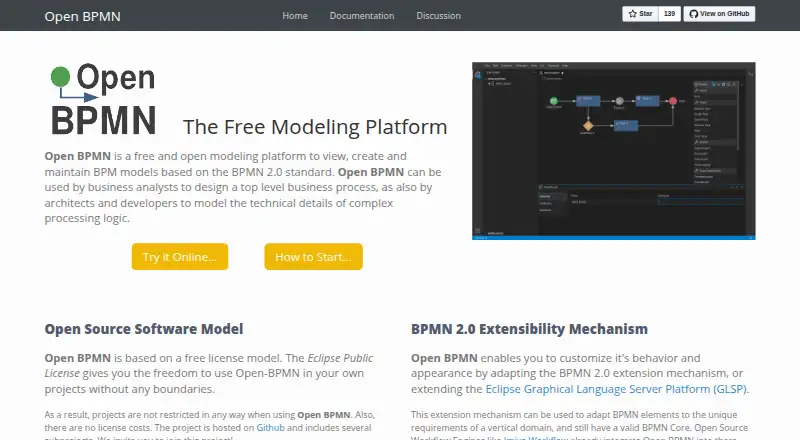
What Open-BPMN is
Open-BPMN is a free, open platform for creating and maintaining business process models using BPMN 2.0. Its editor displays diagrams and lets users add, change, or remove BPMN elements. It is presented for analysts designing high-level processes, as well as architects and developers modeling technical processing logic. The project uses the Eclipse Public License and states that it has no license costs. Open-BPMN can run in Visual Studio Code, Eclipse IDE, Eclipse Theia, or standalone web applications. Its extension system supports adapting editor behavior and appearance through BPMN 2.0 extensions or Eclipse GLSP. The Java metamodel can generate models programmatically and import or export .bpmn files; diagrams can also be exported as lossless SVG, depending on the tooling platform. Documentation covers running it as a Docker web application and deploying it in Kubernetes. The VS Code extension requires Java 17 or later. The project directs users to a GitHub discussion forum for questions and bug reports.
Good
- Free platform with no license costs.
- Supports BPMN 2.0 models.
- Can import and export .bpmn files.
- SVG export is available depending on platform.
- Supports several IDE and web environments.
Watch out
- VS Code extension requires Java 17 or higher.
- SVG export depends on the tooling platform.
Who it suits
It suits business analysts mapping top-level processes, and architects or developers modeling technical process logic. Teams needing extensibility or programmatic BPMN model handling may also find its tooling relevant.
Verdict
Open-BPMN provides BPMN 2.0 diagram editing, extensibility, and model import and export without license costs. Check the Java prerequisite for its VS Code extension and the tooling dependency for SVG export.
Plans and prices
From Open-BPMN's own pricing page, checked 2 Oct 2026.
| Plan | Price | What it gives you |
|---|---|---|
| Open-BPMN | Free | Free and open platform · no license costs |
The facts
Each one read from Open-BPMN's own pages, with the date it was checked.
What it does
- Deployment
- The installation guide documents running Open-BPMN as a web application in Docker and deploying it in Kubernetes.checked 2 Oct 2026
- Diagram editing
- The client displays BPMN models and provides tools to create, modify, and delete BPMN elements.checked 2 Oct 2026
- Export
- The documentation says diagrams can be exported as lossless SVG graphics, depending on the tooling platform.checked 2 Oct 2026
- Extensibility
- Its extension mechanism lets projects adapt the editor’s behavior and appearance using BPMN 2.0 extensions or Eclipse GLSP.checked 2 Oct 2026
- Imixs-Workflow
- The Imixs-Workflow extension adds attributes to BPMN tasks and catch events so models can be executed by the Imixs-Workflow engine.checked 2 Oct 2026
- Integrations
- The documentation lists Visual Studio Code, Eclipse IDE, Eclipse Theia, and standalone web applications as environments for running Open-BPMN.checked 2 Oct 2026
- Intended users
- The site describes it for business analysts designing top-level processes and for architects and developers modeling technical processing logic.checked 2 Oct 2026
- License
- The project says it uses the Eclipse Public License and has no license costs.checked 2 Oct 2026
- Model library
- The Java metamodel can generate BPMN models programmatically and import or export models from .bpmn files.checked 2 Oct 2026
- Prerequisite
- The VS Code extension is based on JDK 17 and requires Java 17 or higher.checked 2 Oct 2026
- Purpose
- Open-BPMN is a free, open modeling platform for creating and maintaining business process models based on BPMN 2.0.checked 2 Oct 2026
- Support
- The site directs users to its GitHub discussion forum and says users can report bugs or start discussions.checked 2 Oct 2026
The company
- Headquarters
- Munich, Germanychecked 28 Sep 2026
- Maker
- The project says it is led by Imixs, a software company located in Munich, Germany, specializing in business process management solutions.checked 2 Oct 2026
The full review of Open-BPMN
Open-BPMN is a free BPMN 2.0 modeling platform for business analysts and technical teams. It is the stronger fit when a project needs an adaptable editor or programmatic model handling; the VS Code extension requires Java 17 or higher.
Overview
Open-BPMN covers the core work of creating and maintaining BPMN 2.0 process models: its client displays diagrams and lets users create, modify, and remove BPMN elements. Process documentation, version history, and BPMN export make it useful beyond one-off diagramming. Its Eclipse Public License carries no license costs, a clear advantage for teams that want an open modeling tool without a software fee.
The project serves both analysts mapping top-level processes and architects or developers modeling technical processing logic. Its extension mechanism can change the editor’s behavior and appearance through BPMN 2.0 extensions or Eclipse GLSP. That adaptability is valuable where modeling needs are specific, but is less compelling for users who want a fixed, ready-to-use workflow and have no need to shape the editor.
Key features
Modeling and model handling
The Java metamodel can generate BPMN models programmatically and import or export .bpmn files. This gives developers a route to work with models in code as well as in the editor. SVG export is documented as lossless, though its availability depends on the tooling platform; teams with a required SVG workflow should confirm that their chosen environment supports it.
Environments and deployment
Open-BPMN runs in Visual Studio Code, Eclipse IDE, Eclipse Theia, and standalone web applications. The VS Code extension is based on JDK 17 and requires Java 17 or higher, so it is not the right route for a machine without that prerequisite. Docker and Kubernetes deployment options suit teams operating the web application themselves, but require them to manage that deployment.
Workflow extension and support
The Imixs-Workflow extension adds attributes to BPMN tasks and catch events so models can be executed by the Imixs-Workflow engine. That is a concrete benefit for teams using that engine, not a general execution capability to assume for other workflows. Users can raise bugs or start discussions in the project’s GitHub discussion forum.
Pricing
Open-BPMN costs nothing. The free plan is the open platform, with no license costs; BPMN support, process documentation, version history, and SVG and BPMN exports are included. There is no paid tier to compare, making it a strong choice when licensing cost is the primary constraint. Its trade-off is that teams needing a managed deployment or a particular platform-dependent export workflow must account for their own tooling and operations.
Platforms
Open-BPMN supports extension, Linux, macOS, self-hosted, web, and Windows use. Its documented environments include VS Code, Eclipse IDE, Eclipse Theia, and standalone web applications. Platform choice matters: Java 17 or higher is a prerequisite for the VS Code extension, and SVG export depends on the tooling platform.
Who it's for
Business analysts can use it to shape top-level processes, while architects and developers can model technical logic, work with .bpmn files, or generate models programmatically. It is especially suitable for teams that value extensibility, need an open tool with no license costs, or plan to deploy the web application themselves. It is a weaker fit for users who expect a turnkey workflow or cannot meet the VS Code extension’s Java requirement.
Pros and cons
Pros
- No license costs: The free, Eclipse Public License platform avoids a software fee for BPMN modeling.
- Adaptable editor: BPMN 2.0 extensions or Eclipse GLSP can alter behavior and appearance for project-specific needs.
- Code-oriented model handling: The Java metamodel supports programmatic generation and .bpmn import and export.
- Multiple deployment environments: IDE, standalone web, Docker, and Kubernetes options accommodate different operating approaches.
Cons
- VS Code has a Java prerequisite: The extension needs Java 17 or higher, adding a setup requirement for users who choose that environment.
- SVG export varies by tooling platform: Teams with a fixed SVG workflow need to ensure their selected environment supports it.
- Extension flexibility assumes customization needs: Users seeking an unchanging, packaged workflow may not benefit from its adaptable design.
Alternatives
Process Mapping Software is a useful category starting point for comparing tools across process mapping needs.
- Bonita is worth considering if a free plan with a 150-process-instance monthly allowance, no time limit, and community support is a better match.
- Camunda may suit teams looking for a free self-managed development and testing plan that also lists production usage.
- HEFLO is an alternative for users who want a web-based option with Android and iOS platforms, or an academic plan with cloud-stored diagrams and image downloads.
- Bizagi Modeler fits users who prefer web or Windows and want a free plan for one user with unlimited processes and models, stored locally.
- Crismo is an alternative for users seeking a free-forever individual plan with BPMN 2.0 modeling, diagram versioning, and PNG or PDF exports.
- ProcessMind may suit a solo user who values unlimited models and 20 AI credits per month on its free plan.
- bpmn.io is another free option for users seeking open-source toolkits for BPMN and related modeling areas.
- Flowable is an alternative to consider for teams evaluating Java-based, Apache 2.0-licensed workflow engines.
Verdict
Choose Open-BPMN if you need BPMN 2.0 modeling without license costs and value the option to adapt the editor or handle models programmatically. Its main advantage is that combination of open access, extensibility, and model import and export. Look elsewhere if your chosen VS Code setup cannot meet the Java 17 requirement, or if a platform-dependent SVG export workflow is essential and your environment does not support it.
Alternatives to Open-BPMN
- 1
Flowable
Free planOpen sourceAndroidiOSWebAPI8.7From $99 a month - 2
Nintex Process Platform
AndroidiOSWebAPI7.8From $25,000 a year - 3

Camunda
Free planWebAPILinuxmacOS7.6Free plan - 4

bpmn.io
Free planOpen sourceWebAPIExtensionLinux7.5Free plan - 5

HEFLO
Free planAndroidiOSWebAPI7.4Free plan - 6
Avidemux
Free planOpen sourceWebLinuxmacOSWindows7.3Free plan