Nexynt Asset Management
Nexynt Asset Management tracks equipment, accessories, consumables, and software licenses from procurement through retirement.
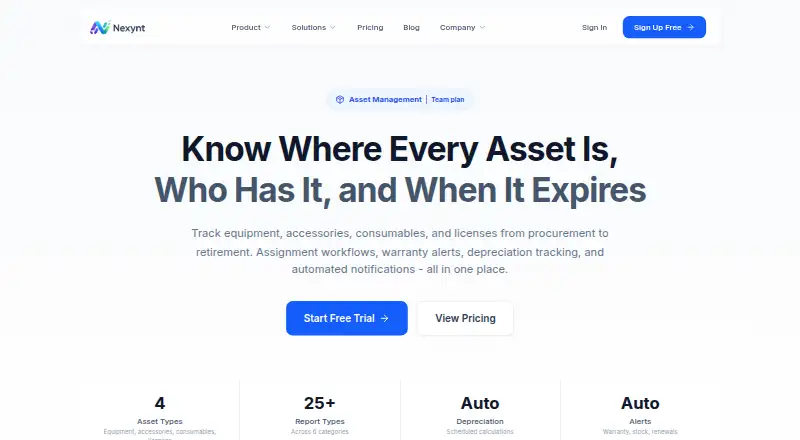
What Nexynt Asset Management is
Nexynt Asset Management tracks equipment, accessories, consumables, and software licenses from procurement through retirement. Its lifecycle covers procurement, registration, assignment, maintenance, and retirement, with an audit trail at each stage. Staff can check assets out, return them, transfer them, and view assigned items in a self-service My Assets view. Alerts cover warranty expirations, low stock, license renewals, and upcoming maintenance. The product also lists scheduled depreciation calculations, more than 25 reports across six categories, custom fields, FIFO batch stock tracking, and bulk handover of up to 50 items. CSV import supports 500 items, and file attachments can be up to 25 MB. Assets can connect to support tickets, while onboarding can provision equipment from inventory. It is cloud-based and lists web, Android, iOS, Windows, macOS, and Linux access.
Good
- Tracks assets through five lifecycle stages with audit trails
- Alerts cover warranties, stock, renewals, and maintenance
- Employee self-service supports asset visibility
- Can link assets to tickets and onboarding
Watch out
- Free plan is limited to 3 users and 500 MB storage
- Starter costs $50/org/mo
- CSV bulk import is specified for 500 items
Who it suits
It suits organizations managing equipment and licenses alongside people, tickets, and tasks. Employee self-service and onboarding provisioning may help teams coordinate asset assignment.
Verdict
Nexynt combines asset tracking with employee workflows, alerts, and reporting in a cloud workspace. Check plan limits and report access tiers against your organization's needs.
Plans and prices
From Nexynt Asset Management's own pricing page, checked 3 Oct 2026.
| Plan | Price | What it gives you |
|---|---|---|
| Free | Free | Up to 3 users · 500 MB storage · $0 forever |
| Starter | $50 a month | Up to 10 users · 10 GB storage · $50/org/mo |
| Team | $112 a month | Up to 25 users · 50 GB storage · $112/org/mo |
| Business | $400 a month | Up to 100 users · 200 GB storage · $400/org/mo |
| Scale | $1,750 a month | Up to 500 users · 1024 GB storage · $1750/org/mo |
| Starter Annual | — | Annual billing available |
| Team Annual | — | Annual billing available |
| Business Annual | — | Annual billing available |
| Scale Annual | — | Annual billing available |
| Enterprise | Priced on request | Unlimited users · Unlimited storage · Custom |
| Enterprise Annual | — | Annual billing available |
The facts
Each one read from Nexynt Asset Management's own pages, with the date it was checked.
What it does
- Advanced asset tools
- The asset page lists custom fields, bulk handover of up to 50 items, FIFO batch stock tracking, license key storage with audit-logged reveals, and asset-to-asset links.checked 3 Oct 2026
- Asset alerts
- Automated alerts cover warranty expirations, low stock, license renewals, and upcoming maintenance.checked 3 Oct 2026
- Asset coverage
- Asset Management tracks equipment, accessories, consumables, and licenses from procurement through retirement.checked 3 Oct 2026
- Asset limit
- 750checked 22 Sep 2026
- Assignment workflows
- Assets can be checked out, returned, transferred between employees, and viewed through an employee self-service My Assets view.checked 3 Oct 2026
- Deployment
- cloudchecked 22 Sep 2026
- Depreciation and reports
- Nexynt describes scheduled depreciation calculations and more than 25 reports across six categories, with access tiered by plan.checked 3 Oct 2026
- Employee self-service
- Yeschecked 22 Sep 2026
- Import and files
- The feature list specifies CSV bulk import for 500 items and file attachments up to 25 MB.checked 3 Oct 2026
- Integrations and API
- Nexynt says its modules share data natively and its documentation describes a REST API with OAuth 2.0 or API key authentication and real-time webhooks.checked 3 Oct 2026
- Intended audience
- Nexynt positions its asset tools as part of a unified workspace for organizations managing assets alongside tickets, people, and tasks.checked 3 Oct 2026
- Lifecycle tracking
- The product describes five lifecycle stages: procurement, registration, assignment, maintenance, and retirement, with an audit trail at each stage.checked 3 Oct 2026
- Paid from
- 50checked 22 Sep 2026
- Security and privacy
- The maker states Nexynt has SOC 2 Type II, GDPR compliance, end-to-end encryption, and organization-scoped data isolation, and says it does not train AI models on customer data.checked 3 Oct 2026
- Software license tracking
- Yeschecked 22 Sep 2026
- Support
- Nexynt advertises 24/7 support, priority response under one hour for critical issues, and a dedicated customer success manager for enterprise accounts.checked 3 Oct 2026
- Workspace connections
- Assets can be linked to support tickets, and employee onboarding can automatically provision equipment from inventory.checked 3 Oct 2026
Money
- Free plan
- Yeschecked 22 Sep 2026
Where it runs
- Supported desktop platforms
- The maker lists a web app and a native desktop app for Windows, macOS, and Linux; its homepage describes the desktop app as supporting offline chat, local caching, and native notifications.checked 3 Oct 2026
The full review of Nexynt Asset Management
Nexynt Asset Management is a cloud-based system for tracking equipment, supplies, and software licenses through their working life. It suits organizations that want asset records connected to employee and support workflows. Its breadth is a strength, but user caps, storage, and plan-based report access deserve close attention.
Overview
Nexynt follows assets from procurement to retirement, recording five stages and an audit trail at each. That lifecycle view can help teams keep assignments, maintenance, and end-of-life records together rather than treating inventory as a static list. Coverage includes equipment, accessories, consumables, and licenses.
Employee self-service and links to support tickets make this more than an inventory register: staff can view assigned items, while onboarding can provision equipment from stock. That connected-workspace approach is most compelling for organizations already managing people, tickets, and tasks in Nexynt. Teams seeking only a standalone inventory tool may not need that scope.
Key features
Assignments and controls
Assets can be checked out, returned, and transferred between employees, with a My Assets view for self-service. Automated alerts cover warranty expirations, low stock, license renewals, and upcoming maintenance. These workflows can reduce reliance on separate reminders, though their usefulness depends on keeping asset records current.
Advanced tools include custom fields, bulk handover of up to 50 items, FIFO batch stock tracking, asset-to-asset links, and license-key storage whose reveals are audit-logged. CSV import supports 500 items, and file attachments are capped at 25 MB. Those limits are relevant when onboarding a large inventory or retaining bulky documentation.
Reporting and connections
Nexynt describes scheduled depreciation calculations and more than 25 reports across six categories, with report access tiered by plan. The breadth should help teams that need recurring asset oversight, but buyers should confirm which reports their chosen plan unlocks. Modules share data natively; assets can link to support tickets, and onboarding can automatically provision equipment from inventory. The documented REST API supports OAuth 2.0 or API key authentication and real-time webhooks for organizations connecting other systems.
The maker states that Nexynt has SOC 2 Type II, GDPR compliance, end-to-end encryption, and organization-scoped data isolation, and says it does not train AI models on customer data. It advertises 24/7 support, critical-issue priority response under one hour, and a dedicated customer success manager for enterprise accounts.
Pricing
The Free plan costs nothing, billed $0 forever, and allows up to 3 users with 500 MB storage. It is the lowest-risk fit for a small team assessing the workspace, but the user and storage ceilings constrain broader adoption.
Starter costs $50 a month, billed $50/org/mo, for up to 10 users and 10 GB storage. Team is $112 a month, billed $112/org/mo, for up to 25 users and 50 GB. Business is $400 a month, billed $400/org/mo, for up to 100 users and 200 GB. Scale is $1,750 a month, billed $1750/org/mo, for up to 500 users and 1024 GB. Each step raises capacity for larger teams, but the listed prices are organizational monthly charges, not per-user rates; check plan-specific report access as well as storage before choosing.
Enterprise has custom pricing, unlimited users, and unlimited storage, making it the option for organizations beyond Scale's stated caps. A 14-day trial is offered. Annual billing is available for Starter, Team, Business, Scale, and Enterprise, each at custom pricing.
Platforms
Nexynt supports Android, iOS, Linux, macOS, web, and Windows. The maker lists native desktop apps for Windows, macOS, and Linux; its homepage describes offline chat, local caching, and native notifications. Those desktop capabilities may suit teams that want a desktop workspace, though they are not asset-specific features.
Who it's for
Nexynt is a strong fit for organizations that manage equipment and licenses alongside employee workflows, support tickets, and onboarding, especially when lifecycle records and automated alerts matter. It is less suited to teams that need a high-capacity inventory on a free plan: that tier stops at 3 users and 500 MB, and the stated CSV import limit is 500 items.
Pros and cons
- Pros: Lifecycle stages carry an audit trail, giving teams a record from procurement through retirement.
- Pros: Employee self-service, transfers, returns, and onboarding provisioning connect inventory to staff workflows.
- Pros: Alerts span warranties, stock, renewals, and maintenance, covering several common reasons asset records need attention.
- Cons: Free is capped at 3 users and 500 MB, which limits its usefulness as an ongoing team-wide system.
- Cons: Reporting access varies by plan, so the headline report count does not guarantee every tier includes the reports a buyer needs.
- Cons: CSV import is limited to 500 items and attachments to 25 MB, constraints to account for during migration and document retention.
Alternatives
For a different fit, compare IT Asset Management Software options by category. xAssets ITAM has a free Express Edition for one user, with cloud hosting and 100 endpoints per user; consider it if that single-user allowance suits your evaluation. Reftab offers a free tier for up to 50 assets, with unlimited inventory and software tracking plus mobile apps and barcode and QR-code support, a better match when those specific free-tier capabilities matter.
CMDBuild READY2USE is a free option with self-installable AGPL software. LICENSEWARE has a free tier capped at 10 rows per table. InvGate Asset Management is a paid alternative whose Starter plan is $1,499 a year for 500 IP devices. ManageEngine AssetExplorer offers self-hosted deployment and a cloud plan for 250 IT assets at $115 a month. uControl Asset Management has a free Community plan for up to 10k servers, on-prem only. Open-AudIT offers a free plan with unlimited devices and community support.
Verdict
Choose Nexynt when asset management needs to sit inside the same workspace as employee self-service, onboarding, and support workflows; its lifecycle audit trail and alerts make that joined-up approach the main draw. Look elsewhere if a small free tier must support more than three users, or if report access and migration limits do not fit your operation. For organizations that can work within its plan capacities, Nexynt brings a substantial set of asset controls into a broader operational workspace.
Alternatives to Nexynt Asset Management
- 1

GLPI
Open sourceAndroidiOSWebAPI9.1From €19 a month - 2
Lansweeper
Free planWebAPILinuxmacOS8.8Free plan - 3

Freshservice
AndroidiOSWebAPI8.6From $19 a month - 4

Reftab
Free planAndroidiOSWeb8.6From $9 a year - 5

LICENSEWARE
Free planWebAPILinuxmacOS8.6From $3.36 a year - 6
i-doit
Open sourceAndroidiOSWebAPI8.5From €48.65 a month