
JSTOR
JSTOR is a research and learning platform with scholarly and primary-source materials across more than 70 disciplines.
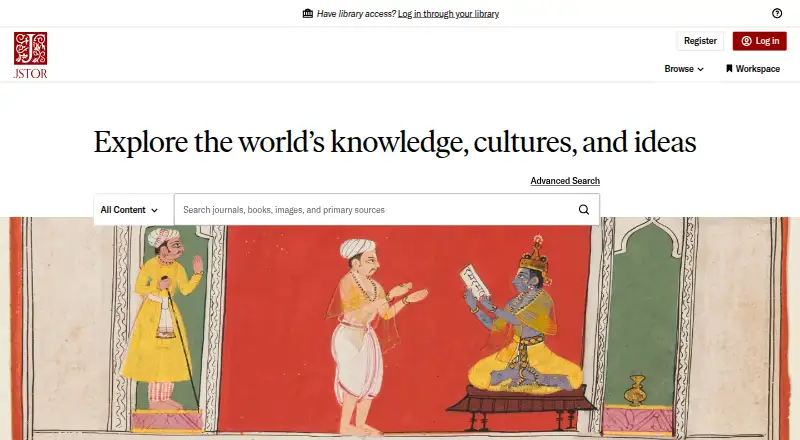
What JSTOR is
JSTOR is a research and learning platform with scholarly and primary-source materials across more than 70 disciplines. Its collection includes more than 12 million academic journal articles, millions of primary sources, ebooks, and Artstor images and multimedia. Advanced search and discovery tools help users find relevant material. Workspace lets users save, annotate, organize, upload, and share research in folders, then export it as PDFs, PowerPoints, or ZIP files. A free personal account can read up to 10 eligible articles online every 30 days, though some publisher policies exclude items from that program. Users can connect their personal account to a subscribing institution for remote access. JPASS Monthly costs $19.50 per month and includes unlimited reading from 2,400+ academic journals and 10 PDF downloads per month. JPASS Yearly costs $199.00 per year and includes 120 PDF downloads per year. JSTOR supports mobile browsers, keyboard navigation, and screen readers, and accepts requests for accessible content versions. Its audience includes students, educators, librarians, and researchers.
Good
- Collection spans more than 70 disciplines.
- Workspace supports saving, annotating, and sharing research.
- Free account offers limited eligible article reading.
- Institutional accounts can provide remote access.
- Supports mobile browsers, keyboard navigation, and screen readers.
Watch out
- Free reading is capped at 10 eligible articles per 30 days.
- Some articles are excluded by publisher policies.
- JPASS Monthly costs $19.50 per month.
- JPASS Yearly costs $199.00 per year.
Who it suits
JSTOR suits students, educators, librarians, and researchers looking for multidisciplinary scholarly content. It may also fit people who need tools to organize and annotate research materials.
Verdict
JSTOR brings a large multidisciplinary collection together with search and research organization tools. Free access is limited, while JPASS offers broader reading and specified PDF download allowances for a monthly or annual charge.
Plans and prices
From JSTOR's own pricing page, checked 15 Oct 2026.
| Plan | Price | What it gives you |
|---|---|---|
| Read only | Free | open content and public-domain articles · limited free reading · Workspace saving |
| JPASS Monthly | $19.50 a month | unlimited online reading · 10 PDF downloads per month · 2,400+ journals · monthly |
| JPASS Annual | $199 a year | unlimited online reading · 120 PDF downloads per year · 2,400+ journals · annual one-time payment |
| JPASS Yearly | $199 a year | Unlimited article reading from 2,400+ academic journals · 120 PDF downloads per year · Workspace · One-time annual payment |
| Institutional access | Priced on request | Fees and options depend on institution type and classification · Custom quote |
The facts
Each one read from JSTOR's own pages, with the date it was checked.
What it does
- Accessibility
- JSTOR states that it applies WCAG and Section 508 standards and provides accessible PDFs, image alt text and an issue-reporting workflow.checked 15 Oct 2026
- Access options
- Users can connect a personal account to a subscribing institution for remote access, and supported institutional login options include Google or Microsoft single sign-on.checked 30 Sep 2026
- AI limitation
- The AI research tool currently supports journal articles, book chapters and research reports but not images, audio, video or text-based primary sources.checked 15 Oct 2026
- AI research tool
- JSTOR’s AI tool supports natural-language searching, document questions and discovery of related topics and materials.checked 15 Oct 2026
- Audience
- JSTOR describes its platform as serving research, teaching, and learning, with solutions for librarians, educators, students, and researchers.checked 30 Sep 2026
- Collection
- The platform includes more than 12 million academic journal articles, millions of primary sources, ebooks, and Artstor images and multimedia.checked 30 Sep 2026
- Collection size
- JSTOR reports more than 12 million academic journal articles, 158,000 scholarly books and over 2 million images and multimedia items.checked 15 Oct 2026
- Corporate history
- An ITHAKA announcement says JSTOR was established in 1997, merged with Ithaka in 2009 and became part of the renamed ITHAKA organization.checked 15 Oct 2026
- Developer projects
- JSTOR Labs publishes open-source projects including Juncture, Access in Prison source code, Topicgraph and Reflowit with GitHub documentation.checked 15 Oct 2026
- Documentation
- The JSTOR help center provides end-user and administrator documentation, FAQs, tutorials, release notes and troubleshooting guidance.checked 15 Oct 2026
- Ebooks
- Books at JSTOR contains more than 158,000 DRM-free ebooks from over 340 academic publishers, including open-access titles.checked 15 Oct 2026
- Google Scholar integration
- JSTOR supplies participating institutions’ IP and license information to Google Scholar so licensed results can show JSTOR links.checked 15 Oct 2026
- Images
- Artstor on JSTOR supplies over two million rights-cleared images and multimedia items from more than 300 curated collections.checked 15 Oct 2026
- Independent coverage praise
- Bentley University’s library guide says JSTOR’s broad journal backfiles and scholarly reputation can support undergraduate through doctoral research.checked 15 Oct 2026
- Independent integration
- Monash University’s Zotero guide lists JSTOR among databases whose result lists can be batch-exported into Zotero using RIS or BibTeX.checked 15 Oct 2026
- Independent outage status
- SaaSHub’s status page reported JSTOR up, with no reported issues in the previous 24 hours and 100% monitored uptime over the prior 30 days at its check.checked 15 Oct 2026
- Institutional integrations
- JSTOR documents support for EZproxy and OpenAthens for institutional remote access.checked 30 Sep 2026
- Integration
- Hypothesis integrates with JSTOR to support collaborative annotation and peer discussion through learning management systems.checked 30 Sep 2026
Where it runs
- Browser support
- Supported browsers are current Chrome, Firefox, Safari and Edge; Internet Explorer 11 is unsupported.checked 15 Oct 2026
The company
- Company history
- JSTOR says it was founded in 1995 and is a nonprofit working with libraries, museums, and publishers worldwide.checked 30 Sep 2026
- Company identity
- LinkedIn describes JSTOR as part of ITHAKA, a nonprofit organization serving academic preservation, research and teaching.checked 15 Oct 2026
- Company size
- LinkedIn lists JSTOR as a nonprofit with 201–500 employees and headquarters in New York, New York.checked 15 Oct 2026
- Founded
- LinkedIn lists JSTOR’s founding year as 1995.checked 15 Oct 2026
Money
- Free access limit
- A free personal account can read up to 10 eligible articles online every 30 days; publisher policies exclude some articles from the program.checked 30 Sep 2026
The full review of JSTOR
JSTOR is a multidisciplinary research and learning platform for finding and working with academic and primary-source material. It best suits students, educators, and researchers who need scholarly reading and a place to organize research. Its free reading allowance is narrow; JPASS makes sense for readers who regularly need journal access and can work within monthly or annual PDF limits.
Overview
JSTOR spans more than 70 disciplines, with over 12 million academic journal articles alongside millions of primary sources, ebooks, and Artstor images and multimedia. The breadth makes it useful when a project crosses formats or fields, not just when looking for journal articles. Advanced search and discovery tools help locate material, while a personal account adds Workspace for saving, annotating, organizing, uploading, and sharing materials in folders. Workspace exports research as PDFs, PowerPoints, or ZIPs.
JSTOR has full-text access, but the ability to read a particular item depends on its access terms. A free personal account can read up to 10 eligible articles online every 30 days, and publisher policies exclude some articles. Readers affiliated with a subscribing institution can connect a personal account for remote access, which may be a better route than paying individually.
Key features
- Multiformat collection: Alongside journals and books, JSTOR covers book chapters, research reports, theses, dissertations, conference proceedings, documents, images, audio, video, panoramas, and serials. That range is valuable for teaching and research that draws on more than published articles.
- Workspace and exports: Folders, annotations, sharing, uploads, and export options help keep research materials together. Hypothesis integration adds collaborative annotation and peer discussion through learning management systems.
- Institutional access: Remote access can connect through a subscribing institution. JSTOR documents EZproxy and OpenAthens support, and supported institutional login options include Google or Microsoft single sign-on.
- Accessibility and support: JSTOR says it applies WCAG and Section 508 standards, with keyboard navigation, screen reader support, and requests for accessible content versions. Support accepts requests by email form, phone, and text; form responses typically arrive within one to two business days.
Pricing
JSTOR is freemium, with no free trial. The free Read only plan costs nothing and includes open content, public-domain articles, limited free reading of select items, and Workspace. The 10-article online limit every 30 days applies to eligible items, so this tier works best for occasional reading or users whose institution already supplies broader access.
JPASS Monthly costs $19.50 a month, billed monthly. It provides unlimited article reading from 2,400+ academic journals, 10 PDF downloads per month, and Workspace. This is the more flexible paid option for regular readers who want a monthly commitment, but its PDF quota still constrains offline or file-based use.
JPASS Yearly costs $199 a year as a one-time annual payment. It includes the same unlimited reading from 2,400+ journals and Workspace, with 120 PDF downloads per year. It fits sustained use and costs less than 12 monthly payments at the stated rates, but requires paying for a full year upfront and keeps the same total PDF allowance over the year.
Institutional access uses custom pricing, with fees and options depending on institution type and classification. It is intended for organizations arranging access for their communities rather than individual readers comparing fixed subscriptions.
Platforms
JSTOR is available on web, Android, and iOS. On mobile, it supports the current native browser, including Safari on iOS and Chrome on Android. ITHAKA’s privacy policy says it may collect account and authentication information to provide access through libraries and institutions.
Who it's for
JSTOR is a strong fit for students, researchers, and educators who need a large multidisciplinary collection and value tools for organizing and sharing research. It is also relevant to librarians and institutions seeking remote-access options. It is less suitable for someone who only needs occasional articles beyond the free cap, or who needs more than 10 monthly PDF downloads on JPASS Monthly.
Pros and cons
- Pros: A broad mix of scholarly and primary-source formats supports work that extends beyond journal articles.
- Pros: Workspace combines organization, annotation, sharing, and multiple export formats rather than leaving research materials scattered.
- Pros: Institutional remote access and documented proxy integrations can make JSTOR usable through a library subscription.
- Cons: The free account allows only up to 10 eligible online articles every 30 days, and publisher policies exclude some content.
- Cons: JPASS PDF downloads are capped at 10 per month or 120 per year, despite unlimited article reading.
- Cons: Individual paid access is a recurring monthly or upfront annual expense, while institutional pricing varies by organization.
Alternatives
For a broader directory of tools in this category, see Academic Research Databases. Consider CORE if API access is central to your work and its free access rate limits suit your request volume. ERIC is a free alternative for readers who want an API- and web-accessible research database. The Lens is another freemium option to consider for API or web access, including anonymous browsing. OpenAlex is worth considering when API, extension, or self-hosted access is preferable. AGRICOLA suits readers focused on its public agriculture catalog, though individual article full text may depend on linked sources. Choose the Directory of Open Access Journals when free access to open-access journals is the priority. SSRN is a fit for sharing and downloading preprints and early-stage research. Dimensions may suit users who want a free version with publication-record exports capped at 500 records for personal, non-commercial use.
Verdict
Choose JSTOR if you need multidisciplinary scholarly material plus practical tools for keeping research organized, especially when a subscribing institution gives you remote access. JPASS can serve regular readers who want broader journal reading, but its price and PDF caps make it a weaker choice for occasional readers or anyone who needs generous downloads.
Getting started
- Visit jstor.org on the web, or use Android or iOS.
- Create a free personal account for open content and limited reading of select items.
- Connect the account to a subscribing institution for remote access, if applicable.
- Choose JPASS Monthly or JPASS Yearly for unlimited article reading from 2,400+ academic journals.
Limits worth knowing
A free personal account can read up to 10 eligible articles online every 30 days, and some articles are excluded by publisher policies. JPASS Monthly includes 10 PDF downloads per month; JPASS Yearly includes 120 per year.
Questions
Is JSTOR free?
Yes. The Read only plan is free and includes open content, public-domain articles, limited free reading of select items, and Workspace.
How much does JPASS cost?
JPASS Monthly costs $19.50 per month. JPASS Yearly costs $199.00 per year as a one-time annual payment.
What does JPASS include?
Both JPASS plans provide unlimited article reading from 2,400+ academic journals and Workspace. Monthly includes 10 PDF downloads per month; Yearly includes 120 PDF downloads per year.
Which devices can I use?
JSTOR is available on the web, Android, and iOS. It supports the current native browser on mobile, including Safari on iOS and Chrome on Android.
Can an institution provide remote access?
Users can connect a personal account to a subscribing institution for remote access. Institutional access options include EZproxy and OpenAthens.
Does JSTOR offer a free trial?
No. JSTOR does not offer a free trial.
Alternatives to JSTOR
- 1
MAXQDA
Free planWebExtensionmacOSWindows7.8From $41 a month - 2
OpenAlex
Free planOpen sourceWebAPIExtensionLinux7.8From $5,000 a year - 3

HeinOnline
Free planAndroidiOSWeb7.5Free plan - 4
Project MUSE
AndroidiOSWebAPI7.5 - 5

Web of Science
Free planAndroidiOSWebAPI7.5Free plan - 6
Academia.edu
Free planAndroidiOSWeb7.2$1 one-time