
ERIC
ERIC is a free searchable online library of education research, sponsored by the Institute of Education Sciences.
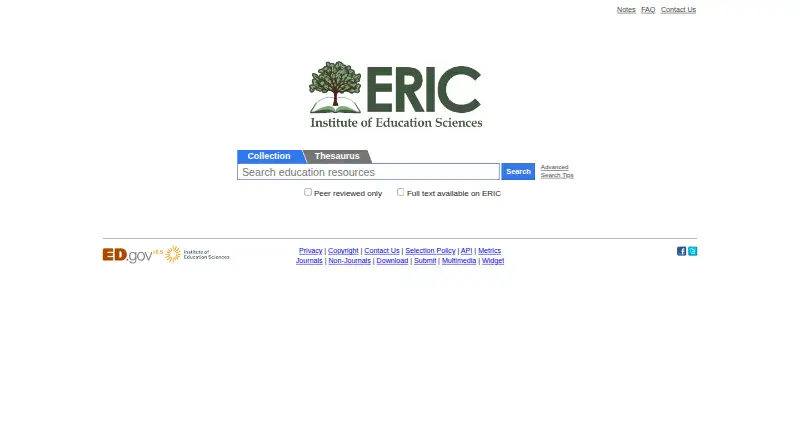
What ERIC is
ERIC is a free searchable online library of education research, sponsored by the Institute of Education Sciences. Its bibliographic records cover journal and non-journal literature from 1966 to the present. Researchers can use advanced search and filters for peer-reviewed material and records with full text available on ERIC; some records include a download option. The collection includes both peer-reviewed and non-peer-reviewed material, with peer-review status marked when a source has an acceptable review process. ERIC assigns subject terms from its Thesaurus, which lists 4,578 descriptors, 7,219 synonyms, and 132 dead terms. Its API accepts HTTPS requests and returns XML, JSON, or CSV. Requests default to 20 records, and the rows setting can range from 20 to 200. ERIC accepts submissions that meet its selection policy, but not textbooks, lesson plans, blogs, or HTML-only text. Submitters need the relevant rights, and online submissions require a PDF up to 100 MB. Full text from IES grantee submissions appears after a 12-month embargo.
Good
- Free searchable education research library.
- Search filters include peer review and ERIC full text.
- API returns XML, JSON, or CSV.
- Advanced search is available.
- Includes journal and non-journal materials.
Watch out
- Online submissions require a PDF under 100 MB.
- IES grantee full text has a 12-month embargo.
- Submissions must meet ERIC’s selection criteria.
Who it suits
ERIC suits educators, parents, policymakers, researchers, and members of the public looking for education research. It also serves users who need an API for retrieving bibliographic records.
Verdict
ERIC offers searchable education research records, filters, and an API without a listed cost. Full-text availability varies by record, and submissions are subject to eligibility and rights requirements.
The facts
Each one read from ERIC's own pages, with the date it was checked.
What it does
- API
- ERIC provides an API, and its product guide includes materials about using the API to export search results.checked 3 Oct 2026
- API pagination
- The API example says results default to 20 records per request and the rows parameter can be set from 20 to 200.checked 2 Oct 2026
- Audience
- ERIC’s mission serves educators, parents, policymakers, researchers, and the public.checked 3 Oct 2026
- Coverage
- ERIC provides bibliographic records of journal and non-journal literature from 1966 to the present.checked 3 Oct 2026
- Full text
- ERIC search results identify records with full text available on ERIC and provide a download option for some records.checked 3 Oct 2026
- History
- ERIC was founded in 1964 to collect and share education research.checked 3 Oct 2026
- IES grantee embargo
- For IES grantee submissions, full text will display in ERIC 12 months after the publication date.checked 2 Oct 2026
- Limits
- ERIC’s selection policy states that the collection includes journal articles and non-journal materials selected under its criteria.checked 3 Oct 2026
- Peer review
- ERIC accepts peer-reviewed and non-peer-reviewed material, and marks records as peer reviewed when the source has demonstrated an acceptable peer-review process.checked 2 Oct 2026
- Purpose
- ERIC is an online bibliographic and full-text digital library of education research, including journal articles and non-journal materials.checked 3 Oct 2026
- Search
- The site provides a searchable collection with advanced search and filters including peer-reviewed and full-text availability.checked 3 Oct 2026
- Search filters
- The collection search offers filters for peer-reviewed material and full text available on ERIC.checked 2 Oct 2026
- Selection policy
- ERIC’s selection policy describes criteria for selecting sources and individual education research materials for the digital library.checked 3 Oct 2026
- Sponsor
- ERIC is administered by the National Center for Education Evaluation and Regional Assistance at the Institute of Education Sciences, U.S. Department of Education.checked 3 Oct 2026
- Submission eligibility
- ERIC accepts education research that meets its Selection Policy criteria and does not index textbooks, lesson plans, blogs, or HTML-only text.checked 2 Oct 2026
- Submission file limit
- The online submission page requires a PDF upload with a maximum size of 100 MB.checked 2 Oct 2026
- Submission rights
- Submitters must be authors, copyright holders, or authorized representatives and grant ERIC a royalty-free, perpetual, and irrevocable license to index and display submitted materials.checked 2 Oct 2026
- Support
- ERIC’s site lists FAQ and Contact Us links, and its product guide offers free videos, infographics, and recorded webinars about ERIC.checked 3 Oct 2026
- Thesaurus
- The ERIC Thesaurus contains 4,578 descriptors, 7,219 synonyms, and 132 dead terms, and was last updated in 2025.checked 3 Oct 2026
- Thesaurus size
- The Thesaurus page states that it contains 4,578 descriptors, 7,219 synonyms, and 132 dead terms, and was last updated in 2025.checked 2 Oct 2026
- What it is
- ERIC is a free, searchable online library of education research sponsored by the Institute of Education Sciences.checked 2 Oct 2026
The company
- Founded
- 1966checked 28 Sep 2026
- Headquarters
- Washington, DC, United Stateschecked 28 Sep 2026
Alternatives to ERIC
- 1

JSTOR
Free planAndroidiOSWeb7.9From $199 a year - 2
MAXQDA
Free planWebExtensionmacOSWindows7.8From $41 a month - 3
OpenAlex
Free planOpen sourceWebAPIExtensionLinux7.8From $5,000 a year - 4

HeinOnline
Free planAndroidiOSWeb7.5Free plan - 5
Project MUSE
AndroidiOSWebAPI7.5 - 6

Web of Science
Free planAndroidiOSWebAPI7.5Free plan