
Web of Science
Web of Science is a research discovery platform built around scholarly literature and citation connections.
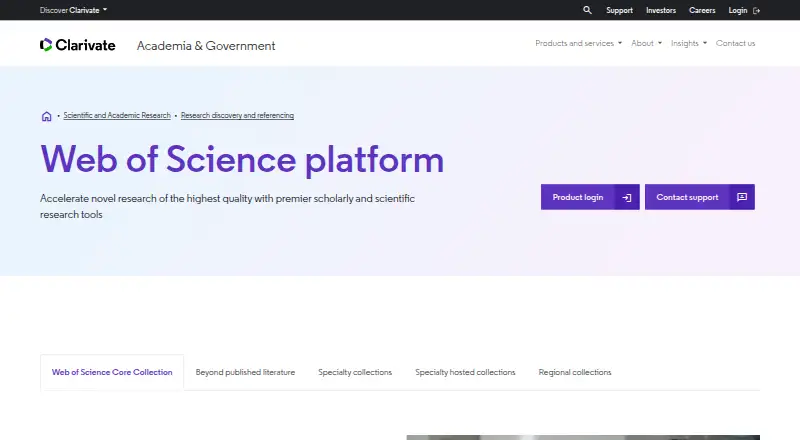
What Web of Science is
Web of Science is a research discovery platform built around scholarly literature and citation connections. Its listed coverage includes more than 34,000 journals, 288 million metadata records, and 3.4 billion citation links. A single search can span journal content, conference papers, grants, preprints, dissertations, books, datasets, and patents. The platform supports finding new research, potential partners, trending topics, and commercial opportunities. Its Research Assistant offers multilingual natural-language search, concise overviews, task guidance, and visualizations, but requires institutional subscription access. Registered users can export records to EndNote, and researcher profiles can sync publications with ORCID. API Expanded provides REST access with JSON or XML output through a paid license and registered application; API plans have request-rate and annual full-record limits. Web of Science is a paid institutional product, and the product page directs organizations to contact sales rather than listing a subscription price. Clarivate says its security program aligns with ISO 27001 and SOC 2, though not all products are individually certified.
Good
- Search spans diverse scholarly and research content types.
- Offers EndNote export and ORCID publication syncing.
- Research Assistant provides multilingual natural-language search.
- API supports REST access with JSON or XML output.
Watch out
- No free plan is listed.
- Platform subscription pricing requires contacting sales.
- Research Assistant requires institutional subscription access.
- API plans have request-rate and record limits.
Who it suits
Web of Science suits researchers, universities, research institutions, governments, funders, publishers, and research-intensive corporations seeking multidisciplinary discovery and citation tools.
Verdict
Web of Science brings scholarly content discovery, citation links, and research tools into one platform. Organizations should clarify subscription access and API limits with sales before choosing it.
Plans and prices
From Web of Science's own pricing page, checked 15 Oct 2026.
| Plan | Price | What it gives you |
|---|---|---|
| Web of Science My Research Assistant free version | Free | Topic searches · up to 3 saved feeds · maximum 25 recent results from the past five years · Freely available |
| Web of Science API Expanded — Basic | Priced on request | 2 requests per second · 50,000 full records per year |
| Web of Science API Expanded — Intermediate | Priced on request | 2 requests per second · 250,000 full records per year |
| Web of Science API Expanded — Advanced | Priced on request | 3 requests per second · 1,000,000 full records per year |
| Web of Science institutional subscription | Priced on request | Access depends on subscription depth · institutional users · Institutional subscription; price quote required |
| Web of Science platform | Priced on request | Institutional subscription; price not listed on the product page |
| Web of Science API Expanded — Premium | Priced on request | 5 requests per second · 3,000,000 full records per year |
The facts
Each one read from Web of Science's own pages, with the date it was checked.
What it does
- Accessibility
- Clarivate says Web of Science is partially compliant with WCAG 2.2 AA and publishes an accessibility conformance report.checked 15 Oct 2026
- AI privacy
- Clarivate says it does not send publisher content, library-owned materials or user data to external large language models; only user-entered query content is transmitted to its private LLM setup.checked 15 Oct 2026
- API access
- The API Expanded offers REST access with JSON and XML output and requires a paid license and registered application.checked 7 Oct 2026
- API authentication
- The API Expanded page states that API access is secured with API keys.checked 15 Oct 2026
- API Expanded
- The Web of Science API Expanded offers REST access with JSON or XML, advanced searching, full item metadata, times-cited counts, affiliations, funding, related records, cited references and citing items.checked 15 Oct 2026
- API limits
- API Expanded plans are limited by request rates and full-record counts, with the listed plans ranging from 50,000 to 3,000,000 records per year.checked 7 Oct 2026
- Audience
- Clarivate describes Web of Science as serving researchers, universities and research institutions, governments, funders, publishers and research-intensive corporations.checked 7 Oct 2026
- Citation network scale
- Clarivate describes the full platform as containing more than 271 million records, while the Core Collection links over 97 million records through 2.4 billion cited references.checked 15 Oct 2026
- Content types
- A single search can include journal content, conference papers, grants, preprints, dissertations, books, datasets and patents.checked 7 Oct 2026
- Core Collection coverage
- The Core Collection spans sciences, social sciences, arts and humanities and indexes more than 22,000 journals across over 250 disciplines.checked 15 Oct 2026
- Data delivery
- Clarivate offers API and XML data delivery for large-scale analysis, research-information systems and business-intelligence dashboards, including behind-the-firewall use.checked 15 Oct 2026
- Deep Search
- Deep Search expands synonyms, combines Boolean and semantic searches, screens and deduplicates documents, examines citation networks and produces a traceable evidence report.checked 15 Oct 2026
- Discovery tools
- The platform supports finding new research, potential partners, trending topics and commercial opportunities in one interface.checked 7 Oct 2026
- Documentation and support
- The Help Center provides expert-written articles, training videos, live training, release updates and chat, phone or email support.checked 15 Oct 2026
- Editorial curation
- In-house editors apply 28 journal-selection criteria: 24 quality tests and four impact tests, with journals periodically re-evaluated.checked 15 Oct 2026
- Employee count filing
- Clarivate’s 2025 Form 10-K says it had more than 12,000 employees in over 40 countries at December 31, 2025.checked 15 Oct 2026
- Integrations
- Registered users can connect ORCID and send references directly to EndNote online from Web of Science.checked 15 Oct 2026
- Limit: interface and support
- G2 feedback mentions a dated-looking interface, non-intuitive tools, slow publication decisions and difficulty reaching support.checked 15 Oct 2026
Where it runs
- Android app status
- AppBrain reports MyRA was removed from Google Play on March 28, 2024; its last listed version was 2.7.0 and required Android 5.0 or newer.checked 15 Oct 2026
- iOS app status
- AppBrain lists MyRA as free, last updated May 18, 2022, with no changelog data and no longer available for download.checked 15 Oct 2026
The company
- Company size
- LinkedIn lists Clarivate as a public information-services company with 10,001+ employees and London headquarters.checked 15 Oct 2026
- Founded
- 1997checked 28 Sep 2026
- Headquarters
- London, United Kingdomchecked 28 Sep 2026
- Legal company facts
- Clarivate Plc is incorporated in Jersey, has principal offices at 70 St Mary Axe in London and trades on the NYSE under CLVT.checked 15 Oct 2026
Alternatives to Web of Science
- 1
OpenClinica
Open sourceAndroidiOSWebAPI8.1From $750 a month - 2
Workday Expenses
AndroidiOSWebAPI6.9 - 3

OmniStar Grants
AndroidiOSWebAPI6.6 - 4
OneRamp ERA Suite
AndroidiOSWeb6.5 - 5
 5.9
- 6

Pure Award Management
WebAPI5.7