The Lens
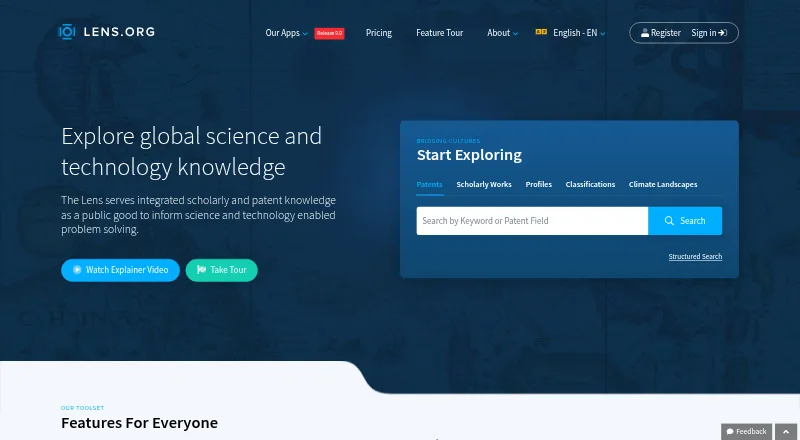
The Lens is a research discovery and analysis platform connecting patent records and scholarly work.
What The Lens is
The Lens is a research discovery and analysis platform connecting patent records and scholarly work. Patent search supports Boolean, structured, biological, and classification queries, with filters and sorting. Its scholarly collection includes more than 200 million records, and citation links connect scholarly works with patents. PatSeq tools let users search, analyze, and share biological sequences disclosed in patents. Search results can be explored in charts and dashboards, which users can save and share. Registered accounts can save queries and collections, add notes, and receive notifications when new indexed records match. Lens Profiles combine author and inventor information and support linking and synchronizing ORCID records. Web access is available, and APIs provide programmatic search and retrieval with approved access and a token. Anonymous browsing is free; academic non-commercial users can use a free workspace with an academic institutional email. Individual commercial use requires commercial-use permissions through a subscription or institution. The Individual Professional Workspace costs $1,000/year.
Good
- Patent search includes biological and classification queries.
- Scholarly collection exceeds 200 million records.
- PatSeq supports biological sequence search and analysis.
- Saved queries can receive matching-result notifications.
- Supports ORCID linking and synchronization.
Watch out
- API access requires approval and a token.
- Commercial individual use requires permissions.
- Professional workspace costs $1,000/year.
- API access is not included by default in the individual professional plan.
Who it suits
The Lens suits researchers and other users searching scholarly works, patents, or their citation connections. Its free academic workspace is for academic non-commercial research, while commercial users need appropriate permissions.
Verdict
The Lens links patent and scholarly discovery with saved searches, analytics, and biological sequence tools. Anonymous browsing is free, but commercial permissions and API access requirements are important to check for professional or programmatic use.
Plans and prices
From The Lens's own pricing page, checked 20 Sep 2026.
| Plan | Price | What it gives you |
|---|---|---|
| Academic / non-commercial access | Priced on request | Guest browsing · Free registered account for personal, non-commercial use · Search, collections, alerts, dashboards, and exports |
| Individual commercial use | $1,000 a year | 1 user · Annual subscription; single user account |
| Academic Workspace | Free | For academic users doing non-commercial research · requires an academic institutional email |
| Anonymous access | Free | Browse without an account · anonymous use remains free |
| API Trial | Free | Requires approval · non-commercial or limited academic use · API access valid for 14 days |
| Individual Professional Workspace | $1,000 a year | Single-seat · non-transferable · for professional or commercial use · no API or bulk data access by default · US$1000/year |
| API Member | Custom Access | Priced on request | Paid · for higher or continued API access, automated downloads, integration or commercial use · Contact The Lens for access |
The facts
Each one read from The Lens's own pages, with the date it was checked.
What it does
- Account security
- The Lens supports two-factor authentication by authenticator app or email and recommends enabling it for accounts.checked 29 Sep 2026
- Analytics
- Users can visualize search results with dashboards and charts, then save and share dashboards.checked 29 Sep 2026
- API and integrations
- Patent and scholarly APIs provide programmatic search and retrieval; the API guide lists cURL and Postman as client examples and requires approved access and a token.checked 29 Sep 2026
- Biological sequences
- PatSeq tools let users search, analyze and share biological sequences disclosed in patents.checked 29 Sep 2026
- Commercial eligibility
- Individual users using The Lens for commercial purposes must obtain commercial-use permissions through a subscription or their institution.checked 29 Sep 2026
- Organization
- The Lens became a wholly owned subsidiary of SPIE in 2026, operating as The Lens Limited, a non-profit based in Australia.checked 29 Sep 2026
- Patent and research search
- Patent search includes Boolean, structured, biological and classification search, with filtering and sorting options.checked 29 Sep 2026
- Privacy
- The privacy policy says registered users may opt out of search-history recording and web analytics, and guest use does not require providing an email address.checked 29 Sep 2026
- Profiles and ORCID
- Lens Profiles combine author and inventor records with aggregated data, and let users link and synchronize their ORCID records.checked 29 Sep 2026
- Purpose
- The Lens connects scholarly and technological knowledge, including patents and scholarly works, to support discovery, analysis, decision-making and partnering.checked 29 Sep 2026
- Saved work and alerts
- Registered accounts can save collections and queries, add personal notes, and receive notifications when new indexed results match saved queries or collections.checked 29 Sep 2026
- Scholarly coverage
- The Lens says it serves more than 200 million scholarly records and links scholarly works with patent records through citations.checked 29 Sep 2026
- Support
- The Lens lists [email protected] and [email protected] as contact emails and provides a support request form.checked 29 Sep 2026
The company
- Founded
- The Lens says it launched in 2001, while its predecessor Patent Lens work began in 1999.checked 29 Sep 2026
- Headquarters
- West End, Queensland, Australiachecked 28 Sep 2026
The full review of The Lens
The Lens is a multidisciplinary discovery platform for scholarly works and patents, best suited to researchers and professionals who need to trace connections between them. Its search and analysis tools are unusually broad, but commercial use and sustained API access come with meaningful conditions.
Overview
The Lens brings scholarly and technological records into one research workflow, linking scholarly works to patents through citations. Its coverage extends across journal articles, conference proceedings, books, book chapters, preprints, theses, and dissertations, and includes full-text access. That connected view is its clearest advantage: readers can follow research toward related inventions rather than treating literature and patent discovery as separate tasks.
Founded in 2001, The Lens is headquartered in West End, Queensland, Australia. It became a wholly owned SPIE subsidiary in 2026 and operates as The Lens Limited, a non-profit based in Australia.
Key features
Patent, scholarly, and sequence search
Patent searching supports Boolean, structured, biological, and classification queries, with filters and sorting to narrow results. That depth suits focused patent work better than a basic keyword-only search. PatSeq adds tools to search, analyze, and share biological sequences disclosed in patents, making The Lens particularly relevant to sequence-related patent research.
Analytics and saved work
Dashboards and charts turn search results into visual summaries, and users can save and share dashboards. Registered accounts can also save collections and queries, add personal notes, and receive notifications when new indexed results match them. These features support ongoing monitoring and organized research; anonymous browsing, by contrast, does not provide the account-based saved-work workflow.
Profiles, privacy, and API access
Lens Profiles combine author and inventor records with aggregated data, and users can link and synchronize ORCID records. Guest use does not require an email address, while registered users can opt out of search-history recording and web analytics. Two-factor authentication is available through an authenticator app or email, and The Lens recommends enabling it.
Patent and scholarly APIs support programmatic search and retrieval, with cURL and Postman among the client examples in the API guide. Access requires approval and a token, so the API is not an immediate extension of free browsing. Higher or continued access, automated downloads, integrations, and commercial API use require the API Member route.
Pricing
The Lens uses a freemium model, with paid access from $1,000/user/yr. The free options are useful, but they divide sharply by purpose and eligibility.
- Anonymous access — free: Browse without an account, with anonymous use remaining free. This is the simplest option for occasional discovery, but it does not include the registered-account tools for saved queries, collections, notes, and alerts.
- Academic Workspace — free: For academic users doing non-commercial research; an academic institutional email is required. It is the relevant free workspace for eligible researchers, but it does not authorize commercial use.
- API Trial — free: Requires approval, is limited to non-commercial or limited academic use, and provides API access valid for 14 days. It is a short evaluation path, not a durable option for ongoing integrations.
- Individual Professional Workspace — $1,000 a year: Billed US$1000/year for professional or commercial use. The single-seat license is non-transferable and provides no API or bulk data access by default, so it fits an individual professional workspace rather than a shared team or automated data pipeline.
- API Member | Custom Access — custom pricing: Paid access for higher or continued API use, automated downloads, integration, or commercial use. The appropriate path for programmatic work, but pricing is handled by contacting The Lens.
A free trial is available through the API Trial, but its 14-day validity and approval requirement make it distinct from a general-purpose free trial. Individual users doing commercial work need commercial-use permissions through a subscription or their institution; paying for an Individual Professional Workspace alone does not provide API or bulk data access by default.
Platforms
The Lens is available on the web and through APIs. The web platform suits manual searching and analysis, while API access is better for programmatic retrieval, subject to approval, tokens, and the relevant access terms.
Who it's for
The Lens is a strong fit for academic researchers, patent professionals, and interdisciplinary teams that need to connect publications with inventions. Its Boolean and classification search, sequence tools, dashboards, and saved-query alerts serve users with recurring or specialized discovery needs. It is less suitable for casual readers who only want open scholarly reading, and commercial users should account for permissions and the professional subscription before relying on it.
Pros and cons
- Pro: Citation links between scholarly works and patents make it easier to follow research across publication and invention records.
- Pro: Boolean, structured, biological, and classification patent searches provide useful depth for focused searching.
- Pro: Saved queries, collections, notes, alerts, and shareable dashboards support ongoing research rather than one-off lookup.
- Con: Academic Workspace is restricted to non-commercial academic use and requires an institutional email.
- Con: The $1,000/year Individual Professional Workspace is single-seat, non-transferable, and excludes API or bulk data access by default.
- Con: API access involves approval and a token; the free trial lasts only 14 days, while continued or commercial access moves to custom pricing.
Alternatives
For a broader set of options, see Academic Research Databases or AI Patent Search Software.
- JSTOR is a better choice for readers focused on open content and public-domain articles, with limited free reading and a JPASS Monthly plan at $19.50 a month.
- MAXQDA suits qualitative analysis workflows on macOS or Windows, rather than combined patent and scholarly discovery.
- CORE is worth considering for API-led open-access discovery; its free no-registration API access is rate-limited to one batch request or five single requests per 10 seconds.
- OpenAlex offers a freemium, API-oriented alternative across web, extension, and self-hosted use.
- AGRICOLA is a free public catalog choice for agriculture-focused discovery, though individual article full text may depend on linked sources.
- arXiv is the straightforward free option for open-access archive searching and article submissions without fees.
- EconLit is a paid bibliographic database with courtesy access for AEA members.
- Europe PMC is a free alternative for life sciences literature and related tools.
Verdict
Choose The Lens if your work depends on moving between scholarly literature and patent records, especially when sequence searching, analytics, or saved-search monitoring matters. Its connected discovery tools make it more capable than a literature-only starting point for that work. Look elsewhere if you need open scholarly reading without patent workflows, or if commercial API and bulk access must be available without approval and custom terms.
Alternatives to The Lens
- 1

FindIP
Free planAndroidiOSWebAPI7.9From $45 a month - 2
PQAI
Free planOpen sourceWebAPILinuxSelf-hosted7.8From $216 a year - 3
Patently
Free planAndroidiOSWebExtension7.4Free plan - 4
PatLab.AI
Free planWeb7.0$49 one-time - 5
PatSnap
Free planWebAPISelf-hosted6.9From $100 a month - 6
GoVeda
Free planWebAPI6.6From $200 a month