
Invofox
Invofox extracts structured information from PDFs, images, and scanned files, returning the results as JSON through an API.
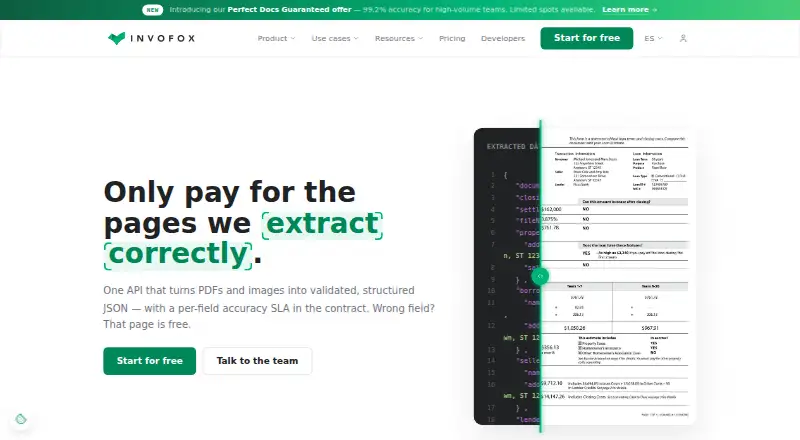
What Invofox is
Invofox extracts structured information from PDFs, images, and scanned files, returning the results as JSON through an API. Its processing pipeline covers OCR, document splitting and classification, field extraction, schema mapping, validation, and webhook delivery. Custom document schemas let teams map extracted fields to their own data models. The site reports 99.2% extraction accuracy and says reported mistakes are automatically credited back. Invofox can connect through Zapier to more than 9,000 apps, including Google Drive and Google Sheets. It lists SOC 2 Type II, ISO 27001, GDPR, and HIPAA compliance, plus TLS 1.3 encryption in transit and AES-256 encryption at rest. Cloud is the default deployment; zero retention is an opt-in for Scale and Enterprise, while on-premise deployment is reserved for Enterprise. The Free plan covers 500 pages, and Starter costs $500 a month, billed annually, for up to 5,000 pages per month. Scale and Enterprise use custom pricing.
Good
- Returns extracted data as structured JSON.
- Supports custom document schemas and field mapping.
- Zapier connects it to over 9,000 apps.
- Free plan includes 500 pages.
- Offers an on-premise option for Enterprise clients.
Watch out
- Starter costs $500 a month, billed annually.
- Free plan is limited to 500 pages.
- On-premise deployment is reserved for Enterprise clients.
Who it suits
Invofox suits teams handling document-heavy workflows in fintech, marketplaces, logistics, accounting platforms, or enterprise operations. Its custom schemas and API may suit teams that need extracted fields mapped into their own systems.
Verdict
Invofox combines document extraction with schema mapping, validation, and downstream delivery. The free tier offers a way to start, while higher-volume and on-premise requirements may call for custom-priced plans.
Plans and prices
From Invofox's own pricing page, checked 15 Oct 2026.
| Plan | Price | What it gives you |
|---|---|---|
| Free | Free | 500 pages · pre-trained invoice/receipt/utility-bill/ticket/payslip models · REST API · self-service onboarding · community support |
| Starter | $500 a month | Up to 5,000 pages/month · pre-trained extraction · REST API · email support · 99.9% uptime SLA · Billed annually |
| Enterprise | Priced on request | Scale features · custom model training · custom SLAs · advanced security controls · zero-retention policy · over 250,000 pages/month |
| Scale | Priced on request | Starter features · advanced models · custom field mapping · priority support · dedicated account manager · team collaboration · SOC 2 and HIPAA compliance |
The facts
Each one read from Invofox's own pages, with the date it was checked.
What it does
- Accounting integrations
- Validated output can be sent to NetSuite, QuickBooks, Sage, SAP, Odoo or an in-house ledger through API, webhooks or no-code tooling.checked 15 Oct 2026
- Accuracy
- The site states 99.2% document extraction accuracy and says reported mistakes are automatically credited back.checked 5 Oct 2026
- Accuracy claim
- The pricing page reports 99.2% document extraction accuracy and an average processing time below three seconds.checked 15 Oct 2026
- AI-agent extensibility
- Invofox publishes llms.txt, a full documentation index and an MCP server for compatible coding agents.checked 15 Oct 2026
- API documentation
- Public documentation includes REST endpoint references for imports, files, documents, users, companies and providers.checked 15 Oct 2026
- API endpoint
- Uploads use POST https://api.invofox.com/v1/ingest/uploads with an x-api-key header and multipart form data.checked 15 Oct 2026
- Classification
- A classifier can identify the document type automatically when the caller does not specify one.checked 15 Oct 2026
- Custom schemas
- Customers can define custom document types and choose the fields returned.checked 15 Oct 2026
- Deployment
- Cloud is the default deployment, zero retention is opt-in for Scale and Enterprise, and on-premise is reserved for Enterprise clients.checked 5 Oct 2026
- Document inputs
- The API accepts PDFs, JPEG/JPG, PNG, TIFF images and ZIP archives.checked 15 Oct 2026
- Document splitting
- The splitter separates multiple documents contained in one PDF.checked 15 Oct 2026
- Encryption
- Security documentation states TLS 1.3 in transit and AES-256 encryption at rest with KMS-managed keys.checked 15 Oct 2026
- Feedback loop
- Corrected values can be sent back through PUT /documents/{id} to improve extraction models.checked 15 Oct 2026
- Funding
- Crunchbase identifies Invofox as a private seed company with two recorded funding rounds and seven investors, including Rebel Fund and JME Ventures.checked 15 Oct 2026
- Independent listing
- Software Advice lists Invofox with no user reviews and pricing available on request.checked 15 Oct 2026
- Independent listing rating
- GetApp lists Invofox at 0.0 from 0 reviews and shows no pricing information.checked 15 Oct 2026
- Independent rating
- Rating on G2: 5.0 out of 5 from 1 review.checked 15 Oct 2026
- Input and output
- The product accepts PDFs, images, or scanned files and returns structured JSON.checked 5 Oct 2026
- Integrations
- The Zapier integration can route extracted data to more than 9,000 apps, including workflows with Google Drive and Google Sheets.checked 5 Oct 2026
The company
- Company
- The site identifies the company as Invofox, Inc.checked 5 Oct 2026
- Company founding
- Y Combinator lists Invofox as founded in 2022 and part of its Summer 2022 batch.checked 15 Oct 2026
- Company legal name
- The legal notice names INVOFOX INC, BRANCH IN SPAIN, with a registered office in Madrid.checked 15 Oct 2026
- Company size
- LinkedIn lists Invofox as having 11–50 employees.checked 15 Oct 2026
- Headquarters
- Madrid, Spainchecked 19 Oct 2026
The full review of Invofox
Overview
Invofox is an API-based service that turns PDFs, images and scanned files into structured JSON. It suits teams handling recurring document workflows that need extracted fields mapped to their own data model; the free allowance is useful for a small start, but scaling brings a substantial annual Starter commitment.
Key features
Extraction built for workflows
Its pipeline combines OCR, document splitting and classification, extraction, schema mapping, validation and webhook delivery. That makes it better suited to operational processing than to occasional document capture. Custom schemas let teams align output with existing data structures instead of adapting downstream systems to a fixed format. The API is included on Free, while line-item extraction, purchase-order matching and duplicate detection make the service relevant to invoice workflows beyond basic text recognition.
Zapier can send extracted data to more than 9,000 apps, including Google Drive and Google Sheets. This offers a practical route into existing tools, though teams with more specialized destinations may need to build around the API and webhooks.
Invofox states 99.2% extraction accuracy and says reported mistakes are automatically credited back. That assurance may help when evaluating automated processing, but teams should still consider how the system performs on their own document mix.
Security and deployment
Invofox states compliance with SOC 2 Type II, ISO 27001, GDPR and HIPAA, and says data is encrypted in transit with TLS 1.3 and at rest with AES-256. Cloud is the default deployment. Zero retention is opt-in on Scale and Enterprise, while on-premise deployment is reserved for Enterprise, so organizations requiring on-premise processing must be prepared for that plan's custom pricing.
Pricing
The free plan costs nothing and includes 500 pages, pre-trained models for invoices, receipts, utility bills, tickets and payslips, the REST API and community support. It is a sensible way to assess the workflow or handle modest volumes, but its page cap makes it unsuitable for sustained higher-throughput use.
Starter costs $500 a month, billed annually, for up to 5,000 pages per month. It adds pre-trained document extraction, email support and a 99.9% uptime SLA. The annual billing term and sharp jump from 500 free pages make this a poor fit for uncertain or sporadic demand; the larger allowance is aimed at teams with regular volume.
Scale has custom pricing and adds volume discounts, advanced extraction models, custom field mapping, priority support, a dedicated account manager, team collaboration tools, and SOC 2 and HIPAA compliance. It is the more relevant step for teams that need those capabilities or support, rather than simply more pages.
Enterprise also uses custom pricing and is intended for custom document types and workflows, custom model training, advanced security controls, zero retention, and large-scale processing beyond 250,000 pages per month. Its SLA tier is available on plans processing 1M+ pages per year. This is the plan to consider for substantial volume or on-premise needs, not a cost-conscious extension of the free tier.
Platforms
Invofox is available through its API, as a web service and in self-hosted deployments. The self-hosted route aligns with organizations needing more control over deployment, while on-premise deployment is reserved for Enterprise clients.
Who it's for
Invofox is aimed at fintechs, marketplaces, logistics operations, accounting platforms and enterprises that need repeatable document processing and structured data in their systems. It is less compelling for occasional users who can stay within 500 pages, or for teams that need predictable low-cost usage: Starter's annual billing and $500.00 USD monthly price are significant commitments.
Pros and cons
- Pros: The pipeline covers classification through validation and webhook delivery, while custom schemas and field mapping help fit output to existing workflows.
- Pros: Free includes API access and 500 pages, giving teams room to evaluate core processing before paying.
- Pros: Stated compliance credentials and encryption standards are relevant for organizations handling sensitive documents.
- Cons: Starter's 5,000-page monthly cap comes with a $500.00 USD monthly price billed annually, a steep step from Free.
- Cons: Zero retention is opt-in only on Scale and Enterprise, and on-premise deployment is limited to Enterprise.
- Cons: Scale and Enterprise use custom pricing, so teams needing their extra controls and support cannot rely on a published price.
Alternatives
For a wider comparison, browse Invoice Processing Software.
Veryfi Invoices OCR API is worth considering for teams that want Android or iOS support as well as API and web access; its Starter price is $500 a month with a minimum commitment and per-invoice pricing.
invoice2data is a free option for readers who prefer software across Linux, macOS, Windows or self-hosted environments and do not need a stated paid tier or usage limit.
Nanonets Invoice OCR may suit teams seeking a free start with $50 in credits and a stated $100/month option for 100 credits, plus API access and email integration.
Parseur is an alternative for email-parsing workflows; its Free plan is capped at 20 pages per month and one user.
Gemina Invoice OCR API is an API-only alternative with a free Starter allowance of 1,500 FileTag tags per month and seven-day retention.
DocuClipper Invoice Approval may be a better fit for teams wanting a $20 a month plan billed annually, with 60 pages per month and unlimited users.
OpenInvoice is a free, open-source alternative; paid deployment, integration and ongoing support are offered as a B2B service.
Tungsten Power PDF is another option for readers seeking a paid PDF editor rather than an API-based document extraction service.
Verdict
Choose Invofox if your team needs to turn recurring document volume into schema-mapped data through a connected API workflow, and can justify the relevant plan as usage grows. Its broad processing pipeline, custom mapping and stated security controls are the case for it; the 500-page Free cap, annual Starter commitment and Enterprise-only on-premise deployment are the reasons to look elsewhere if volumes are low, budgets are tight or local deployment is essential.
Getting started
- Open the Invofox website
- Choose the Free, Starter, Scale, or Enterprise plan
- Use the web interface, API, or self-hosted platform
- Submit PDFs, images, or scanned files
- Map extracted fields with a custom schema if needed
- Connect delivery workflows through webhooks or Zapier
Limits worth knowing
The Free plan includes 500 pages and pre-trained models for invoices, receipts, utility bills, tickets, and payslips. Starter allows up to 5,000 pages per month; Enterprise covers workflows beyond 250,000 pages monthly.
Questions
Does Invofox have a free plan?
Yes. The Free plan costs nothing and includes 500 pages.
What does Starter cost?
Starter costs $500 a month, billed annually, for up to 5,000 pages monthly.
Which platforms does Invofox support?
It supports API, self-hosted, and web platforms.
Can Invofox connect with other applications?
Yes. Zapier can route extracted data to more than 9,000 apps, including Google Drive and Google Sheets.
Does Invofox support custom extraction fields?
Yes. Custom document schemas map extracted fields to a customer's data model.
Which compliance standards does it state?
Invofox states compliance with SOC 2 Type II, ISO 27001, GDPR, and HIPAA.
Alternatives to Invofox
- 1

Veryfi Invoices OCR API
Free planAndroidiOSWebAPI8.2From $500 a month - 2
Circulus
AndroidiOSWebAPI7.6From $39.99 a month - 3

Parseur
Free planWebAPI7.6From $49 a month - 4
ChronoScan AP Invoice Processing
Free planWebAPISelf-hostedWindows7.5From €49 a year - 5

Gemina Invoice OCR API
Free planWebAPI7.3From $25 a month - 6
Rossum AP Automation
WebAPI7.2From $18,000 a year