Harken
Harken monitors keywords, brands, or products across online sources and brings mentions, sentiment, and themes together in a local dashboard.
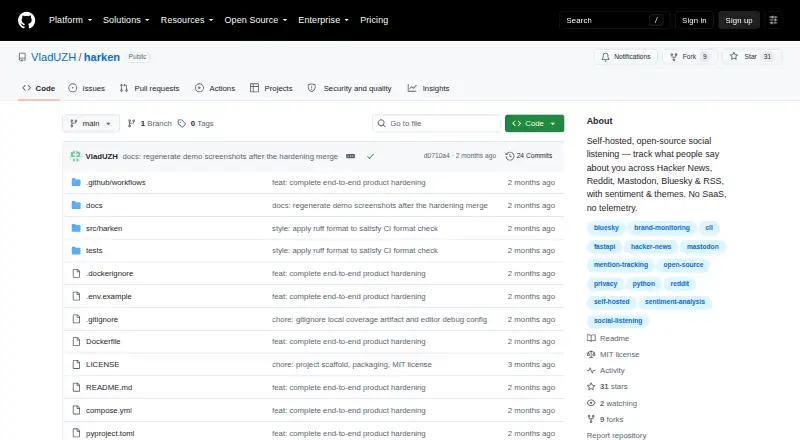
What Harken is
Harken monitors keywords, brands, or products across online sources and brings mentions, sentiment, and themes together in a local dashboard. It can watch Hacker News, Reddit, Mastodon, Bluesky, Stack Overflow, RSS, X, and YouTube. A built-in lexicon analyzer scores sentiment; optional LLM analysis can label themes using Anthropic, OpenAI, or locally run Ollama. The product offers both a local web dashboard and a terminal CLI, and stores its database in SQLite. Harken says it sends no Harken telemetry, though tracking sends search terms to selected source APIs. Using Anthropic or OpenAI for theme labels sends a small sample of mention text to that provider. Alerts for negative mentions and configured volume or sentiment thresholds can go to Slack, generic webhooks, or SMTP email. Hacker News and Bluesky work without credentials; other sources may require credentials, configured feeds, or tokens. Harken is free, open-source MIT software for self-hosting, with API access and no per-seat pricing. Historical data is limited. The quickstart requires Python 3.10 or later, and Docker Compose instructions are included.
Good
- Monitors eight listed source types.
- Offers a dashboard and terminal CLI.
- Stores its database locally in SQLite.
- Provides Slack, webhook, and email alerts.
- Free MIT software with API access.
Watch out
- Historical data is limited.
- Several sources require credentials, feeds, or tokens.
- External LLM labeling shares a small sample of mention text.
- Requires Python 3.10 or later.
Who it suits
Harken suits indie founders, open-source maintainers, and privacy-conscious teams that want to monitor mentions in a locally stored dashboard. It also fits users comfortable with self-hosting and configuring source credentials where needed.
Verdict
Harken combines source monitoring, sentiment and theme analysis, and configurable alerts in a self-hosted package. Consider its limited historical data and the data sent to source APIs or optional external LLM providers when choosing how to use it.
Plans and prices
From Harken's own pricing page, checked 7 Oct 2026.
| Plan | Price | What it gives you |
|---|---|---|
| Free | Free | Open-source MIT · self-hosted · no per-seat pricing |
The facts
Each one read from Harken's own pages, with the date it was checked.
What it does
- Alerts
- It supports Slack or generic webhooks and SMTP email alerts for new negative mentions and configured volume or sentiment thresholds.checked 7 Oct 2026
- Analysis
- It scores sentiment with a built-in local lexicon analyzer and groups mentions into themes, with optional LLM analysis.checked 7 Oct 2026
- Authentication
- Optional account mode supports viewer, operator, and admin roles, with salted PBKDF2-HMAC-SHA256 password hashes and expiring opaque sessions.checked 7 Oct 2026
- Compatibility
- The quickstart requires Python 3.10 or later and the repository includes Docker Compose instructions.checked 7 Oct 2026
- Intended users
- The README describes Harken as suited to indie founders, open-source maintainers, and privacy-conscious teams.checked 7 Oct 2026
- Interfaces
- Harken provides a local web dashboard and a terminal CLI.checked 7 Oct 2026
- Optional LLM providers
- Optional theme labeling supports Anthropic, OpenAI, or locally run Ollama.checked 7 Oct 2026
- Privacy detail
- Tracking sends search terms to selected source APIs, and choosing Anthropic or OpenAI for optional theme labels sends a small sample of mention text to that provider.checked 7 Oct 2026
- Purpose
- Harken tracks mentions of keywords, brands, or products across online sources and presents sentiment and themes in a local dashboard.checked 7 Oct 2026
- Sentiment analysis
- Yeschecked 21 Sep 2026
- Source requirements
- Hacker News and Bluesky work without credentials; Reddit, Mastodon, RSS, X, and YouTube require credentials, configured feeds, or tokens as applicable.checked 7 Oct 2026
- Sources
- Sources include Hacker News, Reddit, Mastodon, Bluesky, Stack Overflow, RSS, X, and YouTube.checked 7 Oct 2026
- Storage and telemetry
- Harken stores its database locally in SQLite and says it sends no Harken telemetry.checked 7 Oct 2026
- Support
- The project invites issues and pull requests, and says paid tools offer broader hosted operations and vendor support.checked 7 Oct 2026
Money
- Free plan
- Yeschecked 21 Sep 2026
The full review of Harken
Harken is a free, self-hosted mention monitor for indie founders, open-source maintainers, and privacy-conscious teams willing to manage setup. Its strongest case is keeping the monitoring database on your own system; it is a less natural fit if you need hosted operations or vendor support.
Overview
Harken collects keyword, brand, and product mentions from Hacker News, Reddit, Mastodon, Bluesky, Stack Overflow, RSS/Atom, X, and YouTube. A local dashboard brings those mentions together with sentiment scores and themes, and a terminal CLI provides another way to work with results. This broad source mix is useful for keeping watch across communities and social platforms, though access is uneven: Hacker News and Bluesky work without credentials, while Reddit, Mastodon, RSS, X, and YouTube require credentials, configured feeds, or tokens as applicable. Historical data is limited, so Harken is better suited to ongoing monitoring than deep retrospective analysis.
Key features
The built-in local lexicon analyzer scores sentiment, while theme grouping helps surface recurring subjects. Optional theme labeling can use Anthropic, OpenAI, or locally run Ollama. The local analyzer and Ollama offer a path that avoids sending mention text to an external LLM provider; choosing Anthropic or OpenAI sends a small sample of mention text to that provider. Tracking also sends search terms to the selected source APIs, even though Harken says it sends no Harken telemetry.
Harken stores its database in local SQLite, a meaningful advantage for teams that want to keep monitoring data on infrastructure they control. Alerts can go to Slack, generic webhooks, or SMTP email for new negative mentions and configured volume or sentiment thresholds. Optional account mode adds viewer, operator, and admin roles, with salted PBKDF2-HMAC-SHA256 password hashes and expiring opaque sessions. That makes the access model more useful for a small team than a single-user dashboard, but operating the service remains your responsibility.
The quickstart requires Python 3.10 or later, and Docker Compose instructions provide another deployment route. Source configuration is part of the work: the sources that need credentials, feeds, or tokens are not ready to monitor without them.
Pricing
Harken's Free plan costs nothing. It is open-source under MIT, self-hosted, and has no per-seat pricing; there is no free trial because the plan is free. This suits individual operators and teams comfortable supplying their own hosting and configuration. The trade-off is operational: Harken invites issues and pull requests, while paid tools offer broader hosted operations and vendor support. There is no cheaper tier that removes those responsibilities.
Platforms
Harken is self-hosted software with a local web dashboard and terminal CLI. The quickstart requires Python 3.10 or later, and Docker Compose instructions are included. API access is available. Its local deployment favors control over convenience, so teams seeking a managed web service should look elsewhere.
Who it's for
Harken is a good match for indie founders tracking a product or brand, open-source maintainers watching community discussion, and privacy-conscious teams that can operate their own deployment. It is less suitable for organizations that need extensive historical analysis, turnkey source connections, hosted operations, or vendor support.
Pros and cons
- Pro: Local SQLite storage and no Harken telemetry give operators control over the database and reduce data sent to the Harken project.
- Pro: Coverage across forums, social platforms, RSS/Atom, and video comments provides a broad monitoring mix in one dashboard.
- Pro: Slack, webhook, and email alerts can flag negative mentions or configured volume and sentiment thresholds.
- Con: Reddit, Mastodon, RSS, X, and YouTube need credentials, feeds, or tokens, adding setup work before monitoring can begin.
- Con: Limited historical data makes it a weaker choice for long-range trend analysis.
- Con: Self-hosting puts deployment and ongoing operations on the user, unlike paid tools that offer broader hosted operations and vendor support.
Alternatives
For a wider shortlist, see AI Social Listening Tools and Social Media Listening Software.
- KWatch.io is a freemium web and API option with a free plan for two Reddit keyword alerts and two Hacker News keyword alerts, but no tracked conversations; choose it if that narrower free alert setup is enough.
- dig is a freemium web and API service with 10 credits per month on its free plan; consider it if a credit-based service better fits your workflow.
- Social Searcher offers a free web plan with 100 real-time searches per day, one monitoring, and 500 saved posts per month; pick it if you want those search and saved-post caps without registration or login.
- Brand24 is a paid option with a free trial and apps for mobile, desktop, web, and API access; its Individual plan includes three keywords, 2K mentions per month, one user, and updates every 12 hours. Consider it if those paid-plan limits and broader platform access suit your needs.
- Meltwater Social Listening is a paid web and API option whose Starter plan is aimed at small communications or marketing teams, startups, scale-ups, and teams with limited in-house analytics.
- OpenMagpie is another free, self-hosted option; choose it if you prefer a tool that is free to run and can provide your own hardware and model.
- Sprinklr Social Listening is an enterprise product with custom pricing.
- Zignal Labs uses custom pricing, with its fees, usage levels, and included services set by a service order form.
Verdict
Choose Harken if you want a free, self-hosted way to watch mentions across varied online sources, with local storage, sentiment and theme analysis, and configurable alerts. Its central advantage is control over your deployment and database; its central limitation is that source setup and operations fall to you, while historical data remains limited. Teams that need managed service, deeper retrospection, or vendor support should look elsewhere.
Getting started
- Open the Harken GitHub repository
- Use Python 3.10 or later for the quickstart
- Follow the repository's Docker Compose instructions if preferred
- Configure sources, credentials, feeds, or tokens as required
- Run the local web dashboard or terminal CLI
- Optionally connect an LLM provider and configure alerts
Limits worth knowing
The free plan is self-hosted and has limited historical data. Source access may require credentials, configured feeds, or tokens, and optional Anthropic or OpenAI labeling sends a small mention-text sample to that provider.
Questions
What does Harken cost?
The Free plan costs nothing. It is open-source MIT software with no per-seat pricing.
Which sources can Harken monitor?
Sources include Hacker News, Reddit, Mastodon, Bluesky, Stack Overflow, RSS or Atom, X, and YouTube.
Which sources work without credentials?
Hacker News and Bluesky work without credentials. Reddit, Mastodon, RSS, X, and YouTube may require credentials, configured feeds, or tokens.
Does Harken offer sentiment analysis and API access?
Yes. It includes a local lexicon sentiment analyzer and provides API access.
Where is Harken's data stored?
Harken stores its database locally in SQLite and says it sends no Harken telemetry.
What platforms and setup options are listed?
Harken is listed for self-hosted and web use. The quickstart requires Python 3.10 or later, and the repository includes Docker Compose instructions.
Alternatives to Harken
- 1

Brand24
AndroidiOSWebAPI7.7From $249 a month - 2
KWatch.io
Free planWebAPI7.5From $19 a month - 3

dig
Free planWebAPI7.4From $25 a month - 4
 7.2From $99 a month
- 5

Mentionlytics
WebAPI7.2From $49 a month - 6

Awario
Web7.0From $29 a month