
dig
dig is a social intelligence platform for tracking reactions, themes and narratives across social content.
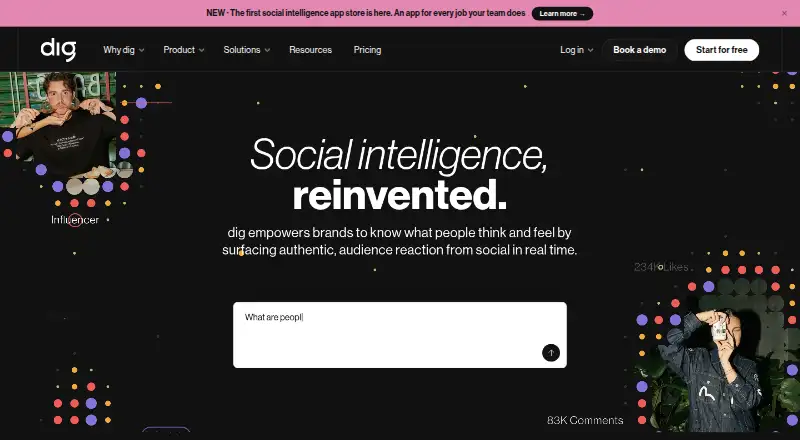
What dig is
dig is a social intelligence platform for tracking reactions, themes and narratives across social content. It analyzes video visuals, speech, tone, scenes, objects, emotions and narrative structure, as well as text accompanying videos. The maker says it covers more than 90% of social video on TikTok, YouTube, Instagram, Reddit, X and Facebook, and reports 95% accuracy for in-video analysis. Findings link to original videos, while its natural-language research chatbot answers questions with links to source posts. The feature set also includes sentiment and creator analysis, narrative intelligence, dashboards, a live feed, smart alerts, comments analysis and figure detection. Its source coverage includes news, forums and blogs, with full historical data listed. The API returns structured JSON enriched with transcripts, sentiment, topics, products, brands and creator information for applications, AI, dashboards and data platforms. All tiers can export narrative summaries and impact scores to PDF or CSV. dig is available on the web and through an API. Its free tier provides 10 monthly credits; Pro costs $25.00 per month and provides 50, with additional research features. Enterprise lists 100+ credits.
Good
- Analyzes video content and accompanying text.
- Research chatbot answers link to source posts.
- Full historical data is listed.
- All tiers can export summaries and impact scores.
- API provides enriched, structured JSON.
Watch out
- Free plan is limited to 10 monthly credits.
- Pro is $25.00 per month.
Who it suits
dig suits brand and consumer insights teams, strategy leaders, communications and PR teams, agencies, research teams and public sector teams. It is also relevant to organizations that want social research findings available through an API or linked back to source posts.
Verdict
Choose dig if your work depends on researching social narratives, video reactions and source-linked findings. The free plan offers a way to start, while Pro adds 50 monthly credits and specified research features; teams needing more than Enterprise’s listed 100+ credits should confirm plan details with the company.
Plans and prices
From dig's own pricing page, checked 14 Oct 2026.
| Plan | Price | What it gives you |
|---|---|---|
| Pro | $25 a month | 50 credits/month · influencer vetting · crisis detection · trend discovery · events analysis · competitive research · $25 per month |
| Free | Free | 10 credits/month · social research · brand analysis · consumer insights · $0 per month |
| Enterprise | Priced on request | 100+ credits · video, visual, text, online news and publisher coverage · real-time alerts · SAML SSO · audit logs · dedicated organization environment · data isolation · Contact sales |
The facts
Each one read from dig's own pages, with the date it was checked.
What it does
- Accuracy and traceability
- The maker states that its in-video analysis runs at 95% accuracy and insights link to original videos.checked 29 Sep 2026
- Accuracy claim
- The company reports 95% accuracy for tagging relevant posts, brand mentions and narratives.checked 14 Oct 2026
- Comment analysis
- The service analyzes comments for sentiment, themes, concerns, emotions and emerging narratives.checked 14 Oct 2026
- Coverage
- The maker says dig analyzes 90%+ of social video across TikTok, YouTube, Instagram, Reddit, X and Facebook.checked 29 Sep 2026
- Coverage claim
- The company states that it decodes more than 90% of social videos and analyzes 750 million posts monthly.checked 14 Oct 2026
- Creator analysis
- Creator profiles include creator type, demographics, reach tier, language and content style.checked 14 Oct 2026
- Credit limit
- The maker defines one credit as one chatbot question analyzed against its global video database; Free includes 10 monthly credits and Pro includes 50.checked 29 Sep 2026
- Dashboards
- Users can build custom dashboards covering trends, sentiment, creator behavior and topic distribution.checked 14 Oct 2026
- Data-training policy
- The pricing page says enterprise customer data is not used for model training, while the terms allow Free and Pro customer data to be used to improve and train services.checked 14 Oct 2026
- Documentation
- The public how-it-works guide documents the four-stage workflow and the evidence and metadata attached to findings.checked 14 Oct 2026
- Exports
- All pricing tiers are described as supporting PDF or CSV export of narrative summaries and impact scores.checked 14 Oct 2026
- Figure detection
- Figure detection identifies key people appearing in videos and measures how often and in what context they occur.checked 14 Oct 2026
- Gartner pricing note
- Gartner says pricing is usage-based, typically tiered by monitored or processed data volume, with enterprise pricing available on request.checked 14 Oct 2026
- Gartner product description
- Gartner describes dig as a video-first narrative-intelligence platform covering social and non-social sources in more than 100 languages.checked 14 Oct 2026
- Integrations and API
- The dig API returns structured JSON enriched with transcripts, sentiment, topics, products, brands and creator information for use in applications, AI, dashboards and data platforms.checked 29 Sep 2026
- Intended users
- The maker identifies brand and consumer insights teams, strategy leaders, communications and PR teams, agencies, research teams, and public sector teams as users.checked 29 Sep 2026
- Key features
- The platform lists sentiment and creator analysis, narrative intelligence, dashboards, a live feed, smart alerts, comments analysis and figure detection.checked 29 Sep 2026
- Leadership
- The company about page names Ofer Familier as CEO and co-founder and Eyal Koren as CTO and co-founder.checked 14 Oct 2026
- Licence
- The terms grant only a limited, revocable, non-transferable service-use licence and prohibit hosting, modification, reverse engineering and resale.checked 14 Oct 2026
- Limit: independent feedback
- Both Gartner Peer Insights and SourceForge state that dig had no submitted user reviews on their listings when opened.checked 14 Oct 2026
Where it runs
- App store roadmap
- The app-store page lists campaign analysis, dashboard builder, industry and product benchmarks, influencer discovery, narrative intelligence and crisis management, with several marked coming soon.checked 14 Oct 2026
The company
- Company facts
- LinkedIn lists dig.ai as privately held, founded in 2021, headquartered in New York and employing 51–200 people.checked 14 Oct 2026
- Company legal name
- The terms identify Dig International Inc. and its affiliates as the operator of ask dig and dig.ai.checked 14 Oct 2026
Money
- Free plan
- Yeschecked 21 Sep 2026
The full review of dig
Overview
dig is a social intelligence platform for teams investigating audience reactions, emerging narratives and the content behind them. It is most compelling when social video is central to the question; its video interpretation and source-linked answers give researchers more context than a sentiment score alone.
Coverage spans TikTok, YouTube, Instagram, Reddit, X and Facebook, as well as news, forums and blogs. The maker says dig analyzes more than 90% of social video across the named social platforms and reports 95% accuracy for in-video analysis. These are the maker’s claims, not independent benchmarks. Links to original videos and source posts make it possible to inspect the material behind an insight.
Key features
- Video and narrative analysis: dig interprets visuals, speech, tone, scenes, objects, emotions and narrative structure, alongside text around videos. That combination suits teams trying to understand how a message is presented, not just whether a post reads as positive or negative.
- Sentiment, creators and comments: Sentiment and creator analysis, comments analysis and figure detection broaden the view from video content to the people and reactions around it. The feature set is useful for audience and communications research, though the service’s defining emphasis remains social narratives and video.
- Research chatbot: Natural-language questions return answers linked to source posts. This offers a direct route from a research question to material a team can review, but each question analyzed against the global video database uses a credit.
- Monitoring and reporting: Dashboards, a live feed and smart alerts support ongoing monitoring, while every tier can export narrative summaries and impact scores to PDF or CSV. Full historical data helps teams examine past activity as well as current conversations.
- API: The API returns structured JSON with transcripts, sentiment, topics, products, brands and creator information. That makes dig a plausible component in an existing application, AI workflow, dashboard or data platform rather than only a standalone research destination.
- Privacy and enterprise controls: Private search data is not used to train models for other customers. Enterprise adds SAML SSO, audit logs, a dedicated organization environment and full data isolation, and says customer data is never used for model training.
Pricing
Free — free, billed monthly: Includes 10 credits per month. It is a sensible way to try source-linked social research or handle occasional questions, but a small allowance will constrain teams running frequent investigations.
Pro — $25 a month, billed per month: Includes 50 credits per month, plus influencer vetting, crisis detection, trend discovery, events analysis and competitive research. It is the practical fit for recurring research that needs those capabilities; teams should still consider whether 50 questions a month matches their workload.
Enterprise — custom pricing: Includes 100+ credits and the enterprise security controls. It is aimed at organizations with heavier research or governance needs, but the stated 100+ allowance may not suit very high-volume use without confirming the arrangement directly.
Credits measure chatbot questions analyzed against dig’s global video database. The free plan’s 10 and Pro’s 50 monthly credits therefore set a meaningful ceiling on question-led work. The company offers a free plan, contact and demo options; it says most teams are up and running in under three hours.
Platforms
dig is available on the web and through an API. The web product suits direct research and monitoring, while the API’s structured output is suited to teams integrating its data into other software. The API is an access route, not a separate listed platform such as a mobile app.
Who it's for
Brand and consumer insights teams, strategy leaders, communications and PR groups, agencies, research teams and public sector teams are the audiences dig identifies. It is particularly well matched to work where video content, audience response and traceable findings matter together. Teams seeking straightforward mention tracking without a video-research focus may find the product’s central emphasis less relevant.
Pros and cons
Pros
- Video-specific context: Analysis of visuals, speech, tone and narrative structure can surface meaning that text-only sentiment misses.
- Traceable outputs: Links to source videos and posts let teams inspect the underlying content rather than rely solely on summaries.
- Broad research workflow: Historical data, monitoring features, exports and an API support both ad hoc inquiries and integration into existing systems.
- Useful entry point: A free tier and monthly Pro billing let teams begin without a long-term billing commitment.
Cons
- Question quotas: Ten monthly credits on Free and 50 on Pro can limit teams that rely heavily on chatbot-led research.
- Maker-reported performance: The 90%+ coverage and 95% accuracy claims are not independent benchmarks, so buyers should assess whether the analysis meets their own needs.
- Enterprise cost requires a conversation: Custom pricing makes it harder to compare the 100+ credit tier with fixed-price options before contacting the company.
Alternatives
AI Social Listening Tools is a useful starting point for comparing products in that category. The broader Social Media Listening Software directory can help readers compare beyond AI-focused tools.
- KWatch.io is worth considering when Reddit and Hacker News keyword alerts are the priority: its free plan includes two alerts for each, but no tracked conversations.
- Social Searcher suits readers who want web-based, real-time searches without registration; its free plan allows 100 searches per day, one monitoring, and 500 saved posts per month.
- Harken is an alternative for readers who prefer free, open-source, self-hosted software with no per-seat pricing.
- Brand24 is a paid alternative with a free trial and broad device support; its Individual plan is $249 a month, billed $ 199 per month, billed annually, for 3 keywords, 2K mentions per month and one user.
- Meltwater Social Listening is aimed at small communications and marketing teams, startups and scale-ups with limited in-house analytics.
- OpenMagpie is a free, self-hosted option for readers willing to provide their own hardware and model.
- Sprinklr Social Listening is an enterprise product available by demo.
- Zignal Labs uses custom pricing through a service order form specifying fees, usage levels and included services.
Verdict
Choose dig if your team needs to investigate social video narratives and audience reactions with links back to source material. Its video analysis, research chatbot and integration options make it a focused choice for communications, strategy and insights work. Look elsewhere if your priority is a higher, predictable volume of chatbot questions at a fixed price, or if video context is not important to your monitoring needs.
Getting started
- Visit https://dig.ai/
- Start with the free plan or contact the company.
- Book a demo if you want one.
- Use dig on the web or connect through its API.
Limits worth knowing
The free plan includes 10 credits per month, and Pro includes 50 credits per month. One credit covers one chatbot question analyzed against dig’s global video database.
Questions
Does dig have a free plan?
Yes. The free plan costs $0.00 and includes 10 credits per month.
How much does Pro cost?
Pro costs $25.00 per month and includes 50 credits per month, influencer vetting, crisis detection, trend discovery, events analysis and competitive research.
What does one credit cover?
One credit covers one chatbot question analyzed against dig’s global video database.
Which platforms does dig support?
dig is available through the web and API.
What sources does dig cover?
Listed sources include TikTok, YouTube, Instagram, X, Reddit, Facebook, news, forums and blogs.
Does dig offer an API?
Yes. It returns structured JSON enriched with transcripts, sentiment, topics, products, brands and creator information.
Alternatives to dig
- 1

Brand24
AndroidiOSWebAPI8.2From $249 a month - 2

Brand Intel
Free planWebAPI8.0From $39 a month - 3
Emplifi
AndroidiOSWebAPI8.0From $1,249 a month - 4
KWatch.io
Free planWebAPI7.9From $19 a month - 5

Meltwater Social Listening
AndroidiOSWebAPI7.8 - 6

Mentionlytics
WebAPI7.8From $49 a month