FEDOT
FEDOT is an open-source framework for automated generation of data-driven composite models.
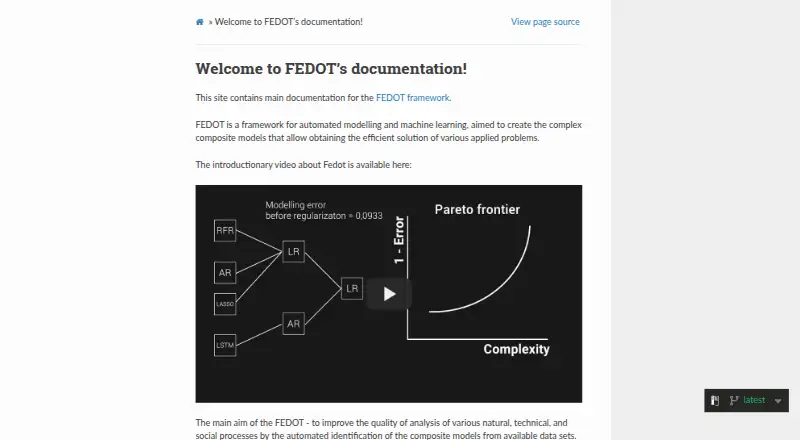
What FEDOT is
FEDOT is an open-source framework for automated generation of data-driven composite models. It supports classification, regression, clustering, and time-series forecasting, and works with tabular, text, and image data, including combinations of these types. Its workflow covers preprocessing, model selection, tuning, cross-validation, and serialization. Users can leave parameters out for fuller automation or supply them to guide pipeline composition. FEDOT uses the GOLEM library to optimize graph-based pipelines with meta-heuristic methods, and provides presets such as best_quality, fast_train, stable, gpu, ts, and automl. Input data can come from CSV files, pandas DataFrames, NumPy arrays, or time-series CSV data. The API can also be called from a console without Python code, saving predictions as CSV files. GPU evaluation uses RAPIDS and supports a specified set of models, including Ridge, Lasso, LogisticRegression, RandomForestClassifier, RandomForestRegressor, KMeans, and SVC. Installation is available through pip, with optional dependencies for image, text-processing, and DNN work. Maintained by NSS Lab at ITMO University's National Center for Cognitive Technologies, FEDOT is free under the 3-Clause BSD license and supports Windows, Linux, and macOS.
Good
- Supports classification, regression, and forecasting.
- Works with tables, text, images, and mixed data.
- Offers automated and parameter-guided pipeline composition.
- Runs on Windows, Linux, and macOS.
Watch out
- GPU evaluation supports only a listed set of models.
- Optional image, text, and DNN dependencies are separate.
- Workflow interface is code-based.
Who it suits
FEDOT suits developers and researchers building automated machine-learning pipelines for supported data types and tasks. Its controls offer both automated composition and parameter-guided workflows.
Verdict
FEDOT provides a configurable AutoML framework spanning preprocessing through serialization, with both automation controls and pipeline optimization. Its code-oriented workflow and specified GPU model coverage are important considerations.
Plans and prices
From FEDOT's own pricing page, checked 2 Oct 2026.
| Plan | Price | What it gives you |
|---|---|---|
| FEDOT | Free | Open-source AutoML framework · BSD 3-Clause license |
The facts
Each one read from FEDOT's own pages, with the date it was checked.
What it does
- automation
- Users can choose full automation by omitting parameters or partial automation by supplying parameters for manual composing.checked 1 Oct 2026
- Automation controls
- Users can adjust automation by omitting parameters for full automation or supplying parameters for partial automation.checked 2 Oct 2026
- cli
- Its API can be called from a console without Python code, and predictions are saved as CSV files.checked 1 Oct 2026
- Contributions
- The project welcomes contributors to report bugs or propose enhancements through its GitHub issues.checked 2 Oct 2026
- data_inputs
- InputData can be created from CSV files, pandas DataFrames, NumPy arrays and time-series CSV data.checked 1 Oct 2026
- Data types
- FEDOT works with tabular, image, and text data, including multimodal data from more than one source.checked 2 Oct 2026
- Extensibility
- The project says FEDOT supports widely used ML libraries such as scikit-learn, CatBoost, and XGBoost, and allows custom libraries to be integrated.checked 2 Oct 2026
- gpu
- GPU evaluation uses RAPIDS and currently supports Ridge, Lasso, LogisticRegression, RandomForestClassifier, RandomForestRegressor, KMeans and SVC.checked 1 Oct 2026
- installation
- FEDOT can be installed with pip using `pip install fedot`, with optional image, text-processing and DNN dependencies available through `fedot[extra]`.checked 1 Oct 2026
- Installation
- The project README documents installation with pip, including an extra option for image and text processing and deep neural networks.checked 2 Oct 2026
- license
- FEDOT is published under the BSD-3 license for use in projects and research.checked 1 Oct 2026
- Maintainer
- FEDOT is developed and maintained by the NSS Lab team, part of the National Center for Cognitive Technologies at ITMO University in Russia.checked 2 Oct 2026
- ML lifecycle
- FEDOT covers preprocessing, model selection, tuning, cross-validation, and serialization.checked 2 Oct 2026
- Model libraries
- FEDOT uses models mostly from scikit-learn, statsmodels, and Keras.checked 2 Oct 2026
- model_presets
- The framework provides presets including best_quality, fast_train, stable, auto, gpu, ts and automl, with auto as the default.checked 1 Oct 2026
- multimodal_data
- FEDOT can work with multimodal data including tables, texts and images.checked 1 Oct 2026
- Operating systems
- The quick-start guide lists Windows, Linux, and macOS as supported operating systems.checked 2 Oct 2026
- pipeline_optimization
- FEDOT uses the open-source GOLEM library for optimization and learning of graph-based pipelines with meta-heuristic methods.checked 1 Oct 2026
- Pipeline optimization
- FEDOT uses the GOLEM library for optimization and learning of graph-based pipelines with meta-heuristic methods.checked 2 Oct 2026
- preprocessing
- Its preprocessing handles infinite values, missing values, binary and non-binary categorical features, and extra spaces in categorical data.checked 1 Oct 2026
- Preprocessing
- FEDOT can replace infinite values, drop rows with many missing values, binarize binary categorical data, and trim extra spaces in categorical features.checked 2 Oct 2026
- purpose
- FEDOT is an AutoML-like framework for automated generation of data-driven composite models.checked 1 Oct 2026
- Purpose
- FEDOT is an open-source framework for automated modeling and machine learning that builds end-to-end solutions using an evolutionary approach.checked 2 Oct 2026
The company
- maker
- FEDOT is developed and maintained by the NSS Lab, part of the National Center for Cognitive Technologies at ITMO University in Russia.checked 1 Oct 2026
The full review of FEDOT
Overview
FEDOT is a free, open-source AutoML framework for building data-driven composite models across classification, regression, clustering and time-series forecasting. It suits developers and researchers who want automated pipeline building but still need control over a code-based workflow. Its breadth across preprocessing, optimization and model serialization is compelling; it is less suited to readers seeking a graphical workflow.
Key features
FEDOT covers much of the machine-learning lifecycle: preprocessing, model selection, tuning, cross-validation and serialization. It accepts inputs from CSV files, pandas DataFrames, NumPy arrays and time-series CSV data, and works with tabular, text and image data, including multimodal combinations. Preprocessing handles missing and infinite values, categorical features and extra spaces in categorical data, reducing some routine cleanup before modeling.
Automation is adjustable rather than all-or-nothing. Omit parameters for full automation, or supply them to guide partial automation and manually compose a pipeline. Presets include best_quality, fast_train, stable, auto, gpu, ts and automl; auto is the default. This flexibility is useful when a quick baseline is only the starting point, though making effective use of the controls assumes comfort with code.
Pipeline optimization and learning use GOLEM, which applies meta-heuristic methods to graph-based pipelines. FEDOT draws models mostly from scikit-learn, statsmodels and Keras, and supports integrating libraries including CatBoost and XGBoost, as well as custom libraries. Feature engineering, automated model selection and explainability are included among its capabilities.
The default cross-validation setting uses five folds. Users can add metrics to the optimizer to address potential bias, a useful option when the default evaluation may not suit a particular objective. GPU evaluation uses RAPIDS, but its supported models are limited to Ridge, Lasso, LogisticRegression, RandomForestClassifier, RandomForestRegressor, KMeans and SVC. The GPU preset therefore does not mean every available model can use GPU evaluation.
Install with pip install fedot; optional image, text-processing and DNN dependencies are available through fedot[extra]. The API can also be called from a console without writing Python code, with predictions saved as CSV files. The framework is published under the BSD 3-Clause license, and the maintainers welcome bug reports and enhancement proposals through GitHub issues.
Pricing
FEDOT is free: its plan costs free and includes the open-source AutoML framework under the BSD 3-Clause license. There is no paid tier or free-trial period to weigh against a subscription, and no seat or usage caps are given. The trade-off is that users work with the framework themselves rather than choosing a commercial plan with a graphical workflow.
Platforms
FEDOT supports API use on Linux, macOS and Windows, as well as self-hosted deployment. The workflow interface is code-oriented; console invocation provides a route to run the API without Python code, but the output is a CSV rather than a graphical pipeline interface.
Who it's for
FEDOT is a strong fit for developers and research teams who need a free, self-hosted framework for several supervised learning tasks and forecasting, and value the option to switch between automated and parameter-guided pipeline construction. Its multimodal inputs and library extensibility make it relevant to projects that do not fit a single tabular-data workflow. Readers who want a visual interface, or GPU evaluation across a wider model selection, should look elsewhere.
Pros and cons
- Pro: One framework covers classification, regression, clustering and univariate or multivariate forecasting, with tabular, image and text inputs.
- Pro: Users can move from full automation to manually guided pipelines, and GOLEM optimizes graph-based pipeline structures.
- Pro: Free open-source use, self-hosting and integration with established ML libraries provide room to adapt it to project needs.
- Con: The workflow is code-based, which makes it a weaker fit for readers who need a visual interface.
- Con: GPU evaluation covers a defined set of models rather than the framework's entire model range.
Alternatives
EvalML is another free option with API, Linux, macOS, self-hosted and Windows support; consider it if you are comparing code-oriented frameworks on those platforms.
LightAutoML is a free, open-source Python library installable from PyPI under Apache License 2.0, and adds web support alongside Linux, macOS, self-hosted and Windows. Choose it if that license or platform mix better fits your requirements.
FLAML is another free option for API, Linux, macOS, self-hosted and Windows use; it is worth comparing if you want an alternative within that platform set.
AutoGluon is a free open-source Python library under Apache 2.0, supporting Linux, macOS, self-hosted and Windows. It is a reasonable alternative if that license is preferable.
BigML offers a web option and a free plan with unlimited tasks and storage, but caps datasets at 16 MB per task, parallel tasks at two and users at one. Pick it if a web workflow matters and those limits suit your work.
Auto-PyTorch is a free, BSD-licensed option for Linux and self-hosted use, developed by the AutoML Groups of the University of Freiburg and Hannover. Consider it if those are your target platforms.
JADBio offers a free Basic plan limited to one seat, three projects, 50 MB uploads, 500 MB storage and one model export, as well as web support. Choose it if those project limits and its web option suit you.
Akkio is a freemium alternative with API, self-hosted and web support; consider it if you want to compare another option in that category.
Browse more options in AutoML Software.
Verdict
Choose FEDOT if you want a free, self-hosted AutoML framework that spans preprocessing through serialization and lets you tune how much pipeline construction is automated. Its combination of task coverage and graph-based optimization is the central reason to choose it. Look elsewhere if your priority is a visual workflow or broader GPU model coverage.
Getting started
- Open the FEDOT documentation website
- Install the package with pip install fedot
- Add fedot[extra] for optional image, text-processing, and DNN dependencies
- Use Windows, Linux, macOS, or a self-hosted environment
- Create input from CSV, a pandas DataFrame, a NumPy array, or time-series CSV data
- Choose a preset or supply parameters to guide pipeline composition
Questions
How much does FEDOT cost?
FEDOT is free and open source under the BSD 3-Clause license.
Which tasks does it support?
It supports binary and multiclass classification, regression, clustering, and univariate or multivariate time-series forecasting.
What data can it use?
It works with tabular, text, and image data, including multimodal combinations. Inputs can come from CSV files, pandas DataFrames, NumPy arrays, or time-series CSV data.
Can I control the automation?
Yes. Omit parameters for fuller automation, or supply parameters to guide manual composition.
Which operating systems are supported?
The quick-start guide lists Windows, Linux, and macOS; the hosting model is self-hosted.
Who maintains FEDOT?
It is developed and maintained by NSS Lab, part of the National Center for Cognitive Technologies at ITMO University in Russia.
Alternatives to FEDOT
- 1
BigML
Free planWebAPImacOSSelf-hosted7.7From $10,000 a year - 2
AutoKeras
Free planOpen sourceAPILinuxmacOSSelf-hosted7.3Free plan - 3
MLJAR AutoML
Free planWebLinuxmacOSSelf-hosted7.1From $20 a month - 4

Obviously AI
Free planWebAPI7.1Free plan - 5

Amazon SageMaker Autopilot
Free planWebAPI6.9Free plan - 6
JADBio
Free planWebAPISelf-hosted6.7Free plan