LightAutoML
LightAutoML is an open-source Python library for automated machine learning on tabular and text data.
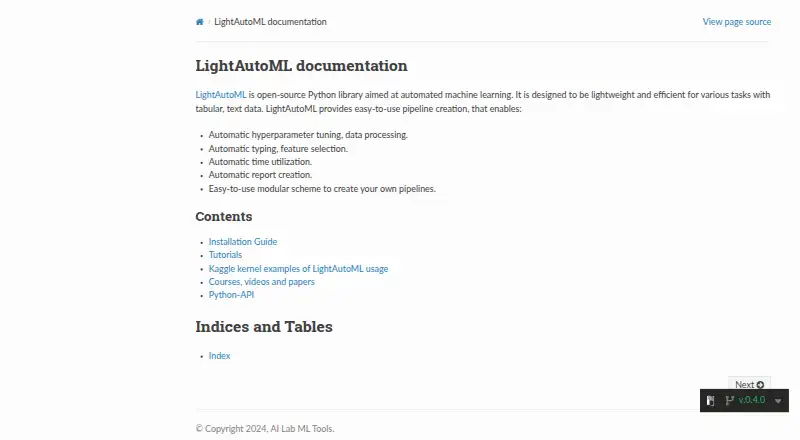
What LightAutoML is
LightAutoML is an open-source Python library for automated machine learning on tabular and text data. It supports binary and multiclass classification, as well as regression, through ready-made tabular, text, and WhiteBox presets or custom modular pipelines. Pipeline creation can automate data processing and typing, feature selection, hyperparameter tuning, time utilization, and report creation. Documented model classes include linear models, LightGBM and CatBoost boosted trees, neural networks, and a WhiteBox scorecard model. The basic tutorial says it can handle missing values and outliers automatically. Optional installation extras cover NLP, computer vision, and reports, while a tutorial demonstrates a SQL data source. The library is installable from PyPI with `pip install lightautoml` and is licensed under Apache License, Version 2.0. It is intended to help data scientists and analysts reduce routine data preparation and model selection work. The current package handles datasets with independent samples in each row; support for multitable datasets and sequences is a work in progress.
Good
- Supports classification and regression tasks.
- Offers ready-made presets and custom pipelines.
- Can automatically handle missing values and outliers.
- Open source under Apache License, Version 2.0.
Watch out
- Multitable datasets are still a work in progress.
- Sequence dataset support is still a work in progress.
- No security or compliance claims are provided.
Who it suits
LightAutoML suits data scientists and analysts working with tabular or text data who want to automate parts of model and pipeline creation. Its current dataset support is limited to independent samples in each row.
Verdict
LightAutoML offers automated pipelines and multiple model types for tabular and text machine learning. Its current data handling is limited to independent samples in each row, so multitable and sequence datasets are not yet supported.
Plans and prices
From LightAutoML's own pricing page, checked 29 Sep 2026.
| Plan | Price | What it gives you |
|---|---|---|
| LightAutoML | Free | Open-source Python library · installable from PyPI · Apache License 2.0 |
The facts
Each one read from LightAutoML's own pages, with the date it was checked.
What it does
- Automation
- Its pipeline creation supports automatic hyperparameter tuning, data processing, typing, feature selection, time utilization, and report creation.checked 29 Sep 2026
- Data handling
- The basic tutorial says LightAutoML can handle missing values and outliers automatically.checked 29 Sep 2026
- Dataset limits
- The repository says the current package handles datasets with independent samples in each row, while multitable datasets and sequences are a work in progress.checked 29 Sep 2026
- Installation
- The documentation says to install LightAutoML from PyPI with `pip install lightautoml`.checked 29 Sep 2026
- Integrations
- The project offers optional installation extras for NLP, computer vision, and reports, and its tutorial demonstrates a SQL data source.checked 29 Sep 2026
- Intended users
- The maker describes LightAutoML as a framework created by Sber AI Lab to help data scientists and analysts reduce routine data preparation and model selection work.checked 29 Sep 2026
- License
- The repository states that the project is licensed under Apache License, Version 2.0.checked 29 Sep 2026
- Models
- Documented model classes include linear models, LightGBM and CatBoost boosted trees, neural networks, and a WhiteBox scorecard model.checked 29 Sep 2026
- Pipeline options
- The documentation describes ready-made tabular, text, and WhiteBox presets, plus modular custom pipeline creation.checked 29 Sep 2026
- Purpose
- LightAutoML is an open-source Python library for automated machine learning on tabular and text data.checked 29 Sep 2026
- Security
- The opened project documentation and repository pages provide no security or compliance claims.checked 29 Sep 2026
- Support
- The repository directs users to its Slack community or Telegram group for advice and GitHub issues for bug reports and feature requests.checked 29 Sep 2026
- Tasks
- The project README lists binary classification, multiclass classification, and regression as supported model creation tasks.checked 29 Sep 2026
The full review of LightAutoML
LightAutoML is a free, open-source Python library for automating machine-learning pipelines on tabular and text data. It is best suited to data scientists and analysts who want to reduce routine preparation and model selection while retaining control over pipeline design. Its breadth is useful for independent-row datasets, but it is not a fit for multitable or sequence data.
Overview
LightAutoML automates data processing and typing, feature selection, hyperparameter tuning, time utilization, and report creation. That combination can shorten the path from a dataset to a model for common classification and regression tasks, without requiring users to assemble every step themselves. It remains a Python library rather than a turnkey service, so users should expect to work in a code-oriented workflow.
It installs from PyPI with pip install lightautoml and is licensed under Apache License 2.0. The project points users to its Slack community or Telegram group for advice, and to GitHub issues for bug reports and feature requests.
Key features
Presets and custom pipelines
Ready-made tabular, text, and WhiteBox presets provide a faster starting point, while modular custom pipeline creation gives experienced users room to tailor a workflow. That flexibility is valuable when a preset is not quite right, but makes LightAutoML less suitable for people looking for a no-code modeling interface.
Models and data preparation
Documented model classes span linear models, LightGBM and CatBoost boosted trees, neural networks, and a WhiteBox scorecard model. The basic tutorial says the library handles missing values and outliers automatically, reducing some routine cleanup. Supported model-creation tasks include binary and multiclass classification and regression.
Integrations and scope
Optional installation extras cover NLP, computer vision, and reports, and a tutorial demonstrates a SQL data source. These broaden its workflow options, but do not change the central data constraint: each row must represent an independent sample. Multitable datasets and sequences are still a work in progress, making the library a poor choice for those data shapes.
Pricing
LightAutoML is free and open source. The LightAutoML plan costs free and includes the open-source Python library, PyPI installation, and Apache License 2.0. There is no free trial because the library is already free; no paid tier, seat cap, or usage quota is stated. This is a strong fit for teams comfortable running a Python library, rather than buyers seeking a hosted commercial service.
Platforms
LightAutoML supports Linux, macOS, Windows, self-hosted use, and web. Its workflow interface is both, so it can suit code-centered work as well as web workflows; the product is delivered as a Python library installable from PyPI.
Who it's for
Data scientists and analysts who need automated preparation and model selection for tabular or text datasets are the clearest audience. It is particularly compelling when they want a choice of model families and the option to move beyond presets into custom pipelines. Teams working with multitable or sequential data should look elsewhere, as should readers who need explicit security or compliance assurances.
Pros and cons
- Broad automation: typing, processing, feature selection, tuning, time utilization, and reporting can reduce repetitive pipeline work.
- Useful model range: linear models, boosted trees, neural networks, and a scorecard model give users multiple approaches for supported tasks.
- Flexible starting points: tabular, text, and WhiteBox presets coexist with modular custom pipelines.
- Important data-shape limit: multitable and sequence datasets are not yet supported, narrowing its usefulness for those projects.
- Code-oriented delivery: Python installation and custom pipeline flexibility suit technical users, not those seeking a no-code product.
Alternatives
FEDOT is another free, open-source AutoML framework, with API, Linux, macOS, self-hosted, and Windows platforms and a BSD 3-Clause license; choose it when that framework or platform mix better fits your setup.
AutoGluon is a free Apache 2.0 Python library for Linux, macOS, self-hosted, and Windows; it is a straightforward alternative if you want another open-source library in that environment.
AutoKeras is a free Python package installed with pip for Linux, macOS, self-hosted, and Windows. Consider it when a pip-installed package is the priority.
BigML offers a free plan with unlimited tasks and storage, but limits each task to a 16 MB dataset, two parallel tasks, and one user. Its web and API options and freemium model may suit readers who prefer a service and can work within those caps.
Amazon SageMaker Autopilot is a paid API and web option with a free trial and pay-as-you-go pricing; consider it if those access and billing terms suit your project.
Auto-PyTorch is a free, Linux and self-hosted option developed by the AutoML Groups of the University of Freiburg and Hannover; choose it if that project and platform scope match your needs.
JADBio has a free Basic plan with one seat, three projects, 50 MB upload, 500 MB storage, and one model export, plus a paid Team plan at $2,199 a year. Its web, API, and self-hosted options may appeal if you prefer a quota-based plan structure.
EvalML is a free option for Linux, macOS, Windows, API, and self-hosted environments; consider it as another no-cost alternative.
Browse the AutoML Software category for more options.
Verdict
Choose LightAutoML if you are a data scientist or analyst who wants a free, customizable pipeline for tabular or text data, with several model families and automated preparation in one Python library. Its main reason to look elsewhere is decisive: projects built around linked tables or sequences fall outside its current data model.
Getting started
- Install Python package from PyPI with `pip install lightautoml`.
- Choose a tabular, text, or WhiteBox preset, or build a modular custom pipeline.
- Use the project's Slack community or Telegram group for advice, or GitHub issues for bugs and feature requests.
Limits worth knowing
The current package handles datasets with independent samples in each row; multitable datasets and sequences are still a work in progress.
Questions
How much does LightAutoML cost?
The listed plan is free at no cost, and the project is open source.
Which tasks does it support?
The project README lists binary classification, multiclass classification, and regression.
What platforms are listed?
Linux, macOS, Windows, web, and self-hosted are listed.
Is LightAutoML open source?
Yes. The repository states that it is licensed under Apache License, Version 2.0.
How do I install it?
The documentation gives the PyPI command `pip install lightautoml`.
What data can the current package handle?
It handles datasets with independent samples in each row. Multitable datasets and sequences are a work in progress.
Alternatives to LightAutoML
- 1
BigML
Free planWebAPImacOSSelf-hosted7.7From $10,000 a year - 2
AutoKeras
Free planOpen sourceAPILinuxmacOSSelf-hosted7.3Free plan - 3
MLJAR AutoML
Free planWebLinuxmacOSSelf-hosted7.1From $20 a month - 4

Obviously AI
Free planWebAPI7.1Free plan - 5

Amazon SageMaker Autopilot
Free planWebAPI6.9Free plan - 6
FEDOT
Free planAPILinuxmacOSSelf-hosted6.8Free plan