AutoKeras
AutoKeras is a free, open-source AutoML system based on Keras, designed to make machine learning accessible through code.
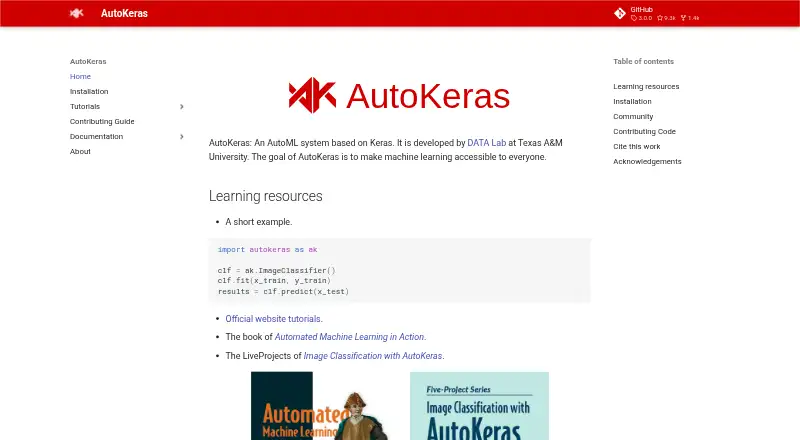
What AutoKeras is
AutoKeras is a free, open-source AutoML system based on Keras, designed to make machine learning accessible through code. It supports image and text classification and regression, along with classification and regression for structured data. Documentation also includes a tutorial for multi-task or multimodal datasets. Users can assemble custom models from AutoKeras blocks and let the system search for detailed configurations. Image workflows allow users to set architecture type, normalization, and data augmentation, or leave those choices to automatic tuning. The best model found can be exported as a Keras Model. AutoKeras is installed as a Python package with pip and supports Linux, macOS, Windows, and self-hosted use. Its installation guide supports Python 3 and recommends PyTorch version 2.3.0 or later when using the PyTorch backend. By default, the final 20% of training data is used for validation, though users can set another split or supply validation data. Model selection uses validation loss by default, with options to customize metrics and objectives. The project points users to GitHub Discussions for questions.
Good
- Supports image, text, and structured data tasks.
- Can export the best model as a Keras Model.
- Allows custom metrics and objectives.
- Can continue a previous fit from directory contents.
Watch out
- Workflow interface is code-based.
- PyTorch backend recommends version 2.3.0 or later.
Who it suits
AutoKeras suits developers and machine-learning practitioners who want automated model selection within a code-based workflow. It supports several data types and allows users to customize model blocks and training validation settings.
Verdict
AutoKeras offers model search and export for users building machine-learning workflows in Python. Its code-based setup provides customization, while users should account for the stated backend recommendation and default validation split.
Plans and prices
From AutoKeras's own pricing page, checked 4 Oct 2026.
| Plan | Price | What it gives you |
|---|---|---|
| AutoKeras | Free | Python package installed with pip |
| Open-source library | Free | Install locally with pip · no hosted-service limits stated |
The facts
Each one read from AutoKeras's own pages, with the date it was checked.
What it does
- Community funding
- Open Collective reports $2,065.59 raised and $205.67 disbursed for AutoKeras.checked 15 Oct 2026
- Community size
- Open Collective lists 32 contributors.checked 15 Oct 2026
- Custom search spaces
- Users can connect built-in blocks or implement their own Block subclasses to customize the search space.checked 15 Oct 2026
- Deployment ecosystem
- The paper states exported models can be deployed through TensorFlow ecosystem tooling.checked 15 Oct 2026
- Documentation depth
- The documentation includes task tutorials, API reference pages, customization guidance, export instructions and an FAQ.checked 15 Oct 2026
- Funding
- Texas A&M reported that the project had been funded by DARPA through an AFRL contract.checked 15 Oct 2026
- Image classification
- The task API supports image-classification workflows.checked 15 Oct 2026
- Image features
- Image workflows can configure architecture type, normalization, and data augmentation, or leave choices to be tuned automatically.checked 4 Oct 2026
- Image regression
- The task API supports image-regression workflows.checked 15 Oct 2026
- Installation
- The official installation method is pip install autokeras, with Python 3 required.checked 15 Oct 2026
- Latest package release
- PyPI lists version 3.0.0 as released on November 12, 2025.checked 15 Oct 2026
- Licence
- The source repository and package metadata specify Apache License 2.0.checked 15 Oct 2026
- Limit: structured-data production fit
- The same Reddit discussion reported relying on boosted trees for tabular data and not finding neural-network success in production.checked 15 Oct 2026
- Maintainer
- The package is developed by DATA Lab at Texas A&M University in collaboration with keras-team for version 1.0 and above.checked 4 Oct 2026
- Model design
- Users can build custom models from AutoKeras blocks while letting the system search for detailed configurations.checked 4 Oct 2026
- Model export
- The best searched model can be exported as a Keras model.checked 15 Oct 2026
- Model selection
- AutoKeras uses validation loss by default to select the best model, and supports customized metrics and objectives.checked 4 Oct 2026
- Multimodal
- The documentation includes a tutorial for working with multi-task or multi-modal datasets.checked 4 Oct 2026
- Multi-modal learning
- AutoModel can combine different input types such as images and text.checked 15 Oct 2026
- Multi-task learning
- AutoModel can produce multiple prediction heads, including classification and regression outputs.checked 15 Oct 2026
- Notable news: 2019
- Texas A&M announced AutoKeras as an open-source machine-learning breakthrough on January 22, 2019.checked 15 Oct 2026
- Praise: accessible experimentation
- A Reddit user reported using AutoKeras during early experimentation because cloud AutoML services felt too complicated.checked 15 Oct 2026
The company
- Company location
- The Texas A&M Engineering page identifies the institution in College Station, Texas.checked 15 Oct 2026
- Maker
- The package is developed by DATA Lab at Texas A&M University with Keras-team collaboration.checked 15 Oct 2026
The full review of AutoKeras
Overview
AutoKeras is a Python package for automating parts of machine-learning model design and selection. It is aimed at people comfortable building workflows in code, especially those working with image, text, or structured data. Its appeal is configurable model search at no software cost, rather than a point-and-click workflow.
Key features
The package supports classification and regression for images, text, and structured data. That range makes it a practical option for teams handling several common supervised-learning tasks within Python. Its documentation also includes examples for multi-task and multimodal datasets, although using those capabilities remains part of a code-based workflow.
AutoKeras lets users assemble custom models from its blocks while searching for detailed configurations. For image work, architecture type, normalization, and augmentation can be chosen directly or left to the search process. This offers more control than handing the entire design over to automation, but requires users to understand the model choices they are making.
The best model found can be exported as a Keras Model. By default, AutoKeras reserves the final 20% of training data for validation and selects models by validation loss. Users can set another split, provide validation data themselves, and customize the metric or objective used for selection. When overwrite is false, rerunning the same code continues the previous fit from the directory contents, which is useful for resuming work rather than starting again.
Installation is through the Python package with pip instructions provided by the project. The installation guide supports Python 3 and recommends PyTorch 2.3.0 or later when using the PyTorch backend. Questions are directed to GitHub Discussions. DATA Lab at Texas A&M University develops the package with keras-team for version 1.0 and above.
Pricing
AutoKeras is free and open source. The AutoKeras plan costs nothing and consists of the Python package installed with pip. There is no paid tier described, so the trade-off is not a restricted entry plan versus an upgrade: users get the package without a software charge, while taking responsibility for running a code-based, self-hosted workflow.
Platforms
AutoKeras is available for Linux, macOS, and Windows, with self-hosted deployment. Its workflow interface is code, so it suits users who want to work in Python rather than manage models through a web interface. Feature engineering and automated model selection are supported.
Who it's for
AutoKeras is a strong fit for Python practitioners who want automated configuration search but still need to shape models from reusable blocks or control image-processing choices. It is less suitable for readers seeking a hosted visual interface or a workflow that avoids package installation and coding.
Pros and cons
- Pros: It covers image, text, and structured-data classification and regression in one package, reducing the need to switch tools across these task types.
- Pros: Users can combine custom blocks with automated search, then export the selected model as a Keras Model.
- Pros: The free, open-source package supports resuming a fit and changing validation and model-selection settings.
- Cons: The code-only, self-hosted approach puts setup and workflow management on the user; it is not a web-based option.
- Cons: The default validation split uses the last 20% of training data, so users who need a different split must configure one or provide validation data.
- Cons: The installation guide recommends PyTorch 2.3.0 or later for the PyTorch backend, a consideration for users planning that setup.
Alternatives
AutoML Software is a broader category directory for comparing tools across the field.
Consider FEDOT for another free, open-source AutoML framework available on Linux, macOS, Windows, and self-hosted setups, as well as through an API.
LightAutoML is another free Python library installable from PyPI, with Linux, macOS, Windows, web, and self-hosted platform options.
MLJAR AutoML offers a free open-source Python package, and also a separate Free plan with 50 prompts per month and 10 published co…; consider it when those plan options and its web availability fit your workflow.
AutoGluon is another free, open-source Python library for Linux, macOS, Windows, and self-hosted use.
Choose BigML if you prefer a web or API service: its free monthly plan includes unlimited tasks and storage, but caps datasets at 16 MB per task, allows two parallel tasks, and is limited to one user.
Amazon SageMaker Autopilot is a paid API and web option with pay-as-you-go pricing and no minimum fees or upfront commitments.
Auto-PyTorch is a free, self-hosted option for Linux, developed by the AutoML Groups of the University of Freiburg and Hannover.
JADBio suits readers looking for a web-accessible or API-based option; its free Basic plan is limited to one seat, three projects, 50 MB uploads, 500 MB storage, and one model export.
Verdict
Choose AutoKeras if you work in Python and want no-cost model search with room to define parts of the architecture and export the result as a Keras Model. Its main strength is that balance of automation and control across several data types. Look elsewhere if you need a visual hosted workflow or want to avoid managing a self-hosted package.
Alternatives to AutoKeras
- 1
BigML
Free planWebAPImacOSSelf-hosted7.7From $10,000 a year - 2
MLJAR AutoML
Free planWebLinuxmacOSSelf-hosted7.1From $20 a month - 3

Obviously AI
Free planWebAPI7.1Free plan - 4

Amazon SageMaker Autopilot
Free planWebAPI6.9Free plan - 5
FEDOT
Free planAPILinuxmacOSSelf-hosted6.8Free plan - 6
JADBio
Free planWebAPISelf-hosted6.7Free plan