
AutoGluon
AutoGluon is an open-source Python library that automates machine learning for tabular data, time series, and multimodal tasks.
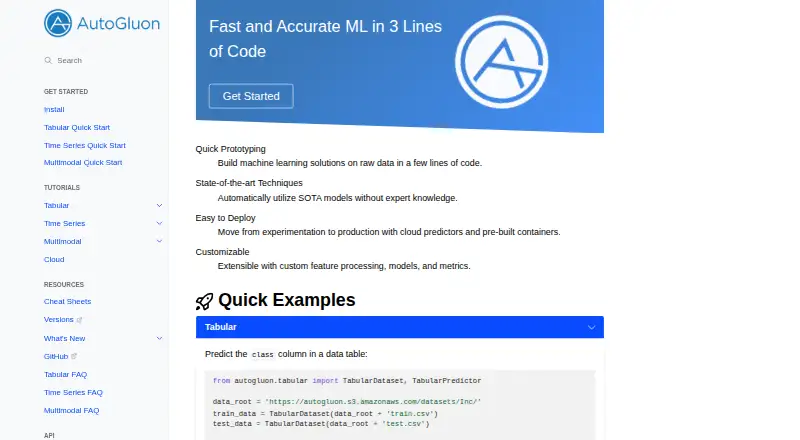
What AutoGluon is
AutoGluon is an open-source Python library that automates machine learning for tabular data, time series, and multimodal tasks. It can train classification and regression models from tables while handling data cleaning, feature engineering, hyperparameter tuning, and model selection. Its TimeSeriesPredictor builds probabilistic forecasts for multiple series from historical data and related covariates. AutoMM reduces manual work when adapting foundation models to specialized data. Documentation examples cover image and text prediction, object detection, image segmentation, document prediction, entity extraction, and semantic matching. The library can use models from Hugging Face, TIMM, and MMDetection collections, and its forecasting methods include ETS, ARIMA, LightGBM, DeepAR, Temporal Fusion Transformer, and Chronos. It requires Python 3.10 through 3.13 and supports Linux, macOS, and Windows. GPU use is not supported on macOS. AutoGluon is available under the Apache 2.0 license; the library itself is free and open source. Cloud deployment options are described, though SageMaker compute and S3 storage are billed to the user's AWS account.
Good
- Automates cleaning, feature engineering, tuning, and model selection.
- Creates probabilistic forecasts across multiple time series.
- Includes examples for image, text, and document tasks.
- Free, open-source Apache 2.0 library.
Watch out
- GPU use is not supported on macOS.
- Requires Python 3.10 through 3.13.
- SageMaker compute and S3 storage incur AWS charges.
Who it suits
AutoGluon suits developers and data teams who want automated model building for tabular, time-series, or multimodal data. GPU users should plan to work on Linux or Windows rather than macOS.
Verdict
AutoGluon covers several machine-learning workflows, including tabular prediction, forecasting, and multimodal tasks. It is a free option for Python users, with macOS GPU use as a notable limitation.
Plans and prices
From AutoGluon's own pricing page, checked 3 Oct 2026.
| Plan | Price | What it gives you |
|---|---|---|
| AutoGluon | Free | Open-source Python library · Apache 2.0 license |
The facts
Each one read from AutoGluon's own pages, with the date it was checked.
Money
- Cloud cost
- AutoGluon-Cloud is described as a free wrapper, while SageMaker compute and S3 storage are billed to the user's AWS account.checked 3 Oct 2026
What it does
- Deployment
- The project points to AutoGluon Cloud and deep learning containers for cloud training and deployment, and describes SageMaker Autopilot as a managed AutoGluon experience.checked 3 Oct 2026
- Forecasting models
- Time-series forecasting combines methods including ETS and ARIMA from StatsForecast, LightGBM, DeepAR and Temporal Fusion Transformer from GluonTS, and Chronos.checked 3 Oct 2026
- GPU limitation
- GPU usage is not supported on macOS; the installation guide directs users to Linux or Windows for GPU use.checked 3 Oct 2026
- Install requirements
- AutoGluon requires Python 3.10 through 3.13 and supports Linux, macOS, and Windows.checked 3 Oct 2026
- Integrations
- AutoMM adapts models from Hugging Face, TIMM, and MMDetection model zoos.checked 3 Oct 2026
- License
- The AutoGluon library is licensed under Apache 2.0.checked 3 Oct 2026
- Multimodal
- AutoMM reduces manual work in preprocessing, model selection, and fine-tuning to adapt foundation models to domain-specific data.checked 3 Oct 2026
- Purpose
- AutoGluon automates machine learning for data such as tables and time series, helping users build predictive models with a few lines of code.checked 3 Oct 2026
- Security reporting
- The contribution guide asks users to report potential security issues to AWS/Amazon Security through its vulnerability reporting page rather than filing a public GitHub issue.checked 3 Oct 2026
- Support
- The project welcomes bug reports and feature requests through its GitHub issue tracker.checked 3 Oct 2026
- Supported tasks
- The documentation includes image and text prediction, object detection, image segmentation, document prediction, entity extraction, and semantic matching examples.checked 3 Oct 2026
- Tabular modeling
- AutoGluon can train classification and regression models from tabular data while handling data cleaning, feature engineering, hyperparameter optimization, and model selection.checked 3 Oct 2026
- Time series
- Its TimeSeriesPredictor trains multiple models to generate probabilistic forecasts for multiple time series using historical data and related covariates.checked 3 Oct 2026
The company
- Founded
- 2019checked 28 Sep 2026
- SageMaker
- AutoGluon is pre-installed in all releases of Amazon SageMaker Distribution.checked 3 Oct 2026
The full review of AutoGluon
AutoGluon is an open-source Python library that automates model building across tabular data, time series, and multimodal tasks. It suits Python users who want automated modeling without a software fee, especially those working with predictive or forecasting workflows. Its range is a strength; macOS users who need GPU acceleration should look elsewhere.
Overview
AutoGluon aims to reduce the work between raw data and predictive models. For tabular classification and regression, it handles data cleaning, feature engineering, hyperparameter optimization, and model selection. That makes it a practical option for users who want a strong automated baseline without assembling each stage themselves, though the workflow remains centered on Python.
Beyond tables, it supports forecasting across multiple time series and multimodal prediction tasks. The breadth is useful when projects span different data types, but AutoGluon is a library rather than a ready-made desktop application.
Key features
Automated tabular modeling
AutoGluon trains classification and regression models while automating several demanding parts of the pipeline, from data preparation through model selection. That can save implementation effort, while users who need full control over each modeling choice may prefer a more manual workflow.
Time-series forecasts
TimeSeriesPredictor trains multiple models to produce probabilistic forecasts for multiple series, using historical observations and related covariates. Its model mix includes ETS and ARIMA from StatsForecast, LightGBM, DeepAR and Temporal Fusion Transformer from GluonTS, and Chronos. This breadth suits forecasting work where uncertainty and multiple related series matter.
Multimodal tasks
AutoMM reduces manual preprocessing, model selection, and fine-tuning when adapting foundation models to domain-specific data. Examples cover image and text prediction, object detection, image segmentation, document prediction, entity extraction, and semantic matching. It can adapt models from Hugging Face, TIMM, and MMDetection, making it relevant to users who need more than conventional tabular modeling.
Pricing
AutoGluon costs nothing. The library is open source under the Apache 2.0 license, with no trial required. This is a strong fit for individuals and teams comfortable installing and operating a Python library; there is no paid tier to unlock in the listed plan.
Cloud use can still incur costs: AutoGluon-Cloud is described as a free wrapper, but SageMaker compute and S3 storage are billed to the user's AWS account. AutoGluon is pre-installed in all releases of Amazon SageMaker Distribution, and SageMaker Autopilot is described as a managed AutoGluon experience.
Platforms
AutoGluon supports Linux, macOS, and Windows and requires Python 3.10 through 3.13. It can be self-hosted, and the project points to AutoGluon Cloud and deep learning containers for cloud training and deployment. GPU use is not supported on macOS, so users who need GPU acceleration must use Linux or Windows.
Who it's for
Choose AutoGluon if you work in Python and want automated workflows for tabular prediction, time-series forecasting, or multimodal tasks without paying for the library. It is particularly well matched to users who value broad modeling coverage and can manage their own development environment. It is less suitable for readers seeking a graphical, non-coding product or macOS GPU support.
Pros and cons
- Pro: One library covers tabular, time-series, and multimodal workflows, reducing the need to switch tools across these task types.
- Pro: Automated cleaning, feature engineering, tuning, and model selection reduce pipeline work for tabular prediction.
- Pro: The open-source Apache 2.0 library has a free plan.
- Con: Python 3.10 through 3.13 is required, so it is not a plug-and-play choice for non-coders.
- Con: macOS GPU use is unsupported, ruling it out for users who require local GPU acceleration on that platform.
- Con: Cloud compute and storage through SageMaker still generate AWS charges despite the free wrapper.
Alternatives
Browse AutoML Software or Predictive Analytics Software for more options in those categories.
- BigML is worth considering for a web- and API-accessible option with a free monthly plan; its FREE plan limits datasets to 16 MB per task, allows two parallel tasks, and includes one user.
- FEDOT is another free open-source AutoML framework, with Linux, macOS, Windows, and self-hosted support.
- JADBio offers a web and API route with a free Basic plan capped at one seat, three projects, 50 MB uploads, 500 MB storage, and one model export.
- H2O Driverless AI is a commercial-license option for readers willing to contact sales rather than use a free plan.
- FLAML is another free option for users seeking an AutoML tool across Linux, macOS, Windows, API, or self-hosted environments.
- LightAutoML is a free, Apache 2.0 Python library installable from PyPI, making it a comparable open-source route.
- Auto-PyTorch is a free alternative for Linux or self-hosted environments.
- DataRobot may suit teams wanting a self-service SaaS trial, with up to five team members and an account-specific number of shared modeling workers for 30 days.
Verdict
AutoGluon is a compelling free choice for Python users who want automated modeling across tables, time series, and multimodal data. Its broad workflow coverage and open-source license are the main reasons to choose it. Look elsewhere if you need macOS GPU support, a non-coding interface, or cloud usage without separate AWS compute and storage charges.
Getting started
- Visit the AutoGluon website
- Install Python 3.10 through 3.13
- Install the library on Linux, macOS, or Windows
- Choose tabular, time-series, or multimodal workflows
- Use AutoGluon Cloud or deep learning containers for cloud deployment
- Use SageMaker Distribution for a pre-installed environment
Limits worth knowing
The library is free, but macOS cannot use GPUs. When using SageMaker, compute and S3 storage charges are billed to the user’s AWS account.
Questions
Is AutoGluon free?
Yes. AutoGluon is an open-source Python library under the Apache 2.0 license, listed as free.
Which operating systems and Python versions are supported?
It supports Linux, macOS, and Windows with Python 3.10 through 3.13.
Can AutoGluon use a Mac GPU?
No. The installation guidance directs GPU users to Linux or Windows.
What machine-learning tasks does it cover?
Examples include tabular classification and regression, time-series forecasting, image and text prediction, object detection, segmentation, document prediction, entity extraction, and semantic matching.
Are cloud services included?
AutoGluon Cloud is described as a free wrapper, while SageMaker compute and S3 storage are charged to the user’s AWS account.
Alternatives to AutoGluon
- 1
BigML
Free planWebAPImacOSSelf-hosted7.7From $10,000 a year - 2
AutoKeras
Free planOpen sourceAPILinuxmacOSSelf-hosted7.3Free plan - 3
MLJAR AutoML
Free planWebLinuxmacOSSelf-hosted7.1From $20 a month - 4

Obviously AI
Free planWebAPI7.1Free plan - 5

Amazon SageMaker Autopilot
Free planWebAPI6.9Free plan - 6
FEDOT
Free planAPILinuxmacOSSelf-hosted6.8Free plan