FLAML
FLAML is a free, MIT-licensed library for automated machine learning and tuning.
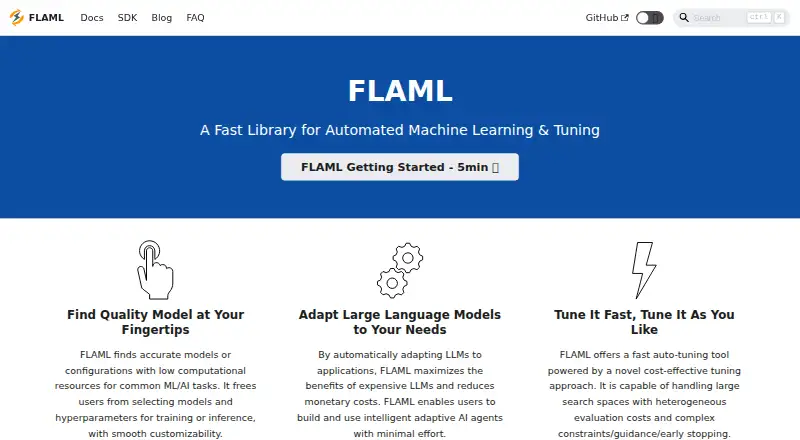
What FLAML is
FLAML is a free, MIT-licensed library for automated machine learning and tuning. It aims to find accurate models or configurations for common ML and AI work using low computational resources, and can adapt large language models to applications to reduce monetary costs. Its AutoML tasks include classification, regression, time-series and panel forecasting, learning to rank, and sequence classification. The flaml.default package recommends data-dependent hyperparameter defaults without runtime tuning. Its tuning tools handle large search spaces, differing evaluation costs, constraints, guidance, and early stopping; users can also restrict which learners are tried or tune a customized learner. Python installation requires version 3.10 or later and, for the latest version, earlier than 3.14. Optional integrations include OpenAI models, CatBoost, Prophet, Hugging Face Transformers, Ray, and Spark, among others. Ray or Spark can be used for parallel tuning, but not together in one job; GPU training is not supported with Spark as the backend. FLAML also has a .NET implementation through ML.NET and supports MLflow logging and Azure Machine Learning integration.
Good
- Supports several AutoML task types.
- Tuning can stop early.
- Users can restrict or customize learners.
- MIT-licensed and free.
Watch out
- Python requires version 3.10 or newer.
- Spark backend does not support GPU training.
- Ray and Spark cannot run together in one tuning job.
Who it suits
FLAML may suit developers and data practitioners seeking automated model selection or hyperparameter tuning in Python or .NET. Its task support includes forecasting, ranking, and sequence classification.
Verdict
FLAML offers task-oriented AutoML and tuning options for users who want to control learners, constraints, and compute approaches. Check the Python version requirement and Spark limitation if those apply to your workflow.
The facts
Each one read from FLAML's own pages, with the date it was checked.
What it does
- Auto-tuning
- Its tuning approach handles large search spaces, heterogeneous evaluation costs, complex constraints, guidance, and early stopping.checked 1 Oct 2026
- Availability
- The repository identifies FLAML as MIT-licensed open-source software.checked 2 Oct 2026
- Community support
- The project provides community support through Discord, issues, discussions, and contributions.checked 1 Oct 2026
- Customization
- Users can restrict the learners FLAML tries or tune a customized learner.checked 2 Oct 2026
- Distributed integrations
- FLAML provides optional Ray and Spark distributed tuning, plus NNI, BlendSearch, and Azure Synapse options.checked 1 Oct 2026
- Installation
- The Python library can be installed with pip or conda, and optional packages enable features such as AutoML, Hugging Face Transformers, Ray, and Spark.checked 2 Oct 2026
- Integrations
- The documentation describes MLflow logging and integration with Azure Machine Learning.checked 2 Oct 2026
- License
- The repository is distributed under the MIT License, permitting users to use, copy, modify, publish, distribute, sublicense, and sell the software subject to its conditions.checked 1 Oct 2026
- LLM adaptation
- FLAML automatically adapts large language models to applications to reduce monetary costs.checked 1 Oct 2026
- Microsoft Fabric
- The repository says FLAML supports AutoML and hyperparameter tuning in Microsoft Fabric Data Science.checked 2 Oct 2026
- Model integrations
- Optional installations include OpenAI models, CatBoost, Vowpal Wabbit, Prophet, statsmodels, and Hugging Face Transformers.checked 1 Oct 2026
- .NET support
- FLAML has a .NET implementation in the cross-platform ML.NET framework, including Model Builder, the ML.NET CLI, and Microsoft.ML.AutoML.checked 1 Oct 2026
- Parallel tuning
- FLAML supports Ray and Spark backends for parallel tuning, but a tuning job cannot use both.checked 2 Oct 2026
- Purpose
- FLAML automates machine learning model selection and hyperparameter tuning with low computational resources.checked 2 Oct 2026
- Python requirement
- The installation documentation requires Python version 3.10 or newer.checked 1 Oct 2026
- Resource efficiency
- It finds accurate models or configurations for common ML/AI tasks with low computational resources.checked 1 Oct 2026
- Runtime requirement
- The repository specifies Python 3.10 or later and earlier than 3.14 for its latest version.checked 2 Oct 2026
- Security reporting
- The project directs security vulnerability reports to Microsoft Security Response Center for coordinated disclosure rather than public issues.checked 1 Oct 2026
- Spark limitation
- GPU training is not supported when Spark is used as the parallel backend.checked 1 Oct 2026
- Support
- The official site links to a Discord community.checked 2 Oct 2026
- Supported tasks
- Task-oriented AutoML supports classification, regression, time-series forecasting, panel forecasting, learning to rank, and sequence classification.checked 1 Oct 2026
- Tasks
- The documentation lists classification, regression, forecasting, and ranking among the supported AutoML tasks.checked 2 Oct 2026
- Tuning
- Its tuning tool handles large search spaces with varied evaluation costs, constraints, guidance, and early stopping.checked 2 Oct 2026
- Zero-shot AutoML
- The flaml.default package recommends data-dependent hyperparameter defaults without runtime tuning.checked 1 Oct 2026
Alternatives to FLAML
- 1
BigML
Free planWebAPImacOSSelf-hosted7.7From $10,000 a year - 2
AutoKeras
Free planOpen sourceAPILinuxmacOSSelf-hosted7.3Free plan - 3
MLJAR AutoML
Free planWebLinuxmacOSSelf-hosted7.1From $20 a month - 4

Obviously AI
Free planWebAPI7.1Free plan - 5

Amazon SageMaker Autopilot
Free planWebAPI6.9Free plan - 6
FEDOT
Free planAPILinuxmacOSSelf-hosted6.8Free plan