
FakerForge
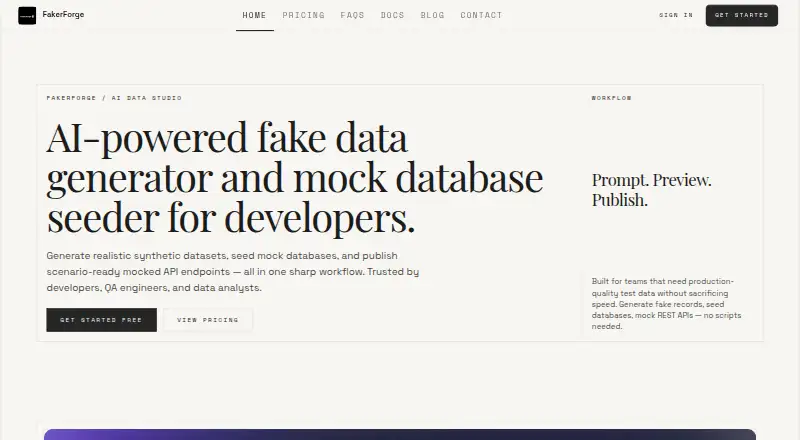
FakerForge generates synthetic datasets, seeds mock databases, and publishes mocked API endpoints.
What FakerForge is
FakerForge generates synthetic datasets, seeds mock databases, and publishes mocked API endpoints. Users can upload SQL schemas or migration files, choose row counts and field rules, and generate records that respect schema relationships. Supported databases or destinations include MySQL, PostgreSQL, SQLite, MariaDB, MongoDB, and BigQuery. Exports are available as SQL, JSON, CSV, and XML. Mock endpoints can return configurable fake JSON payloads for success states, errors, edge cases, and timeouts. Its open-source CLI can inspect local or private PostgreSQL and MySQL databases and push generated data into their tables; installation options cover Linux, macOS, and Windows on amd64 and arm64. The site says CLI credentials stay in the operating system keychain and only schema shape is uploaded. FakerForge describes its generated records as synthetic and containing no real names, email addresses, or phone numbers. Usage can be capped by plan limits, and high request volume may be throttled or rejected. The service is aimed at developers, QA engineers, data analysts, and product teams.
Good
- Generates records that follow uploaded schema relationships.
- Exports SQL, JSON, CSV, and XML.
- Mock endpoints cover errors and edge cases.
- CLI credentials stay in the operating system keychain.
Watch out
- Generation and mock actions can be capped by plan limits.
- High request volume may be throttled or rejected.
- The CLI database support listed covers PostgreSQL and MySQL.
Who it suits
FakerForge suits developers, QA engineers, data analysts, and product teams that need synthetic datasets, mock databases, or API responses. Its CLI may suit users working with local or private PostgreSQL and MySQL databases.
Verdict
FakerForge combines schema-based synthetic data generation with database seeding and API mocking. Check the plan limits and request-volume constraints against the amount of test data and mock traffic needed.
Plans and prices
From FakerForge's own pricing page, checked 15 Oct 2026.
| Plan | Price | What it gives you |
|---|---|---|
| Free | Free | 1 database · 50,000 AI tokens · 100 rows/table · 10 tables/database · 500 API requests · 1 mock API · 5 endpoints/mock · 2 scenarios/endpoint · 500 mock requests · per month |
| Basic | $10 a month | 5 databases · 1,000,000 AI tokens · 1,000 rows/table · 20 tables/database · 10,000 API requests · 10 mock APIs · 50 endpoints/mock · 10 scenarios/endpoint · 10,000 mock requests · per month |
| Pro | $20 a month | 20 databases · 5,000,000 AI tokens · 100,000 rows/table · 50 tables/database · 50,000 API requests · 50 mock APIs · 100 endpoints/mock · 50 scenarios/endpoint · 100,000 mock requests · per month |
The facts
Each one read from FakerForge's own pages, with the date it was checked.
What it does
- AI data sharing
- The privacy policy says schemas and messages may be shared with AI providers such as OpenAI to provide assistant features.checked 15 Oct 2026
- AI generation
- The service generates names, emails, addresses, timestamps, UUIDs and custom field types using AI-assisted mappings.checked 15 Oct 2026
- API limit behavior
- Rows are capped by plan limits, successful calls consume quota, and exceeding the API allowance returns HTTP 429.checked 15 Oct 2026
- API mocking
- Mock endpoints support success, error, edge-case and timeout scenarios with configurable JSON payloads.checked 15 Oct 2026
- Audience
- The site identifies developers, QA engineers, data analysts, and product teams as users of FakerForge.checked 7 Oct 2026
- CLI
- The open-source CLI connects to private PostgreSQL or MySQL databases and pushes generated rows directly into tables.checked 15 Oct 2026
- CLI credential handling
- The CLI stores database credentials and API keys in the operating-system keychain and sends only schema shape to FakerForge.checked 15 Oct 2026
- CLI credentials
- The site says CLI database credentials stay in the operating system keychain and only schema shape is uploaded.checked 7 Oct 2026
- CLI databases
- The open-source CLI introspects local or private PostgreSQL and MySQL databases and can push generated data into their tables.checked 7 Oct 2026
- Database integrations
- Officially listed database targets include MySQL 5.7/8, PostgreSQL 13–16, SQLite, MariaDB 10/11, MongoDB and BigQuery.checked 15 Oct 2026
- Database support
- The site lists MySQL, PostgreSQL, SQLite, MariaDB, MongoDB, and BigQuery among its supported databases or destinations.checked 7 Oct 2026
- Documented quota limits
- Large row targets can be capped, generation can fail after quota exhaustion, mock creation can stop at plan maximums and high request volume can be throttled or rejected.checked 15 Oct 2026
- Export formats
- Exports include SQL, JSON, CSV, XML, BSON-ready JSON, newline-delimited JSON and Parquet.checked 15 Oct 2026
- Independent package extensibility
- The separate Python project supports custom Faker providers, seeded generation, schema validation and optional NumPy, pandas and YAML extras.checked 15 Oct 2026
- Independent package identity
- A separate PyPI project also named FakerForge describes itself as a Python synthetic-data framework built on Faker; the page provides no link to fakerforge.com.checked 15 Oct 2026
- Independent package licence
- That separate PyPI project declares an MIT licence.checked 15 Oct 2026
- Independent package maturity
- The separate PyPI project is classified as Alpha and lists one maintainer.checked 15 Oct 2026
- Independent package popularity
- The separate GitHub repository shows one star and zero forks.checked 15 Oct 2026
- Independent package release
- PyPI records version 0.2.0 of the separate package as released on October 5, 2026.checked 15 Oct 2026
- Independent package requirement
- That separate PyPI project requires Python 3.10 or newer.checked 15 Oct 2026
- Limit: independent package execution
- The separate Python project states that generation execution is single-threaded.checked 15 Oct 2026
- Limit: independent package relationships
- The separate Python project documents that many-to-many relationships are not supported.checked 15 Oct 2026
- MCP integrations
- The MCP server is described as compatible with GitHub Copilot, Claude Desktop, Cursor, Windsurf and other MCP clients.checked 15 Oct 2026
Where it runs
- CLI platforms
- The CLI is offered through an install script, Homebrew, Go installation and binaries for Linux, macOS and Windows on amd64 and arm64.checked 15 Oct 2026
The full review of FakerForge
FakerForge is a synthetic-data generator that also seeds databases and serves mocked APIs. It suits developers and QA teams who need connected test records alongside controllable API responses. Schema-aware generation is its strongest draw, while plan quotas make the right tier depend on data volume and request traffic.
Overview
Upload a SQL schema or migration file, set row counts and field rules, and FakerForge generates records that respect relationships in the schema. That makes it a practical option for filling structured test databases, rather than creating isolated sample records. Database seeding, exports, and API mocking extend the workflow, although generation and request limits constrain how much a project can do on each plan.
Key features
- Schema-based data generation: Relationship-aware records are useful when tests depend on connected tables. Row and table ceilings, however, set a real boundary on dataset size, particularly on the free tier.
- Database support and exports: Supported databases or destinations include MySQL, PostgreSQL, SQLite, MariaDB, MongoDB, and BigQuery. SQL, JSON, CSV, and XML outputs give teams several ways to move generated records into their workflows.
- API mocking: Fake JSON payloads can be paired with success, error, edge-case, and timeout scenarios. That variety helps QA teams exercise different response paths, but mock-request quotas matter for sustained or busy testing.
- Local database CLI: The open-source CLI can inspect local or private PostgreSQL and MySQL databases and push generated records into their tables. It supports Linux, macOS, and Windows on amd64 and arm64. Credentials remain in the operating system keychain, and only schema shape is uploaded, which can suit teams reluctant to send database credentials to a service.
- MCP integrations and synthetic records: The MCP server works with GitHub Copilot, Claude, Cursor, Windsurf, and other compatible clients. FakerForge describes generated records as fully synthetic, without real names, email addresses, or phone numbers.
- Automated refresh and usage controls: Refresh automation is supported. Generation, API, and mocking actions can be capped by plan, and high request volume may be throttled or rejected, so teams with bursty workloads should account for these constraints.
Pricing
The free plan costs nothing, billed monthly. It allows 1 database, 50,000 AI tokens, 100 rows per table, 10 tables per database, 500 API requests, 1 mock API, 5 endpoints per mock, 2 scenarios per endpoint, and 500 mock requests. It is a useful starting point for a small project, but its row and request ceilings are restrictive for larger datasets or repeated API testing.
BASIC costs $10 a month, billed monthly. It raises the allowances to 5 databases, 1,000,000 AI tokens, 1,000 rows per table, 20 tables per database, 10,000 API requests, 10 mock APIs, 50 endpoints per mock, 10 scenarios per endpoint, and 10,000 mock requests. This is the sensible step up for a small team or project that has outgrown the free quotas.
PRO costs $20 a month, billed monthly. It includes 20 databases, 5,000,000 AI tokens, 100,000 rows per table, 50 tables per database, 50,000 API requests, 50 mock APIs, 100 endpoints per mock, 50 scenarios per endpoint, and 100,000 mock requests. It fits heavier data generation and broader mock coverage, though request caps still make it a poor match for workloads that cannot tolerate throttling or rejection.
Platforms
FakerForge is available through API, Linux, macOS, web, and Windows. The CLI supports Linux, macOS, and Windows on both amd64 and arm64 systems.
Who it's for
Developers and QA engineers can use the schema-aware generation and configurable mock scenarios to prepare structured test environments and exercise API behavior. Data analysts and product teams may also find the exports and automated refresh useful. It is less suited to high-volume projects unless the selected plan's quotas match the expected generation and request load.
Pros and cons
- Pros: Schema relationships carry through generated records, making the output more relevant to structured database tests.
- Pros: Database seeding, multiple export formats, and API mocking bring several test-data tasks together.
- Pros: The CLI can work with local or private PostgreSQL and MySQL databases while keeping credentials in the operating system keychain.
- Cons: The free plan's 100-row table limit and 500 API and mock requests can quickly constrain active projects.
- Cons: Paid plans still impose request limits, and high-volume traffic may be throttled or rejected.
Alternatives
For a broader comparison, see Test Data Management Software and AI Synthetic Data Generators.
- Windocks is worth considering when database images and simultaneous containers are central: its free plan includes a 1 GB database image and one simultaneous container, while the free plan has no support.
- Data Maestro may suit a self-hosted Linux or macOS workflow; its free offering includes a 30-day full trial, then remains limited forever, with 100 rows per export or database push and two saved database connections.
- Metasyn is an option for teams that want a no-cost, open-source Python package under the MIT license.
- MOSTLY AI is another freemium option for teams seeking synthetic-data tooling across API, Linux, self-hosted, and web platforms.
- Tonic Fabricate may appeal to teams that prefer monthly credits: its free plan includes $5 monthly credits, basic exports, Discord support, and Tonic Cloud.
- Mockaroo is a fit for browser-based sample-file generation: its free tier allows 1,000 rows per file, unlimited browser downloads, and 200 API requests per day.
- Faker.js is a no-cost alternative for teams that want an MIT-licensed option for commercial or non-commercial use.
- Synthetic Data Vault offers a freemium alternative with a no-cost community plan.
Verdict
Choose FakerForge when your team needs schema-aware synthetic records, database seeding, and configurable API mocks in one workflow, particularly if its local-database CLI fits your environment. Its free and BASIC tiers provide clear entry points, but look elsewhere if your workload requires request volumes beyond the plan ceilings or cannot accommodate possible throttling.
Getting started
- Visit https://fakerforge.com/ to access FakerForge.
- Choose the FREE plan or a paid plan; BASIC is $10 a month, billed monthly.
- Upload a SQL schema or migration file and set row counts and field rules.
- Choose an available database or destination and generate records.
- Export generated data as SQL, JSON, CSV, or XML, or configure mocked API endpoints.
- For local or private PostgreSQL or MySQL databases, install the CLI for Linux, macOS, or Windows on amd64 or arm64.
Limits worth knowing
The FREE plan includes 1 database, 100 rows per table, 10 tables per database, and 1 mock API with 5 endpoints per mock. Generation, API, and mocking actions can be capped by plan limits; high request volume may be throttled or rejected.
Questions
Does FakerForge have a free plan?
Yes. FREE costs nothing, billed monthly.
What do the paid plans cost?
BASIC is $10 a month and PRO is $20 a month; both are billed monthly.
Which databases and destinations are supported?
The site lists MySQL, PostgreSQL, SQLite, MariaDB, MongoDB, and BigQuery.
What platforms are available?
FakerForge lists API, Linux, macOS, web, and Windows. The CLI install options cover Linux, macOS, and Windows on amd64 and arm64.
Is the CLI open source?
Yes. The CLI is described as open source and can inspect local or private PostgreSQL and MySQL databases.
What are the FREE plan's main limits?
It includes 1 database, 100 rows per table, 10 tables per database, 500 API requests, and 1 mock API. That mock API can have 5 endpoints, 2 scenarios per endpoint, and 500 mock requests.
Alternatives to FakerForge
- 1

Synth Studio
Free planOpen sourceWebAPILinuxmacOS7.5Free plan - 2
Synthehol Dataset
Free planWebAPISelf-hosted7.3From $3,990 a year - 3
SimpleTest
Free planWebAPIExtensionSelf-hosted7.2From $750 a month - 4
SynthEngyne
Free plan7.1Free plan - 5

Tonic Fabricate
Free planWebAPISelf-hosted6.8$29 usage-based - 6

Synthetic Data Vault
Free planAPISelf-hosted6.6From $250 a month