SynthEngyne
SynthEngyne generates synthetic datasets for AI training and development projects.
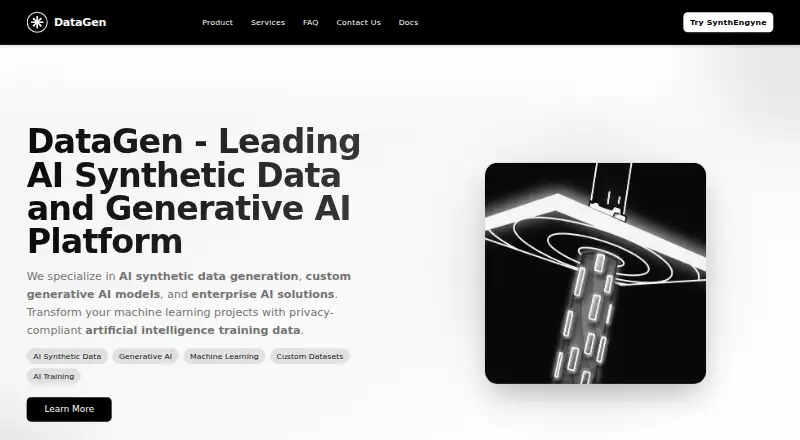
What SynthEngyne is
SynthEngyne generates synthetic datasets for AI training and development projects. It supports text, image, tabular and time-series data, with a workflow for creating dataspaces, generating datasets, then viewing, analyzing and exporting them for AI models. Users can build domain-specific datasets from proprietary documents using adjustable parameters and generation methods. Listed controls include quality checks, validation, deduplication and data cleaning. Processing options include real-time, streaming and batch generation, as well as enterprise-scale processing. Credit use varies by output: text, tabular and time-series generation costs 1 credit per row, while image generation costs 10 credits per image. The free plan provides 1,000 credits each month without a credit card. Paid bundles are one-time purchases, starting with Starter at ₹1,500 and including 30,000 credits; credits do not expire, and dataspaces, datasets and storage are described as unlimited. SynthEngyne is currently described as being in closed alpha, with public availability planned by the end of March 2026.
Good
- Supports four data modalities, including images and time series.
- Free plan provides 1,000 credits monthly without a credit card.
- Credits never expire.
- Lists validation, deduplication and data cleaning.
Watch out
- The service is described as currently in closed alpha.
- Image generation costs 10 credits per image.
- Generated datasets are retained for 30 days by default.
Who it suits
SynthEngyne may suit AI teams seeking synthetic text, image, tabular or time-series data. The maker names healthcare, finance, automotive and retail among industries that may use it.
Verdict
SynthEngyne's format coverage and credit-based bundles offer options for different synthetic-data workloads. Its closed-alpha status is an important availability constraint to check before planning around it.
Plans and prices
From SynthEngyne's own pricing page, checked 8 Oct 2026.
| Plan | Price | What it gives you |
|---|---|---|
| Monthly free credits | Free | No credit card required · text, tabular and time-series: 1 credit per row · images: 10 credits per image · 1,000 credits every month |
| Starter | ₹1,500, paid once | 30,000 credits · 30,000 rows of text/tabular data · 3,000 images · ₹0.05 per credit · One-time purchase; no subscription |
| Popular | ₹3,000, paid once | 60,000 credits · 60,000 rows of text/tabular data · 6,000 images · ₹0.05 per credit · One-time purchase; no subscription |
| Pro | ₹6,000, paid once | 120,000 credits · 120,000 rows of text/tabular data · 12,000 images · ₹0.05 per credit · One-time purchase; no subscription |
| Enterprise | ₹10,000, paid once | 200,000 credits · 200,000 rows of text/tabular data · 20,000 images · ₹0.05 per credit · One-time purchase; no subscription |
The facts
Each one read from SynthEngyne's own pages, with the date it was checked.
What it does
- Audience
- The maker identifies healthcare, finance, automotive, and retail among industries that may use its synthetic data.checked 9 Oct 2026
- Availability
- The Try SynthEngyne page describes the product as in closed alpha and says public availability is planned by the end of March 2026.checked 9 Oct 2026
- Credit limits
- Credits never expire; the page also advertises unlimited dataspaces, datasets, and storage, and custom purchases from ₹100 to ₹1,00,000.checked 9 Oct 2026
- Credit pricing
- The maker states that text, tabular, and time-series generation costs 1 credit per row, while image generation costs 10 credits per image.checked 8 Oct 2026
- Credit usage
- Text, tabular, and time-series data costs 1 credit per row; image generation costs 10 credits per image.checked 9 Oct 2026
- Custom datasets
- It can generate domain-specific datasets from proprietary documents with confidentiality and security protocols.checked 9 Oct 2026
- Data formats
- It supports text, image, tabular, and time-series data generation.checked 9 Oct 2026
- Data location
- The privacy policy says DataGen primarily processes and stores data on servers in India and may transfer it elsewhere with safeguards.checked 8 Oct 2026
- Data retention
- The privacy policy says generated synthetic datasets are retained for 30 days by default and can be deleted earlier from the dashboard.checked 9 Oct 2026
- Dataset workflow
- The described workflow is to create dataspaces, generate datasets, then view, analyze, and export them for AI models.checked 8 Oct 2026
- Privacy policy
- The privacy policy says DataGen does not sell or rent personal data and identifies service providers as recipients under contractual data-processing agreements.checked 8 Oct 2026
- Processing
- The product page describes real-time generation, streaming, batch processing, and enterprise-scale processing.checked 9 Oct 2026
- Product
- SynthEngyne is a platform for generating custom synthetic datasets for AI training.checked 9 Oct 2026
- Quality
- Features include quality control, validation, data cleaning, and deduplication.checked 9 Oct 2026
- Quality controls
- The product page lists quality control, validation, deduplication, and data cleaning capabilities.checked 8 Oct 2026
- Retention
- The privacy policy says generated synthetic datasets are retained for 30 days by default and can be deleted sooner from the dashboard; backups are destroyed within 180 days.checked 8 Oct 2026
- Security
- The privacy policy says the company uses encryption in transit and at rest, role-based access controls, multi-factor authentication, vulnerability assessments, and an incident-response program.checked 9 Oct 2026
- Storage and credit limits
- The pricing page says dataspaces, datasets, and storage are unlimited, credits never expire, and custom purchases range from ₹100 to ₹1,00,000.checked 8 Oct 2026
- Support
- The site provides a contact form and lists [email protected] for messages and privacy requests.checked 9 Oct 2026
- Target industries
- The maker names healthcare, finance, automotive, and retail as industries that can benefit from its synthetic data.checked 8 Oct 2026
- Workflow
- Users can create dataspaces, generate datasets, then view, analyze, and export them for AI models.checked 9 Oct 2026
The company
- Founded
- 2024checked 28 Sep 2026
- Headquarters
- Indiachecked 28 Sep 2026
Money
- Free credits
- The maker advertises 1,000 free credits every month and says no credit card is required.checked 9 Oct 2026
The full review of SynthEngyne
SynthEngyne is a synthetic-data platform for AI training and development, covering text, images, tabular records, and time-series data. It is best suited to teams that need several modalities and prefer one-time credit purchases over subscriptions. Its current alpha-stage access makes it a cautious choice for production plans that require dependable public availability.
Overview
Work is organized into dataspaces: create a space, generate datasets, then view, analyze, and export them for model development. You can build domain-specific data from proprietary documents and adjust generation parameters and methods, which is more useful than a one-size-fits-all generator when a project has specialized terminology or structures.
SynthEngyne describes real-time, streaming, batch, and enterprise-scale processing. That range covers interactive experiments as well as larger jobs. Quality control, validation, deduplication, and data cleaning are included in the workflow, giving teams practical checks before generated data reaches a model pipeline.
The important limitation is access. SynthEngyne is described as being in closed alpha, with public availability planned by the end of March 2026. Organizations needing a generally available service now should treat that as a significant constraint.
Key features
- Four data modalities: Text, image, tabular, and time-series generation support mixed AI projects. The trade-off is consumption: an image costs 10 credits, while each text, tabular, or time-series row costs 1 credit.
- Custom dataset generation: Proprietary documents, configurable parameters, and selectable generation methods support domain-specific datasets for areas such as healthcare, finance, automotive, and retail.
- Generation options: Real-time, streaming, batch, and enterprise-scale processing let teams choose between immediate output and larger scheduled workloads.
- Dataset controls: Validation, quality control, deduplication, and cleaning address common problems in synthetic-data preparation, although they do not replace a team’s own model-quality review.
- End-to-end workspace: Dataspaces provide a path from generation to analysis and export rather than leaving users with raw generated files.
- Security and retention: DataGen states that it encrypts data in transit and at rest, uses role-based access, multi-factor authentication, vulnerability assessments, and an incident-response program. Generated datasets are retained for 30 days by default and can be deleted sooner; backups are destroyed within 180 days. Processing and storage are primarily on servers in India, with transfers elsewhere protected by safeguards.
Pricing
The free plan provides 1,000 credits each month with no credit card required. Credits do not expire, and dataspaces, datasets, and storage are advertised as unlimited. At the stated rates, a monthly allowance can produce 1,000 text, tabular, or time-series rows, or 100 images, making the free tier suitable for prototypes and small evaluations rather than sustained image-heavy work.
| Plan | Price | Included | Best for |
|---|---|---|---|
| Monthly free credits | ₹0.00 per free | 1,000 credits billed every month; no card required | Initial experiments and light recurring use |
| Starter | ₹1,500.00 once | 30,000 credits; 30,000 rows or 3,000 images; ₹0.05 per credit | Small projects needing a larger one-time allowance |
| Popular | ₹3,000.00 once | 60,000 credits; 60,000 rows or 6,000 images; ₹0.05 per credit | Growing development workloads |
| Pro | ₹6,000.00 once | 120,000 credits; 120,000 rows or 12,000 images; ₹0.05 per credit | Regular, higher-volume generation |
| Enterprise | ₹10,000.00 once | 200,000 credits; 200,000 rows or 20,000 images; ₹0.05 per credit | Large projects that still prefer pay-once billing |
Every paid tier is a one-time purchase with no subscription. The packs scale linearly at ₹0.05 per credit, so choosing a tier is mainly a question of volume. Custom credit purchases range from ₹100 to ₹1,00,000. Image-focused teams will use their allowance much faster than teams generating rows.
Platforms
SynthEngyne is delivered as a web service; the product information describes its processing and workspace functions but does not identify separate desktop or mobile applications.
Who it's for
It is a sensible candidate for AI teams in healthcare, finance, automotive, or retail that need structured and unstructured synthetic data, especially when proprietary documents must shape the output. The free monthly credits are useful for proofs of concept, while non-expiring paid credits suit intermittent projects that do not want a recurring bill. Teams needing guaranteed public access today should wait or choose an established alternative.
Pros and cons
Pros
- Broad format coverage: One service handles text, images, tables, and time series.
- Pay-once packs: Paid credits have no subscription renewal and never expire.
- Useful preparation controls: Validation, cleaning, deduplication, and quality controls support a more orderly dataset workflow.
- Workspace and customization: Dataspaces and document-based generation connect source material to exportable model data.
- Documented safeguards: Encryption, access controls, MFA, and defined retention practices help teams assess handling requirements.
Cons
- Closed-alpha access: Availability is a material risk for schedules that depend on a public service.
- Uneven credit economics: Images cost ten times as many credits as rows, which can make image-heavy workloads consume packs quickly.
- India-centered processing: Primary storage and processing in India may require jurisdiction review for regulated projects.
- Default retention window: Generated datasets remain for 30 days unless deleted earlier, with backups lasting up to 180 days.
Alternatives
Choose REaLTabFormer instead if you want free, MIT-licensed software that runs on Linux, macOS, Windows, or in a self-hosted setup, particularly for tabular-focused work.
FakerForge is a better fit when an API and web access, mock APIs, and a defined free allowance of 50,000 AI tokens are more important than four-way modality coverage.
Pick Synth Studio for a free, MIT-licensed option with up to 1 million rows per generation and API, web, or self-hosted deployment.
MOSTLY AI suits teams wanting a freemium service with API, web, Linux, and self-hosted access.
Synthehol Dataset is worth considering when a free plan with 1,000 monthly credits, 50,000 rows, projects and dataset caps, and 30-day retention matches the project.
SimpleTest targets API and web testing workflows rather than a general synthetic-data workspace.
Synthetic AI Data is another freemium synthetic-data option for API, web, or self-hosted use.
NVIDIA ShadowPlay is a free Windows utility, not a direct synthetic-data replacement.
Browse AI Synthetic Data Generators and Synthetic Data Generation Software for more category options.
Verdict
Choose SynthEngyne if your AI work spans multiple data types, benefits from document-driven customization and dataset controls, and can use non-expiring credits without a subscription. Look elsewhere when public availability, image-heavy economics, or a different data-residency requirement is non-negotiable.
Alternatives to SynthEngyne
- 1

Synth Studio
Free planOpen sourceWebAPILinuxmacOS7.5Free plan - 2

YData SDK
Free planAPILinuxmacOSSelf-hosted6.9Free plan - 3

Tonic.ai
Free planWebAPISelf-hosted6.8From $29 a month - 4
SDV Enterprise
Free planLinuxmacOSSelf-hostedWindows6.7From $250 a month - 5

Synthetic Data Vault
Free planAPISelf-hosted6.6From $250 a month - 6

SynthForge IO
Free planWebAPI6.6Free plan