
YData SDK
YData SDK is a Python toolkit for data profiling, data improvement and synthetic data generation.
What YData SDK is
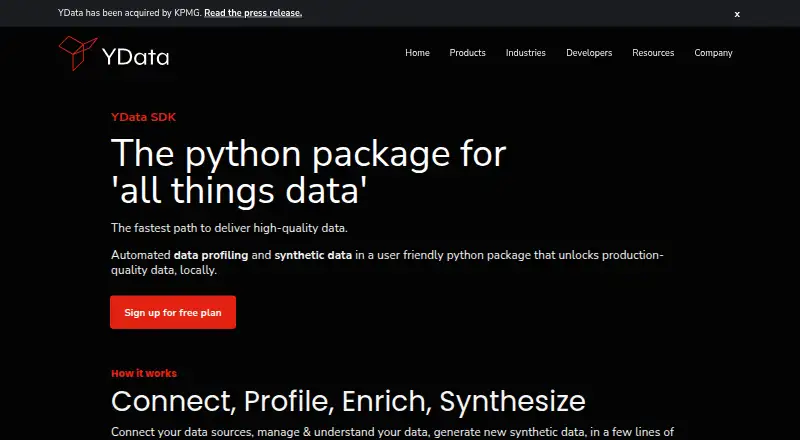
YData SDK is a Python toolkit for data profiling, data improvement and synthetic data generation. It creates automated data profiles and comparison reports to help teams assess data quality and identify issues or drift. Synthetic outputs can include tabular, time-series, relational, text, question-and-answer and document data. The documentation describes built-in PII detection and anonymization, plus checks of generated data quality, utility and privacy. Connectors include local files, cloud storage, databases and Databricks; named LLM backends include Workbench, OpenAI, Anthropic and Gemini. The SDK supports Python 3.10 and above on Windows, Linux and macOS. YData says its platform can run on customer cloud or on-premises infrastructure, avoiding data transfer between customer and YData. Some features require native libraries to be installed before the SDK. The free plan lists all features and 20+ connectors; pay-as-you-go pricing is $1.00 per credit, with each credit covering 1 million data points or 10,000 tokens and a 0.1-credit minimum transaction.
Good
- Profiles data and produces comparison reports.
- Generates several synthetic data types.
- Includes PII detection and anonymization.
- Supports Windows, Linux and macOS.
- Free plan includes all features and 20+ connectors.
Watch out
- Some features require native libraries first.
- Enterprise pricing is available on request.
- Pay-as-you-go purchases have a 0.1-credit minimum.
Who it suits
It suits data science, data engineering, analytics and AI development teams using Python. Teams should account for possible native-library prerequisites and choose between the free plan, pay-as-you-go credits or enterprise pricing.
Verdict
YData SDK combines data profiling with synthetic data generation and privacy-related tools. Its free plan provides a way to start, while usage beyond that follows the listed credit terms.
Plans and prices
From YData SDK's own pricing page, checked 30 Sep 2026.
| Plan | Price | What it gives you |
|---|---|---|
| Free plan | Free | Free monthly credit · all features available · 20+ connectors · Free monthly credit |
| Pay-as-you-go | $1, paid once | 1 credit per 1 million data points or 10,000 tokens · minimum transaction of 0.1 credits · $1.00/ credit |
| Enterprise | Priced on request | All features available · predictable pricing · Contact us |
The facts
Each one read from YData SDK's own pages, with the date it was checked.
What it does
- Deployment
- YData says its platform can be deployed on customer cloud or on-premises infrastructure so data does not transfer between the customer and YData.checked 30 Sep 2026
- Integrations
- Documented connectors include local files, Amazon S3, Azure Blob Storage, Google Cloud Storage, BigQuery, Microsoft SQL Server, MySQL, Snowflake, and Databricks.checked 30 Sep 2026
- Intended users
- YData describes the SDK as a Python toolkit for data science, data engineering, analytics, and AI development teams.checked 30 Sep 2026
- LLM providers
- The SDK documentation names Workbench, OpenAI, Anthropic, and Gemini as supported LLM backends.checked 30 Sep 2026
- Notable requirement
- The SDK installation guide says some features require native libraries to be installed before the SDK.checked 30 Sep 2026
- Privacy features
- The SDK documentation describes built-in PII detection and anonymization alongside synthetic data generation.checked 30 Sep 2026
- Profiling
- It generates automated data profiles and comparison reports to help evaluate data quality and detect issues or drift.checked 30 Sep 2026
- Purpose
- YData SDK is a Python toolkit for data profiling, data improvement, and synthetic data generation.checked 30 Sep 2026
- Security
- YData states that it is a SOC 2 Type 2 certified company.checked 30 Sep 2026
- Support
- The SDK documentation directs users to contact YData for support and other inquiries.checked 30 Sep 2026
- Synthetic data
- The SDK generates tabular, time-series, relational, text, Q&A, and document data.checked 30 Sep 2026
- Synthetic data checks
- YData says it evaluates generated data quality, utility, and privacy using divergence and correlation measures, TSTR, and privacy tests such as inference attacks.checked 30 Sep 2026
The company
- Headquarters
- Seattle, Washington, USAchecked 28 Sep 2026
Where it runs
- Supported platforms
- The SDK supports Python 3.10 and above and can be installed on Windows, Linux, or macOS.checked 30 Sep 2026
The full review of YData SDK
Overview
YData SDK is a Python toolkit for profiling data, improving its quality, and generating synthetic datasets. It best suits data science, engineering, analytics, and AI teams building Python-based workflows. Its breadth—from profiling and drift checks to multiple synthetic data types and privacy tools—is a strong fit for varied data work, though some features require native libraries to be installed first.
Key features
Automated profiles and comparison reports help teams spot data-quality problems and drift. That makes the SDK useful not only for generating data but also for checking how datasets change; generated-data assessments cover quality, utility, and privacy, including divergence and correlation measures, TSTR, and inference-attack tests.
Generation spans tabular, time-series, relational, text, question-and-answer, and document data. Built-in PII detection and anonymization add privacy-related tools to that workflow. Documented connectors reach local files and cloud storage, warehouses, databases, and Databricks; supported LLM backends include Workbench, OpenAI, Anthropic, and Gemini. API access and formats including CSV, Parquet, PDF, DOCX, and HTML extend its use across data pipelines and outputs.
Deployment on customer cloud or on-premises infrastructure can keep data from transferring between the customer and YData. YData is SOC 2 Type 2 certified. These capabilities will matter most to teams with infrastructure and Python expertise; installation prerequisites for some features add setup work.
Pricing
The Free plan costs nothing and provides a free monthly credit, all features, and 20+ connectors. It is a practical starting point for exploring the toolkit, but usage beyond that free credit follows the paid credit terms.
Pay-as-you-go costs $1, paid once, billed at $1.00 per credit. One credit covers 1 million data points or 10,000 tokens, with a minimum transaction of 0.1 credits. This gives teams a usage-based route instead of a fixed subscription, but the credit unit differs between data points and tokens, so expected consumption depends on the workload.
Enterprise has custom pricing and includes all features with predictable pricing. It is the better fit for organizations that need predictable costs; the free and pay-as-you-go plans are more suitable for trying the SDK or metered usage.
Platforms
The SDK supports Python 3.10 and above on Windows, Linux, and macOS, with API access and self-hosted deployment. Teams need a compatible Python environment, and some features also require native libraries installed beforehand.
Who it's for
YData SDK is best for data teams that want profiling, synthetic-data generation, and privacy tools in one Python toolkit, especially when they work across multiple data formats or need customer-controlled deployment. It is less compelling for readers who want a turnkey web app or who do not want to manage Python dependencies and infrastructure.
Pros and cons
- Pro: Profiling, comparison reports, generation across six data modalities, and PII-related tools cover a broad data workflow in one SDK.
- Pro: Customer-cloud and on-premises deployment supports keeping data within customer infrastructure.
- Pro: A free plan and credit-based pay-as-you-go pricing provide ways to start without an enterprise commitment.
- Con: Python 3.10+ and native-library prerequisites make setup more demanding than a hosted, no-code tool.
- Con: Credit consumption is tied to data points or tokens, so teams need to estimate workload usage rather than rely on a flat monthly price.
Alternatives
For a broader category comparison, browse Synthetic Data Generation Software.
MOSTLY AI is another freemium option with a free plan and API, Linux, self-hosted, and web platforms; choose it if those deployment options fit better. Tonic.ai offers a $29 per month Fabricate Plus plan with $25 of monthly credits and basic data exports, making it an option for readers who prefer a monthly plan with included credits. SynthForge IO provides a free web-app tier with the first 20,000 rows of each dataset free, suited to readers who want browser-based access and a defined free row allowance. Synth Studio is free to use, supports desktop and self-hosted platforms, and allows up to 1M rows per generation; it suits readers seeking that free-use model.
SDV Enterprise has a free SDV Community tier with five data types, five basic constraints, nine models, CSV and Excel support, and forum support, making it a fit for readers whose needs align with that defined community feature set. Synthesized uses custom sales contact for pricing, so consider it if you prefer to discuss pricing directly. Aindo Synthetic Data Platform is a paid option with API and self-hosted platforms. Synthetic Data Vault offers a free SDV Community tier with five data types, five basic constraints, nine models, CSV and Excel support, local filetypes, and forum support; it is worth considering for readers who want that community-tier offering.
Verdict
Choose YData SDK if your team wants a Python toolkit that joins data profiling, broad synthetic-data generation, and privacy-related tools, with customer-controlled deployment as an option. Its main drawback is the setup and usage-management burden: Python dependencies and credit-based consumption suit technical teams, not readers looking for a ready-made hosted interface or flat-rate plan.
Getting started
- Open the YData SDK product page
- Use Python 3.10 or newer
- Choose Windows, Linux, or macOS
- Install required native libraries for features that need them
- Select the free plan or pay-as-you-go credit billing
- Connect local files, cloud storage, databases, or supported LLM backends
Questions
What does YData SDK cost?
The free plan is free. Pay-as-you-go costs $1.00 per credit, and Enterprise uses contact-based pricing.
What does one pay-as-you-go credit cover?
One credit covers 1 million data points or 10,000 tokens. The minimum transaction is 0.1 credits.
Which systems can run the SDK?
YData SDK supports Python 3.10 and above on Windows, Linux, and macOS. It is also available through API and self-hosted deployments.
Which data can it generate?
It can generate tabular, time-series, relational, text, question-and-answer, and document data.
Can YData SDK connect to databases and cloud storage?
Yes. Documented connectors include local files, Amazon S3, Azure Blob Storage, Google Cloud Storage, BigQuery, SQL databases, Snowflake, and Databricks.
Does the free plan include all features?
Yes. The free plan lists all features and more than 20 connectors.
Alternatives to YData SDK
- 1

Synth Studio
Free planOpen sourceWebAPILinuxmacOS7.5Free plan - 2
SynthEngyne
Free plan7.1Free plan - 3

Tonic.ai
Free planWebAPISelf-hosted6.8From $29 a month - 4
SDV Enterprise
Free planLinuxmacOSSelf-hostedWindows6.7From $250 a month - 5

Synthetic Data Vault
Free planAPISelf-hosted6.6From $250 a month - 6
SynthForge IO
Free planWebAPI6.6Free plan