
Synth Studio
Synth Studio generates synthetic tabular datasets designed to preserve privacy while providing mathematical privacy guarantees.
What Synth Studio is
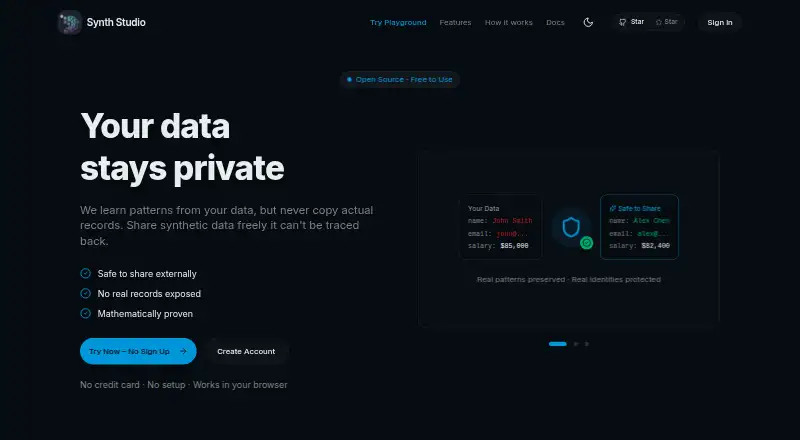
Synth Studio generates synthetic tabular datasets designed to preserve privacy while providing mathematical privacy guarantees. It accepts CSV and JSON files and detects their schemas automatically. Users can choose CTGAN, TVAE, GaussianCopula, or schema-based generation, and configure differential privacy with epsilon and delta settings and RDP accounting. Quality tools assess statistical similarity, machine-learning utility, and privacy leakage; automatic PII detection flags sensitive fields such as names, emails, and SSNs before generation. The platform offers compliance reporting for HIPAA, GDPR, CCPA, and SOC-2, with audit logs and model cards. It is open source and can be self-hosted or used through its cloud offering. Local installation documentation lists Windows 10+, macOS 10.15+, and Linux support. The free plan permits up to 1 million rows per generation under an MIT License. REST API integration is available, but direct API access currently needs a session cookie or trusted proxy headers; API keys are upcoming.
Good
- Accepts CSV and JSON with automatic schema detection
- Offers four listed generation methods
- Includes configurable differential privacy settings
- Automatically detects sensitive fields before generation
Watch out
- Free plan permits up to 1 million rows per generation
- Direct API access requires a session cookie or trusted proxy headers
- API keys are upcoming
Who it suits
Synth Studio may suit healthcare, fintech, machine-learning, and enterprise data-sharing teams working with tabular data. Its self-hosted option may suit teams that want to run it locally.
Verdict
Synth Studio pairs several synthetic-data generation methods with privacy controls and quality checks. Consider its current API access requirements alongside whether cloud or self-hosted deployment fits your workflow.
Plans and prices
From Synth Studio's own pricing page, checked 15 Oct 2026.
| Plan | Price | What it gives you |
|---|---|---|
| Free to Use | Free | Up to 1M rows / gen · MIT License · Free |
The facts
Each one read from Synth Studio's own pages, with the date it was checked.
What it does
- AI features
- An AI layer provides contextual chat, metric explanations, guided workflows, smart suggestions and automated documentation.checked 15 Oct 2026
- API
- The product exposes REST endpoints for dataset upload, generation and evaluation, but direct external access currently requires a session cookie or trusted proxy headers.checked 15 Oct 2026
- API access
- The platform exposes REST API integration, while direct API access currently requires a session cookie or trusted proxy headers and API keys are upcoming.checked 30 Sep 2026
- API limitation
- API-key access is described as upcoming, so the documented programmatic authentication model is not yet a conventional API-key flow.checked 15 Oct 2026
- API limits
- The integration guide lists 1,000 authenticated requests per minute, 10 uploads per minute, five concurrent generation jobs and 5,000 API calls per hour.checked 15 Oct 2026
- Cloud deployment
- Deployment guidance covers Heroku, Railway, Render, AWS, Google Cloud and Azure.checked 15 Oct 2026
- Compliance
- It provides HIPAA, GDPR, CCPA, and SOC-2 compliance reporting with audit logs and model cards.checked 30 Sep 2026
- Compliance reports
- The product describes HIPAA, GDPR, CCPA and SOC-2 alignment plus exportable compliance reports, audit narratives and model cards.checked 15 Oct 2026
- CTGAN
- CTGAN is offered for complex tabular data with mixed types and nonlinear relationships.checked 15 Oct 2026
- Deployment
- Synth Studio is open source, self-hostable, and also available through its cloud offering.checked 30 Sep 2026
- Differential privacy
- DP-CTGAN and DP-TVAE use differential-privacy guarantees with RDP accounting and configurable epsilon values from 0.1 to 100.0.checked 15 Oct 2026
- Docker
- Docker and Docker Compose deployment instructions are provided for running the backend and production services.checked 15 Oct 2026
- Documentation depth
- The documentation site includes getting-started, user, developer, examples, tutorials, deployment, testing and troubleshooting sections.checked 15 Oct 2026
- GaussianCopula
- GaussianCopula provides fast, interpretable schema-based generation without machine-learning training.checked 15 Oct 2026
- Generation methods
- Users can generate data with CTGAN, TVAE, GaussianCopula, and schema-based generation.checked 30 Sep 2026
- Independent listing
- AlternativeTo categorizes Synth Studio under Security & Privacy, lists it as an online product and records no comments or reviews.checked 15 Oct 2026
- Independent listing date
- AlternativeTo says Urz1 added Synth Studio on February 4, 2026 and the page was last updated that day.checked 15 Oct 2026
- Independent repository activity
- AlternativeTo reports the linked repository had 22 stars, zero forks and 10 open issues when updated March 30, 2026.checked 15 Oct 2026
- Input files
- The platform accepts CSV, JSON and Excel data, with schema validation, type inference and preprocessing.checked 15 Oct 2026
- Input formats
- The platform accepts CSV and JSON files with automatic schema detection.checked 30 Sep 2026
- Installation
- The documented setup clones the GitHub repository, creates a virtual environment, installs Python requirements and initializes the database.checked 15 Oct 2026
- Licence
- AlternativeTo lists Synth Studio as free open-source software under the MIT licence.checked 15 Oct 2026
- Limit: active development
- The documentation banner says Synth Studio is in active development.checked 15 Oct 2026
- Limit: independent validation
- AlternativeTo shows no comments or reviews, so that directory provides no user-review evidence for reliability or satisfaction.checked 15 Oct 2026
The full review of Synth Studio
Synth Studio is a tabular synthetic-data generator for teams working with sensitive records. It suits healthcare, fintech, machine-learning and enterprise data-sharing workflows. Its combination of configurable differential privacy, quality evaluation and deployment flexibility makes it worth considering, especially for teams that can work around its current API authentication requirements.
Overview
Import CSV or JSON files and Synth Studio detects their schemas automatically. It can generate synthetic datasets using CTGAN, TVAE, GaussianCopula or schema-based methods, giving teams multiple approaches to tabular data rather than a single generation path. The tabular focus is a clear boundary: it is not aimed at other data modalities.
Before generation, the software can detect sensitive fields such as names, email addresses and SSNs. Differential privacy uses configurable epsilon and delta settings with RDP accounting, while evaluation tools assess statistical similarity, machine-learning utility and privacy leakage. Together, these controls help teams scrutinize both data usefulness and exposure risk; they do not remove the need to judge whether a particular generated dataset suits its intended use.
Synth Studio is open source and can run self-hosted or through its cloud offering. Its architecture uses PostgreSQL for metadata, Redis for queueing and cache, and AWS S3 for files. That deployment choice is useful for organizations with different data-handling needs, though teams planning integrations should account for the current API access hurdle: direct access requires a session cookie or trusted proxy headers, with API keys upcoming.
Key features
Privacy and governance
Compliance reporting covers HIPAA, GDPR, CCPA and SOC-2, with audit logs and model cards. Secure authentication and access control, privacy-budget enforcement, audit trails and lineage add governance controls around generation. These features make Synth Studio a stronger fit for teams that need to track and manage sensitive-data workflows than for users seeking only a basic generator.
API and integrations
The REST API guide gives limits of 1,000 authenticated requests per minute, 10 file uploads per minute, five concurrent generation jobs and 5,000 API calls per hour. Those ceilings provide defined operating limits, but the session-cookie or trusted-proxy requirement may complicate automated integrations until API keys arrive. Support resources include documentation, GitHub Issues, GitHub Discussions and a security contact email.
Pricing
Synth Studio's Free to Use plan costs nothing and allows up to 1M rows per generation under an MIT License. The row allowance makes it a substantial starting point for teams evaluating synthetic tabular data or running workloads within that cap, while the free price avoids an entry fee. The stated plan terms do not specify seat counts, a trial period or renewal conditions.
Platforms
Synth Studio supports API, Linux, macOS, self-hosted, web and Windows use. Local installation documentation covers Windows 10+, macOS 10.15+ and Linux. The choice of cloud or self-hosted deployment is useful for teams balancing convenience against control over where the software runs.
Who it's for
Healthcare and fintech teams handling sensitive records are natural candidates, as are machine-learning groups that need synthetic tabular data and evaluation of its utility. Enterprise data-sharing teams may value the privacy controls, compliance reporting and self-hosting option. It is less suitable for projects requiring non-tabular data or integrations that depend on API keys today.
Pros and cons
- Pros: Four generation methods and automatic CSV/JSON schema detection give teams flexibility within tabular data workflows.
- Pros: Configurable differential privacy, quality checks and sensitive-field detection address privacy and usefulness together.
- Pros: Open-source self-hosting and a cloud option let organizations choose a deployment approach.
- Cons: Direct API access depends on session cookies or trusted proxy headers, which can make automated integration less straightforward.
- Cons: Its data scope is tabular, ruling it out for other modalities.
Alternatives
AI Synthetic Data Generators and Synthetic Data Generation Software are useful starting points for comparing options across the category.
Choose REaLTabFormer instead if a free, MIT-licensed option for Linux, macOS, Windows or self-hosting meets the need and Python 3.7 or later is acceptable. MOSTLY AI is another free-start option for teams looking across API, Linux, self-hosted and web deployments.
Synthehol Dataset may suit a small project that can work within its Free plan's 1,000 monthly credits, 50K rows per month, five projects, five datasets, one user, 1 GB storage and 30-day retention. For a cloud-oriented option with basic exports and Discord support, consider Tonic Fabricate, whose Free plan includes $5 monthly credits.
SynthCity is a free open-source Python library for Linux, while DataSynthesizer is a free MIT-licensed option for self-hosted or web use that installs with pip and requires first-normal-form table input. SimpleTest is a freemium API, extension and web option with a Starter plan allowing 50 parallel test runs and 500 execution minutes per month, with AI-generated datasets limited to one per test. NVIDIA ShadowPlay is a free Windows option requiring Windows 10 or 11, a GeForce 551.52 driver or later and a supported GPU.
Verdict
Synth Studio is a strong candidate for teams generating sensitive tabular data that need privacy settings, evaluation and a choice between self-hosting and cloud deployment. Its free plan and governance controls are compelling reasons to start with it; look elsewhere if the project needs other data modalities or direct API-key access now.
Getting started
- Choose the cloud offering or follow the local installation documentation for Windows 10+, macOS 10.15+, or Linux.
- Upload a CSV or JSON file for automatic schema detection.
- Choose a generation method: CTGAN, TVAE, GaussianCopula, or schema-based generation.
- Configure epsilon and delta settings if using differential privacy.
- Generate data and review its quality evaluation and privacy leakage results.
Limits worth knowing
The free plan allows up to 1 million rows per generation. Direct API access currently requires a session cookie or trusted proxy headers, with API keys upcoming.
Questions
Is Synth Studio free?
Yes. Its Free to Use plan costs nothing and allows up to 1 million rows per generation.
Can I host Synth Studio myself?
Yes. It is open source and supports self-hosting as well as a cloud offering.
Which operating systems are supported for local installation?
The installation documentation lists Windows 10+, macOS 10.15+, and Linux.
What input formats does it accept?
It accepts CSV and JSON files and detects their schemas automatically.
Does it provide an API?
It offers REST API integration. Direct API access currently requires a session cookie or trusted proxy headers; API keys are upcoming.
What compliance reporting does it provide?
Synth Studio provides reporting for HIPAA, GDPR, CCPA, and SOC-2, along with audit logs and model cards.
Alternatives to Synth Studio
- 1
SynthEngyne
Free plan7.1Free plan - 2

YData SDK
Free planAPILinuxmacOSSelf-hosted6.9Free plan - 3

Tonic.ai
Free planWebAPISelf-hosted6.8From $29 a month - 4
SDV Enterprise
Free planLinuxmacOSSelf-hostedWindows6.7From $250 a month - 5

Synthetic Data Vault
Free planAPISelf-hosted6.6From $250 a month - 6
SynthForge IO
Free planWebAPI6.6Free plan