DataSynthesizer
DataSynthesizer generates synthetic data that simulates a supplied dataset.
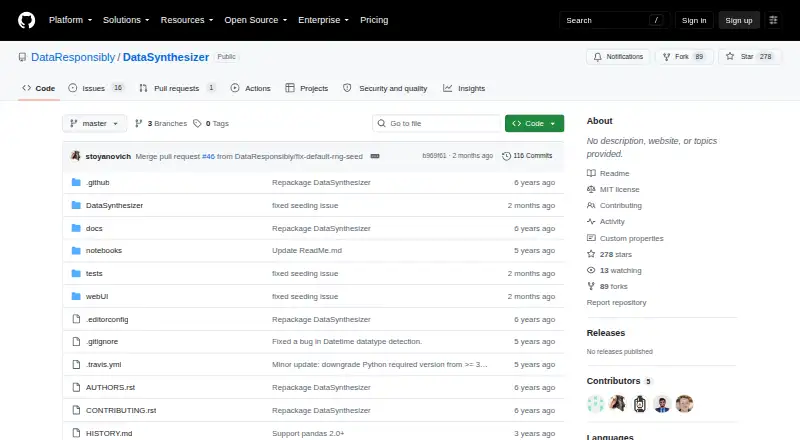
What DataSynthesizer is
DataSynthesizer generates synthetic data that simulates a supplied dataset. The project says it applies differential privacy techniques to provide a privacy guarantee. Its demonstrations cover random, independent-attribute, and correlated-attribute modes. The documented input must be a table in first normal form. Users can install the package with `pip install DataSynthesizer`, run example notebooks in Jupyter Notebook, or launch the Django web interface locally and open it in a browser at `/synthesizer`. The project aims to support collaboration between data scientists and owners of sensitive data. Its identified tools and integrations include Python pip, Jupyter Notebook, and the companion Django interface. DataSynthesizer is MIT-licensed and free, with self-hosted and web platforms listed; no free trial is listed. GitHub Issues are available for questions and reports. Its stated scope does not include relational or unstructured data.
Good
- Uses differential privacy techniques.
- Includes three synthesis modes.
- Can be installed with pip.
- MIT-licensed and free.
- Offers notebooks and a local web interface.
Watch out
- Input must be a first-normal-form table.
- Relational data is outside its stated scope.
- Unstructured data is outside its stated scope.
- No free trial is listed.
Who it suits
DataSynthesizer is suited to data scientists collaborating with owners of sensitive data who work with tabular input in first normal form. It offers package, notebook, and locally run web-interface workflows.
Verdict
DataSynthesizer offers a free, self-hosted route to generating synthetic data from a specifically structured table. Its scope excludes relational and unstructured data.
Plans and prices
From DataSynthesizer's own pricing page, checked 4 Oct 2026.
| Plan | Price | What it gives you |
|---|---|---|
| DataSynthesizer | Free | MIT-licensed software · install with pip · input must be a first-normal-form table |
The facts
Each one read from DataSynthesizer's own pages, with the date it was checked.
What it does
- Input requirement
- The documented input assumption is that the dataset is a table in first normal form.checked 4 Oct 2026
- Installation
- The README gives `pip install DataSynthesizer` as the installation command.checked 4 Oct 2026
- Integration
- The published usage instructions identify Python pip, Jupyter Notebook, and the companion Django web UI.checked 4 Oct 2026
- Intended users
- The project says it aims to facilitate collaboration between data scientists and owners of sensitive data.checked 4 Oct 2026
- License
- The repository identifies its license as MIT.checked 4 Oct 2026
- Local web UI
- A Django project includes a web UI that can be run locally and opened in a browser at `/synthesizer`.checked 4 Oct 2026
- Modes
- The repository includes demos for random, independent-attribute, and correlated-attribute modes.checked 4 Oct 2026
- Notebook use
- The README directs users to run example notebooks with Jupyter Notebook.checked 4 Oct 2026
- Privacy
- The project says it applies differential privacy techniques to provide a strong privacy guarantee.checked 4 Oct 2026
- Purpose
- DataSynthesizer generates synthetic data that simulates a given dataset.checked 4 Oct 2026
- Support
- The repository exposes GitHub Issues for project questions and reports.checked 4 Oct 2026
The company
- Maker identity
- The GitHub organization describes Data, Responsibly as a responsible data management platform and tools project and links to dataresponsibly.org.checked 4 Oct 2026
Alternatives to DataSynthesizer
- 1

FakerForge
Free planWebAPILinuxmacOS7.8From $10 a month - 2

Synth Studio
Free planOpen sourceWebAPILinuxmacOS7.5Free plan - 3
Synthehol Dataset
Free planWebAPISelf-hosted7.3From $3,990 a year - 4
SimpleTest
Free planWebAPIExtensionSelf-hosted7.2From $750 a month - 5
SynthEngyne
Free plan7.1Free plan - 6

Tonic Fabricate
Free planWebAPISelf-hosted6.8$29 usage-based