Metasyn
Metasyn generates synthetic tabular data to make sensitive datasets more accessible, reproducible, and reusable.
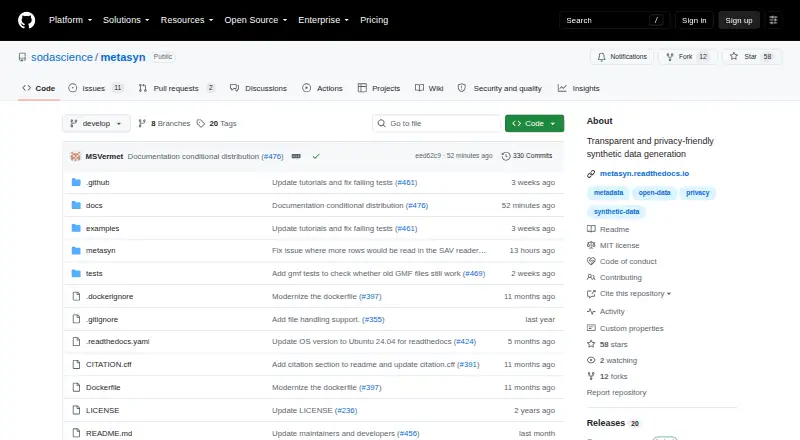
What Metasyn is
Metasyn generates synthetic tabular data to make sensitive datasets more accessible, reproducible, and reusable. Users fit a MetaFrame to a dataframe, save the model and settings as auditable JSON, then use them to generate new rows. It handles multiple data types, missing values, categories, unique key columns, and structured strings such as postcodes and identifiers. Metasyn supports pandas and Polars dataframes and uses Faker to create localized names, emails, phone numbers, and other data. Its default model excludes multivariate information to reduce disclosure risks, and a disclosure-control plugin is available. However, synthetic output still needs human review and is not guaranteed to contain no sensitive information. The plugin system lets users and organizations add extensions. Generated dataframes can be exported to CSV, Parquet, Excel, and other formats. Metasyn is a free, MIT-licensed Python package for self-hosted use on Linux, macOS, and Windows, with installation through pip or GitHub.
Good
- Supports pandas and Polars dataframes.
- Handles missing values and multiple data types.
- Exports to CSV, Parquet, Excel, and other formats.
- Free under the MIT License.
- Offers a plugin system for extensions.
Watch out
- Synthetic output requires human review.
- Output is not guaranteed free of sensitive information.
- Does not provide data masking or subsetting.
Who it suits
Metasyn suits public organizations, research groups, and individual researchers working with sensitive datasets. It is intended for users who can fit dataframes and review synthetic output themselves.
Verdict
Metasyn offers a self-hosted workflow for generating and exporting synthetic tabular data. Its disclosure-reduction approach does not remove the need to review generated rows for sensitive information.
Plans and prices
From Metasyn's own pricing page, checked 4 Oct 2026.
| Plan | Price | What it gives you |
|---|---|---|
| Metasyn | Free | Open-source Python package · MIT license |
The facts
Each one read from Metasyn's own pages, with the date it was checked.
What it does
- Deployment
- The project points users to versioned Docker containers and a command-line interface for building programs with Metasyn.checked 4 Oct 2026
- Exports
- Generated dataframes can be exported to CSV, Parquet, Excel, and other formats.checked 4 Oct 2026
- Extensibility
- A plugin system lets users or organizations add extensions to adapt Metasyn to their needs.checked 4 Oct 2026
- Installation
- The package can be installed with pip from PyPI or directly from GitHub for the development version.checked 4 Oct 2026
- Integrations
- Metasyn supports Polars and pandas dataframes and uses Faker to generate localized names, emails, phone numbers, and other data.checked 4 Oct 2026
- Intended users
- The documentation identifies public organizations, research groups, and individual researchers who own sensitive datasets as the intended audience.checked 4 Oct 2026
- License
- The software is distributed under the MIT License, which grants free use, modification, distribution, and sublicensing subject to its conditions.checked 4 Oct 2026
- Privacy plugin
- The maker offers a disclosure-control plugin, while warning that synthetic output still needs human review and is not guaranteed to be free of sensitive information.checked 4 Oct 2026
- Purpose
- Metasyn generates synthetic tabular data to help make sensitive datasets more accessible, reproducible, and reusable.checked 4 Oct 2026
- Support
- Users can report bugs or ask technical questions through GitHub issues and can contact Raoul Schram.checked 4 Oct 2026
- Supported data
- Metasyn handles multiple data types, missing values, categorical data, unique key columns, and structured strings such as postcodes or identifiers.checked 4 Oct 2026
- Workflow
- Users fit a MetaFrame to a dataframe, save its model and settings as auditable JSON, and synthesize new rows.checked 4 Oct 2026
Where it runs
- Privacy approach
- By default, Metasyn excludes multivariate information from its model to reduce risks such as identity, attribute, or group disclosure.checked 4 Oct 2026
The full review of Metasyn
Metasyn is a Python package for generating synthetic rows from tabular data. It is a good fit for researchers and public organizations that can run software themselves and assess disclosure risk. Its appeal is a reproducible, extensible workflow; it is not a data-masking tool or a privacy guarantee.
Overview
Users fit a MetaFrame to a dataframe, save the model and settings as auditable JSON, then synthesize new rows. That repeatable process is useful when a team needs to document how generated data was produced, rather than make a one-off export. Metasyn handles missing values, categorical data, unique keys and structured strings such as postcodes and identifiers, so it can accommodate more than simple name-and-number tables.
By default, Metasyn leaves multivariate information out of its model to reduce identity, attribute and group disclosure risks. A disclosure-control plugin is also offered, but generated rows are not guaranteed to be free of sensitive information. Human review remains necessary, so teams that need a turnkey privacy assurance process should look elsewhere.
Key features
Support for pandas and Polars lets users work with either dataframe library. Faker supplies localized names, email addresses, phone numbers and other data, while a plugin system allows users or organizations to add extensions. This flexibility suits teams able to adapt a Python workflow; it also means Metasyn is not a managed service that removes implementation responsibility.
Users can install the package with pip from PyPI or directly from GitHub for the development version. Versioned Docker containers and a command-line interface support deployment and building programs with Metasyn. Generated dataframes can be exported to CSV, Parquet, Excel and other formats. API access is supported, but the self-hosted deployment model makes the user responsible for running the software.
Pricing
Metasyn costs nothing under its open-source MIT-licensed plan. The plan is the package itself, with no separate free-trial period. The MIT License permits free use, modification, distribution and sublicensing subject to its conditions, making the offer suitable for researchers and organizations that want to adapt the software without a paid plan. It does not include data masking or data subsetting, so readers who need either capability should not treat synthetic-data generation as a substitute.
Platforms
Metasyn supports Linux, macOS and Windows, and is self-hosted. The Python package, Docker containers and command-line interface give technical teams deployment options, but readers seeking a hosted service should consider another tool.
Who it's for
Metasyn is aimed at public organizations, research groups and individual researchers who own sensitive datasets. It is most compelling for people who need a reproducible generation process, can work with pandas or Polars, and are prepared to review outputs for disclosure risks. It is a weaker fit for teams seeking masking, subsetting, or a hands-off hosted product.
Pros and cons
- Pros: Auditable JSON model settings make the generation workflow repeatable.
- Pros: Support for missing values, unique keys and structured strings broadens its usefulness across tabular datasets.
- Pros: Free, open-source use and a plugin system suit teams that want to extend their own workflow.
- Cons: Synthetic output still needs human review and is not guaranteed to exclude sensitive information.
- Cons: It offers neither data masking nor data subsetting, limiting its value for teams that need those operations.
- Cons: Self-hosting and a Python-centered workflow place deployment and integration work on the user.
Alternatives
For a more bounded database-mocking offer, FakerForge has a free monthly plan with one database, 50,000 AI tokens, 100 rows per table, 10 tables per database, 500 API requests, one mock API and five endpoints per mock. Choose it if those stated quotas and its API, web or desktop platform options better suit the task; Metasyn instead centers on dataframe-based generation.
Windocks is worth considering for database images and containers: its free plan caps image size at 1 GB and simultaneous containers at one, supports Windows and Linux, and includes no support. Its Standard plan is $499 a month. Pick it when that container-oriented offer matches the deployment need rather than Metasyn's dataframe workflow.
Data Maestro offers a 30-day full trial followed by a limited free plan, with 100 rows per export or database push, two saved database connections, and a mock API server during the trial. Consider it when those database-connection and trial terms are a better fit.
MOSTLY AI has a free plan and supports API, Linux, self-hosted and web use. It is a neutral alternative for readers comparing synthetic-data tools across those deployment options.
Tonic Fabricate offers a free plan with $5 monthly credits, basic data exports, Discord support and Tonic Cloud; its Plus plan is $29 a month with $25 monthly credits and metered additional usage. Choose it if cloud access and monthly credits suit better than self-hosting.
Mockaroo has a free plan with 1,000 rows per file, unlimited browser downloads, 200 API requests per day, and 1x speed, with all features hosted on mockaroo.com. It is a better fit when browser-based hosted generation and those limits work for the job.
Faker.js is a free, MIT-licensed option for commercial and non-commercial use. Choose it if a web-based Faker alternative is preferable.
Synthetic Data Vault offers a free Community plan with five data types, five basic constraints, nine models, CSV and Excel support, local filetypes and forum support. It is an alternative for readers who want that model-and-constraint package rather than Metasyn's dataframe workflow.
Browse the Test Data Management Software category for more options.
Verdict
Choose Metasyn if you need free, self-hosted synthetic tabular data generation with auditable settings and the flexibility to extend a Python workflow. Its central limitation is that neither default disclosure reduction nor the plugin removes the need to review output. Teams that require masking, subsetting, hosted convenience or a guarantee against sensitive data should look elsewhere.
Alternatives to Metasyn
- 1

FakerForge
Free planWebAPILinuxmacOS7.8From $10 a month - 2

Windocks
Free planWebAPILinuxSelf-hosted6.9From $499 a month - 3
Databucket
Free planOpen sourceAPISelf-hosted6.8Free plan - 4

Tonic Fabricate
Free planWebAPISelf-hosted6.8$29 usage-based - 5

Data Maestro
Free planLinuxmacOSSelf-hosted6.7From $149 a year - 6

Mockaroo
Free planWebAPISelf-hosted6.7From $60 a year