
Faker.js
Faker.js is a JavaScript tool for generating fake but realistic data for testing and development.
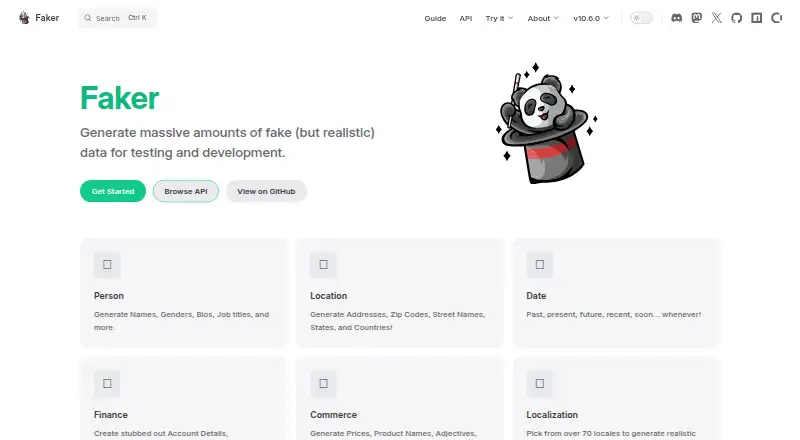
What Faker.js is
Faker.js is a JavaScript tool for generating fake but realistic data for testing and development. Its modules provide person, location, date, finance, commerce, and other data types, useful for unit or performance testing, demos, and work before a backend is complete. It includes pre-built instances for more than 70 locales and lets users create custom locales. Setting a seed can make output repeatable, although results for the same seed may change between Faker versions. The JavaScript implementation runs in browsers and Node.js; Faker v10 requires Node.js 20 or above. Installation guidance covers npm, pnpm, yarn, and Deno, and framework examples include Vitest, Jest, Cypress, and Playwright. Faker is free under the MIT License for commercial and non-commercial use and supports self-hosted deployment. The full package is over 5 MiB minified, and the guide advises against deploying it whole in a web app. Locale coverage varies: some locales have limited coverage and may fall back to English, while some locale and method combinations have no applicable data.
Good
- Modules cover people, locations, dates, and finance
- Pre-built instances cover more than 70 locales
- Supports custom locales and seeded output
- Free under MIT for commercial and non-commercial use
- Examples cover Vitest, Jest, Cypress, and Playwright
Watch out
- Faker v10 requires Node.js 20 or above
- Full package exceeds 5 MiB minified
- Some locales have limited or fallback coverage
- Same seed can vary between Faker versions
Who it suits
Faker.js suits developers who need generated data for tests, demos, or work without a completed backend. It is for JavaScript environments in browsers or Node.js, with Faker v10 requiring Node.js 20 or above.
Verdict
Faker.js offers broad data-generation modules and locale options for development and testing. Check its runtime requirement, package size, and locale coverage before using it in a project.
Plans and prices
From Faker.js's own pricing page, checked 7 Oct 2026.
| Plan | Price | What it gives you |
|---|---|---|
| Faker | Free | MIT licensed · commercial and non-commercial use |
The facts
Each one read from Faker.js's own pages, with the date it was checked.
What it does
- Data types
- Faker can generate person, location, date, finance, commerce, and other data through its modules.checked 7 Oct 2026
- Deterministic output
- Users can set a seed to repeat generated values, though results for the same seed may change between Faker versions.checked 7 Oct 2026
- Installation
- The guide documents installation through npm, pnpm, yarn, and Deno.checked 7 Oct 2026
- Integrations
- The framework guide provides examples for Vitest, Jest, Cypress, and Playwright.checked 7 Oct 2026
- Limited locales
- Some locales have limited coverage and may rely on English fallback data; some locale and method combinations have no applicable data.checked 7 Oct 2026
- Localization
- Faker provides pre-built instances for more than 70 locales and lets users build custom locales.checked 7 Oct 2026
- Package size
- The full Faker package is over 5 MiB minified, and the guide advises against deploying it whole in a web app.checked 7 Oct 2026
- Purpose
- Faker generates fake but realistic data for testing and development.checked 7 Oct 2026
- Runtime
- The JavaScript implementation runs in browsers and Node.js, and Faker v10 requires Node.js 20 or above.checked 7 Oct 2026
- Security and compliance
- The opened official pages state that Faker is released under the MIT License and do not list security certifications or compliance claims.checked 7 Oct 2026
- Support
- The project directs users with questions to its Discord community and GitHub Discussions.checked 7 Oct 2026
- Use cases
- The guide lists unit testing, performance testing, building demos, and working without a completed backend as use cases.checked 7 Oct 2026
Alternatives to Faker.js
- 1

Benerator
Free planOpen sourceWebAPILinuxmacOS7.6Free plan - 2
RandomUser
Free planOpen sourceWebAPIExtensionSelf-hosted7.1Free plan - 3

Tonic Fabricate
Free planWebAPISelf-hosted6.8$29 usage-based - 4

Mockaroo
Free planWebAPISelf-hosted6.7From $60 a year - 5

Synthetic Data Vault
Free planAPISelf-hosted6.6From $250 a month - 6
Chance.js
Free planWebAPI6.4Free plan