
ESPnet
ESPnet is an open-source toolkit for speech processing, including speech recognition, text-to-speech, translation, enhancement, speaker diarization, and spok…
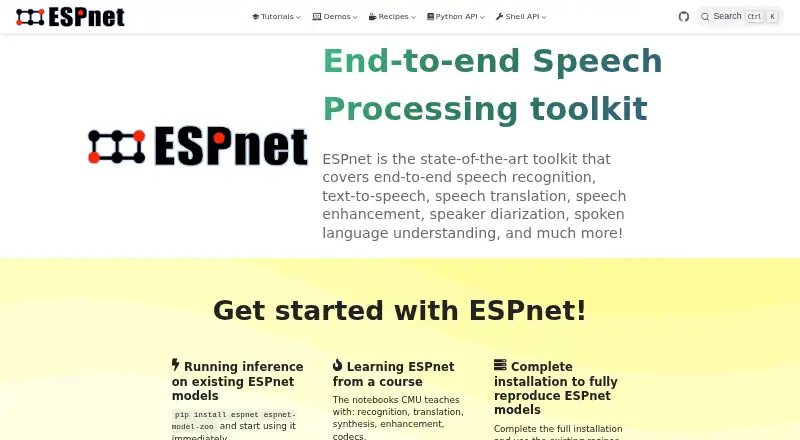
What ESPnet is
ESPnet is an open-source toolkit for speech processing, including speech recognition, text-to-speech, translation, enhancement, speaker diarization, and spoken language understanding. It also lists real-time transcription, speaker identification, and speaker labeling. The project provides complete task recipes, along with tutorials, notebooks, and demos for existing models. Users can install ESPnet and espnet-model-zoo with pip to run inference on existing models; published models can also run in CPU or GPU inference containers without checking out the repository. Installation supports editable pip setup and optional dependency groups for tasks such as recognition, text-to-speech, and enhancement. Training requires a separate extra that includes Lightning, TensorBoard, W&B, torch_optimizer, matplotlib, and Dask. Some task-specific packages must also be installed separately when a recipe needs them. ESPnet 1 is no longer supported, while ESPnet2 users can skip installing Kaldi. The project is released under Apache License 2.0 and permits commercial use. It offers API access and lists Linux, macOS, Windows, and self-hosted platforms; WAV is the listed export format. Voice cloning is not supported. The project credits the ESPnet community and dates its founding to 2018.
Good
- Supports recognition, text-to-speech, translation, and enhancement.
- Provides recipes, tutorials, notebooks, and model demos.
- Existing models can run in CPU or GPU containers.
- Apache 2.0 license permits commercial use.
- Offers API access and WAV export.
Watch out
- ESPnet 1 is no longer supported.
- Training requires a separate dependency extra.
- Some task packages require separate installation.
- Voice cloning is not supported.
Who it suits
ESPnet suits developers and speech-processing learners who want recipes, tutorials, and existing-model inference or task-specific training. Users should be prepared to install optional dependencies where needed.
Verdict
ESPnet covers a broad range of speech tasks and offers paths for inference and training. Its optional dependencies and discontinued ESPnet 1 support are important setup considerations.
Plans and prices
From ESPnet's own pricing page, checked 12 Oct 2026.
| Plan | Price | What it gives you |
|---|---|---|
| ESPnet | Free | Apache License 2.0 · open-source toolkit · pretrained-model inference and training via optional task extras |
| ESPnet open-source toolkit | Free | self-hosted research toolkit · optional task and training dependencies · no hosted SaaS plan stated |
The facts
Each one read from ESPnet's own pages, with the date it was checked.
What it does
- Additional task coverage
- The documentation lists singing-voice synthesis, speech codecs, language modeling, spoken dialogue systems and self-supervised learning.checked 15 Oct 2026
- API access
- Yeschecked 20 Sep 2026
- Automatic speech recognition
- The project provides automatic speech-recognition recipes, including discrete-unit and enhancement-assisted variants.checked 15 Oct 2026
- Commercial use
- Yeschecked 20 Sep 2026
- Containers
- The Docker guide says published models can run in CPU or GPU inference images without checking out the repository.checked 12 Oct 2026
- Current PyPI package
- PyPI lists ESPnet release 202610.post2 as a Python 3 universal wheel published on September 24, 2026.checked 15 Oct 2026
- Dependency groups
- The package defines optional groups for training, ASR, TTS, enhancement, speech translation, speaker recognition, speech language models, MCP, development, testing and documentation.checked 15 Oct 2026
- Distributed training
- The project documents multi-GPU and distributed training and provides job-scheduling tutorials.checked 15 Oct 2026
- Docker
- Official Docker instructions provide CPU and GPU images, recipe execution, local builds and configurable CUDA environments.checked 15 Oct 2026
- Experiment integrations
- Training documentation describes optional Weights & Biases logging and multi-GPU execution through CUDA device selection.checked 15 Oct 2026
- Export formats
- WAVchecked 20 Sep 2026
- Hugging Face availability
- Hugging Face's ESPnet library filter shows 1,054 compatible models.checked 15 Oct 2026
- Inference
- The homepage says users can install espnet and espnet-model-zoo with pip to run inference on existing models.checked 12 Oct 2026
- Installation
- The installation guide documents editable pip installation and optional dependency groups for tasks such as ASR, TTS, and speech enhancement.checked 12 Oct 2026
- Installation prerequisites
- Full installation may require CMake, SoX, FLAC, Python environment setup and optional Kaldi or task-specific installers.checked 15 Oct 2026
- Integrations
- The installation guide lists W&B and TensorBoard among the training dependencies.checked 12 Oct 2026
- Legacy status
- ESPnet1 is marked unsupported, while ESPnet2 recipes can be used without compiling Kaldi.checked 15 Oct 2026
- Legacy support
- The installation guide states that ESPnet 1 is no longer supported and that ESPnet2 users can skip installing Kaldi.checked 12 Oct 2026
- Licence
- The repository and website identify the software as Apache License 2.0.checked 15 Oct 2026
- License
- The project homepage states that ESPnet is released under the Apache License 2.0.checked 12 Oct 2026
- Limit: API stability
- An independent review says the training and configuration interfaces are recipe-oriented and do not provide a stable public API promise.checked 15 Oct 2026
- Limit: large-model hardware
- The Bagpiper model card estimates roughly 24 GB of GPU memory for BF16 inference, with longer inputs requiring more.checked 15 Oct 2026
The company
- Company identity
- The independent project profile describes espnet/espnet as an open-source project with Apache-2.0 licensing, about 9,984 stars and 2,444 forks at its October 2026 snapshot.checked 15 Oct 2026
- Founded
- 2018checked 28 Sep 2026
The full review of ESPnet
ESPnet is a free, open-source toolkit for building speech systems across recognition, synthesis, translation and related tasks. It is best suited to developers, researchers and engineering teams that need model control and reproducible recipes, not to users seeking a finished transcription app. The payoff is unusually broad coverage at no license cost; the trade-off is a technical installation and training workflow.
Overview
Created by the ESPnet community in 2018, ESPnet brings speech recognition, text-to-speech, speech translation, speech enhancement, speaker diarization, spoken-language understanding and other workloads into one project. Complete recipes give teams structured starting points instead of requiring every pipeline to be assembled from scratch. Speaker identification, speaker labeling and real-time transcription are supported, while voice cloning is not.
For inference, installing espnet and espnet-model-zoo with pip provides a route to existing pretrained models. ESPnet 2 is the supported generation; ESPnet 1 is no longer supported. ESPnet 2 users can skip Kaldi, which removes one legacy setup step, but task-specific installation remains part of using the toolkit.
Key features
- Wide task range: Recognition, TTS, translation, enhancement, diarization and spoken-language understanding make ESPnet a strong choice when one team handles several speech problems. A single-purpose transcription buyer gains less from that breadth.
- Recipes and model zoo: Complete recipes support repeatable workflows, and published models can be used for inference before a team commits to training its own system.
- Training stack: The train extra adds Lightning, TensorBoard, Weights & Biases, torch_optimizer, matplotlib and Dask. That supports experiment tracking and distributed-style workflows, but also increases the environment a maintainer must keep working.
- Optional task dependencies: ASR, TTS and enhancement have separate dependency groups, and some recipe packages must be installed separately. This flexibility avoids forcing every user to install everything, while making setup less predictable for newcomers.
- Containers and output: Docker CPU and GPU inference images can run published models without checking out the repository. WAV is the stated export format, and API access is available for integrations.
- License and use: Apache License 2.0 permits commercial use, making the toolkit viable for products as well as research.
Pricing
ESPnet — free. The Apache License 2.0 open-source toolkit includes pretrained-model inference and training through optional task extras. There is no paid tier, trial period or seat quota. The cost advantage is substantial for teams able to provide their own engineering and compute; it does not remove the time required to install dependencies, prepare data and operate models.
Platforms
ESPnet supports API, Linux, macOS, self-hosted deployments and Windows. Self-hosting and Docker inference suit organizations that need control over runtime environments, while API support allows it to sit inside a larger application. The documented workflow is oriented toward technical environments rather than a browser-only experience.
Who it's for
Choose ESPnet when you need several speech capabilities, want to run pretrained models and may train or adapt systems under your own control. Tutorials, notebooks, full installation guidance and demos provide entry points for learners as well as experienced engineers. It is particularly suitable for commercial teams that need Apache-licensed software and for research groups standardizing recipes across projects.
Look elsewhere if the priority is immediate meeting transcription, managed collaboration or a polished consumer interface. ESPnet asks users to select extras, resolve recipe dependencies and manage training infrastructure, so its flexibility is most valuable to people comfortable with Python environments and model operations.
Pros and cons
Pros
- Exceptional scope: Many major speech tasks live in one toolkit, reducing the need to stitch together unrelated frameworks.
- Free commercial foundation: Apache 2.0 licensing and a 0.00 USD price remove subscription and per-minute software charges.
- Inference-to-training path: The model zoo supports quick starts, while recipes and training extras support deeper customization.
- Deployment choice: API, self-hosted operation and CPU/GPU Docker images accommodate different infrastructure plans.
Cons
- Setup overhead: Optional and recipe-specific packages make installation more involved than a hosted speech service.
- Training complexity: The train extra brings a substantial toolchain that teams must configure and maintain.
- Legacy boundary: ESPnet 1 is unsupported, so older workflows may require migration.
- Limited stated export: WAV is the documented export format, which may not fit pipelines needing many output types.
Alternatives
Notta is a better fit for a ready-made, cross-platform transcription app: its free plan covers one seat and 120 transcription minutes per month, whereas ESPnet provides a toolkit rather than a managed workspace.
Gladia suits teams wanting an API-first paid service with a free option and trial instead of maintaining speech infrastructure.
Happy Scribe is aimed at users who prefer hosted transcription and meeting recording, with a free tier including unlimited meeting recordings capped at 45 minutes each and a 10-minute AI trial.
Speechmatics offers managed API and self-hosted choices plus a free credit allowance and concurrent real-time sessions, making it preferable when usage quotas are easier to budget than a toolkit build.
Grain is designed around recorded meetings, not general speech-model development.
noScribe is a free GPL-3.0 desktop alternative for users who want an open-source transcription application rather than a broad research toolkit.
Rev fits English-focused transcription and caption work with a free monthly minute allowance and a simple user limit.
tl;dv is the stronger choice for unlimited recording and transcription in a meeting-oriented workflow.
For category browsing, see Audio Transcription Software, Speech Recognition Software and Text-to-Speech Software.
Verdict
ESPnet is the right choice for technical teams that need broad speech coverage, pretrained-model inference and the freedom to train under an Apache 2.0 license. Its main reason to choose it is control without licensing fees; its main reason to look elsewhere is the dependency and infrastructure work required before that control pays off.
Alternatives to ESPnet
- 1

Voicebox
Free planOpen sourceAndroidiOSWebAPI9.3From $12 a year - 2

Speechify
Free planAndroidiOSWebAPI9.0From $10 a month - 3
Resemble AI
Free planAndroidiOSWebAPI9.0From $280 a month - 4
iSpeech
Free planOpen sourceAndroidiOSWebAPI9.0Free plan - 5

Fliki
Free planAndroidiOSWebAPI8.8From $28 a month - 6

Voice.ai
Free planAndroidiOSWebAPI8.8From $5 a month