DreamPay
DreamPay provides embedded and private-label payment solutions for merchant acquirers, software platforms, insurers, and financial institutions.
What DreamPay is
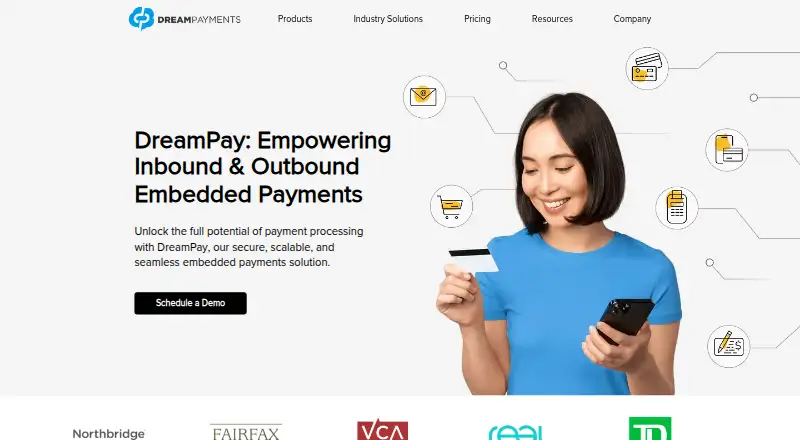
DreamPay provides embedded and private-label payment solutions for merchant acquirers, software platforms, insurers, and financial institutions. Its platform supports inbound and outbound digital and mobile payments within clients’ core software, as well as point-of-sale solutions for in-person payments. Online transactions can be one-time or recurring, by card or pay-by-bank, including ACH in the US and EFT in Canada. Checkout options include hosted payment pages, embedded checkout, and one-click payment using stored cards. Listed payout methods include ACH, EFT, real-time payments, virtual cards, Interac e-Transfer, and cheques. The dashboard tracks transaction volume, success rates, revenue, refunds, and chargebacks. APIs support payment data integration and webhook updates about outcomes and status changes. Dream says it follows PCI DSS and SOC 2 standards, uses end-to-end encryption, and offers KYC and AML tools; its security page also lists GDPR compliance. Pricing is on request. The company is headquartered in Toronto, Ontario, Canada.
Good
- Supports one-time and recurring card or bank payments
- Offers multiple payout methods
- Dashboard tracks refunds and chargebacks
- APIs support payment data integration and webhooks
Watch out
- Pricing is available on request
- Zero-fee processing passes transaction fees to customers
Who it suits
DreamPay is aimed at banks and other financial institutions, insurers, software platforms, marketplaces, and large enterprises seeking payment capabilities within their services.
Verdict
DreamPay combines embedded payments, checkout options, payouts, and reporting for organizations integrating payment services. Confirm pricing and payment availability for the relevant market and setup.
The facts
Each one read from DreamPay's own pages, with the date it was checked.
What it does
- API tools
- The developer page describes APIs for embedding inbound and outbound payments, payment data integration, and webhook notifications for payment outcomes and status changes.checked 9 Oct 2026
- Bank transfers
- Embedded bank transfers settle to the platform’s bank account in 1–2 business days via EFT in Canada and ACH in the US.checked 9 Oct 2026
- Checkout
- The online payment options include hosted payment pages, embedded checkout, and one-click payments using stored card options.checked 9 Oct 2026
- Compliance tools
- The security page describes built-in tools for KYC and AML and lists GDPR compliance.checked 9 Oct 2026
- Developer tools
- The API supports payment data integration for reconciliation and webhook notifications about payment outcomes and status updates.checked 9 Oct 2026
- Inbound and outbound payments
- Its API and embedded payments platform lets clients launch digital and mobile payments within their core software applications.checked 9 Oct 2026
- Intended customers
- Dream describes its solutions for banks and other financial institutions, insurers, software platforms, and marketplaces.checked 9 Oct 2026
- Intended users
- Dream describes its solutions for banks, insurers, software platforms, marketplaces, and large enterprises.checked 9 Oct 2026
- Online payments
- The platform supports one-time and recurring payments by credit or debit card and pay-by-bank through ACH or EFT.checked 9 Oct 2026
- Payments
- Its online payments support one-time and recurring card or pay-by-bank payments, including ACH in the US and EFT in Canada.checked 9 Oct 2026
- Payout methods
- Payout methods listed include ACH, EFT, real-time payments, virtual cards, Interac e-Transfer, and cheques.checked 9 Oct 2026
- Point of sale
- DreamPay offers point-of-sale solutions for in-person merchant payments.checked 9 Oct 2026
- Product
- DreamPay provides embedded and private-label payment solutions for merchant acquirers, software platforms, insurance companies, and financial institutions.checked 9 Oct 2026
- Reporting
- The revenue-sharing platform includes a reporting dashboard with real-time visibility into transactions and revenue earned.checked 9 Oct 2026
- Revenue share
- Dream offers customizable revenue-sharing opportunities for financial institutions, software platforms, and marketplaces, with earnings dependent on transaction volume.checked 9 Oct 2026
- Revenue sharing
- DreamPay offers customizable revenue-sharing opportunities for financial institutions, software platforms, and marketplaces, with terms tailored to the business model.checked 9 Oct 2026
- Security
- Dream says its platform follows PCI DSS and SOC 2 standards and uses end-to-end encryption for payment transactions and payouts.checked 9 Oct 2026
- Security and compliance
- Dream’s security page lists PCI DSS, SOC 2, KYC, AML, GDPR, and end-to-end encryption for payment transactions and payouts.checked 9 Oct 2026
- Support
- The zero-fee payments page says Dream provides full support for the integration process.checked 9 Oct 2026
- Zero-fee option
- Its zero-fee processing option passes transaction fees to customers, with a flat-fee or percentage-based fee structure.checked 9 Oct 2026
- Zero-fee processing
- Its zero-fee model passes processing fees to customers, and businesses can choose a flat fee or percentage-based fee.checked 9 Oct 2026
The company
- Headquarters
- Dream Payments lists its address as 201-171 East Liberty Street, Toronto, Ontario, M6K 3P6.checked 9 Oct 2026
The full review of DreamPay
DreamPay is an embedded and private-label payments platform for organizations that need acceptance, payouts, and payment data inside their own products. It is best suited to banks, insurers, software platforms, marketplaces, and large enterprises rather than small merchants wanting a ready-made checkout. Its broad rail and integration coverage is persuasive, but custom pricing makes the commercial case something each organization must establish directly.
Overview
DreamPay lets clients launch digital and mobile payment experiences within their core applications, combining inbound collection with outbound disbursement. The private-label approach is useful when the payment service should feel like part of a platform or financial product instead of a separate vendor interface. Point-of-sale capability also covers in-person merchant payments, giving organizations one provider for online and physical acceptance.
Online acceptance handles one-time and recurring credit- and debit-card payments as well as pay-by-bank. ACH is supported in the United States and EFT in Canada, with embedded bank transfers settling to the platform bank account in one to two business days. A zero-fee model can pass processing costs to customers through either a flat charge or a percentage; that can protect the business's margin, but the customer sees the additional fee.
Key features
Checkout and acceptance
Hosted payment pages, embedded checkout, and one-click payments using stored card options give product teams control over how much of the payment journey sits inside their application. Recurring billing support matters for subscriptions and repeat obligations, while pay-by-bank adds an alternative to cards. The range is valuable for platforms serving different merchant or customer preferences, although organizations still need to decide which methods fit their market.
Payouts and transfers
Outbound payments can use ACH, EFT, real-time payments, virtual cards, Interac e-Transfer, or cheques. That mix suits marketplaces, insurers, and financial institutions with varied recipient requirements. Canadian and US bank-transfer settlement is clearly defined at one to two business days through EFT or ACH; other payout methods do not carry a stated timing promise.
APIs, reporting, and controls
APIs cover inbound and outbound payments, payment-data integration for reconciliation, and webhooks for payment outcomes and status changes. Those tools are a practical foundation for connecting payment events to an existing ledger or workflow, rather than relying on manual updates. The dashboard tracks transaction volume, success rates, revenue, refunds, and chargebacks, giving operations teams the measures needed to monitor performance and exceptions.
Dream says its platform follows PCI DSS and SOC 2 standards, uses end-to-end encryption for transactions and payouts, and includes KYC and AML tools alongside GDPR compliance. The KYC/AML capability is basic, so organizations with demanding compliance operations should assess whether it covers their own review and monitoring processes.
Pricing
DreamPay uses paid, custom pricing: pricing is available on request. There is no published free plan, seat allowance, trial period, renewal term, or transaction schedule to compare. That model is understandable for institutions and platforms whose volumes, payment rails, revenue-sharing terms, and integration scope vary, but it makes budget planning and side-by-side procurement harder than with a public rate card.
The zero-fee processing option changes who pays rather than removing the cost: businesses select a flat fee or percentage that is passed to customers. Revenue-sharing arrangements are customizable for financial institutions, software platforms, and marketplaces, with earnings tied to transaction volume. Prospective buyers should therefore evaluate both the negotiated platform price and the customer-facing fee design.
Platforms
DreamPay supports Android, iOS, web, and API integrations. The combination covers mobile and browser experiences while allowing payment functions to be embedded directly into software through developer tools.
Who it's for
DreamPay is a strong candidate for banks and other financial institutions, insurers, software platforms, marketplaces, and large enterprises building payment functionality into a broader service. It is particularly relevant when one project needs both collection and disbursement, several payout rails, private-label presentation, and webhook-driven integration. A small business seeking a simple standalone checkout is unlikely to benefit from that breadth or from a sales-led custom-pricing process.
Pros and cons
Pros
- Broad payment coverage: cards, pay-by-bank, ACH, and EFT support both one-time and recurring collection.
- Flexible disbursements: real-time payments, virtual cards, Interac e-Transfer, cheques, ACH, and EFT address varied payout needs.
- Embedded architecture: APIs, reconciliation data, and webhooks let organizations connect payment activity to core applications.
- Operational visibility: reporting includes success rates, revenue, refunds, and chargebacks.
- Enterprise controls: PCI DSS, SOC 2, encryption, KYC, AML, and GDPR support address common security and compliance requirements.
Cons
- Opaque pricing: custom quotes and no public trial or plan limits complicate initial cost comparison.
- Customer-borne zero-fee charges: passing fees through can protect business economics but may make checkout less attractive.
- Basic KYC/AML tooling: organizations with complex compliance programs may need additional processes or systems.
Alternatives
Stripe Connect is the better comparison when a platform wants a broadly established connected-account model, including a plan with no platform fees while Stripe sets and collects processing fees. Checkout.com suits organizations seeking tailored pricing, with a free processing option for registered charities in countries where it operates. NMI is an alternative for teams that need support across Android, API, iOS, Linux, web, and Windows.
PayPal Multiparty Payments is worth considering for a PayPal-based marketplace or platform arrangement, subject to approval. Unipaas offers custom fees shaped around business model, transaction volume, payment rails, and growth plans. WePay provides a Link Standard option with published card-present and card-not-present rates, although it is currently in closed beta. Rainforest is an alternative with volume-based card transaction pricing and standard payout options. Stax Connect is another sales-led option with pricing supplied by its team. For a wider comparison, see Embedded Payments Platforms.
Verdict
Choose DreamPay if you are embedding branded payments into an institutional, insurance, software, marketplace, or enterprise product and need both acceptance and flexible payouts. Its strongest reason to buy is the combination of payment rails, payout methods, APIs, reporting, and compliance controls in one platform. Look elsewhere if transparent pricing, a self-serve trial, or a simple standalone checkout matters more than embedded breadth.
Alternatives to DreamPay
- 1

Stripe Connect
AndroidiOSWebAPI8.0From $20.25 a month - 2

Checkout.com
Free planAndroidiOSWebAPI7.7Free plan - 3

Adyen
AndroidiOSWebAPI7.5$0.13 one-time - 4

Airwallex Platform APIs and Embedded Finance
Free planAndroidiOSWebAPI7.3Free plan - 5
Rainforest
AndroidiOSWebAPI7.3From $0.20 a month - 6

Rapyd
AndroidiOSWebAPI6.8From $99 a month