Doorstop
Doorstop is a free, open-source tool for managing textual requirements alongside source code in version control.
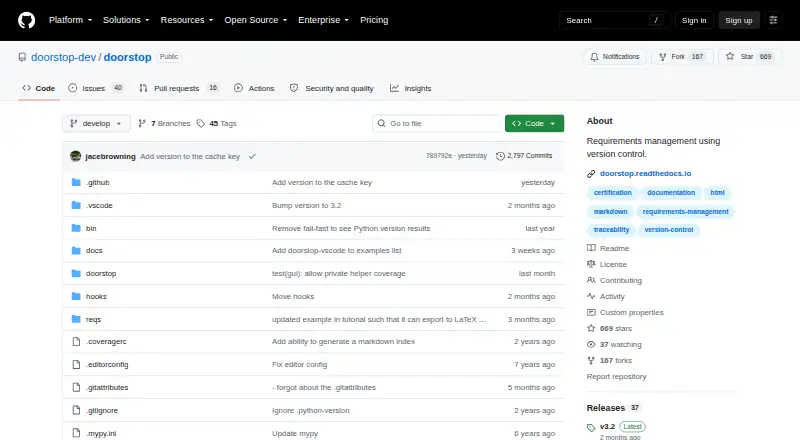
What Doorstop is
Doorstop is a free, open-source tool for managing textual requirements alongside source code in version control. It stores requirements and other linkable items as YAML files in directories that form documents, which can be arranged as a tree. Doorstop can validate traceability across that hierarchy and publish document hierarchies and trace matrices as plain text, HTML, LaTeX, or Markdown. Publishing templates can shape output; HTML and LaTeX publishing use templates. Requirements can be imported or exported as YAML, CSV, TSV, or Excel files. The project requires Python 3.10 or later and Git or another version control system, and it can be added to a Poetry project. It runs on Linux, macOS, and Windows, and can operate as a standalone web server or WSGI application. An experimental desktop GUI supports basic editing. Doorstop is licensed under LGPLv3 and costs nothing. LaTeX or PDF publishing requires a LaTeX distribution; HTML and Markdown need no additional tools.
Good
- Validates traceability across document hierarchies.
- Publishes trace matrices in four formats.
- Imports and exports YAML, CSV, TSV, and Excel.
- Supports baselines and version history.
- Runs on Linux, macOS, and Windows.
Watch out
- Requires Python 3.10 or later and version control.
- Approval workflows are not included.
- LaTeX or PDF publishing requires a LaTeX distribution.
- Desktop GUI is experimental.
Who it suits
Doorstop suits teams that keep requirements with source code and need traceability across linked documents. It may also fit workflows that use its supported import/export formats and publishing outputs.
Verdict
Doorstop focuses on requirements traceability, publishing, and version-controlled files. It includes baseline support and version history, but teams needing approval workflows should account for their absence.
Plans and prices
From Doorstop's own pricing page, checked 7 Oct 2026.
| Plan | Price | What it gives you |
|---|---|---|
| Doorstop | Free | Open source · requires Python and a version control system |
| Open-source Doorstop | Free | LGPLv3 · Python 3.10+ · version-control system required · self-hosted |
The facts
Each one read from Doorstop's own pages, with the date it was checked.
What it does
- Academic description
- The 2014 Doorstop paper presents it as a lightweight developer-oriented alternative to centralized database requirements tools, using text files in version control.checked 15 Oct 2026
- Assets
- Images, attachments and other files placed in an assets directory can be copied into published output and referenced from requirements.checked 15 Oct 2026
- Command-line interface
- The project exposes a stateless `doorstop` CLI for creating documents, adding and linking items, validating trees, publishing and interchange.checked 15 Oct 2026
- Dependencies
- The package declares Python 3.10 through 3.14 support and depends on PyYAML, Markdown, Bottle, Requests, frontmatter, PlantUML Markdown and openpyxl among others.checked 15 Oct 2026
- Desktop client
- The project describes an experimental desktop GUI for basic editing tasks and notes macOS may require python-tk.checked 7 Oct 2026
- GUI
- An experimental `doorstop-gui` desktop interface supports basic editing, and macOS may require python-tk.checked 15 Oct 2026
- Import and export
- Documents can be exchanged in YAML, CSV, TSV and XLSX formats, including Excel round trips.checked 15 Oct 2026
- Independent feature listing
- AlternativeTo lists command-line use, scripting, Git support, filtering and requirements management as Doorstop features.checked 15 Oct 2026
- Independent review availability
- AlternativeTo shows no reviews, three likes and zero comments for Doorstop.checked 15 Oct 2026
- Independent shortlist limitation
- ONES says teams must define their own document conventions, review practices, permissions and change-governance rules.checked 15 Oct 2026
- Independent shortlist view
- ONES describes Doorstop as transparent, portable and suitable for Git-based traceability and automation, while lacking native backlog, sprint, roadmap and release planning.checked 15 Oct 2026
- Independent technical assessment
- RTEMS describes Doorstop as a Python, YAML-based, Git-oriented tool with a CLI, predefined attributes, a primitive GUI and item fingerprints.checked 15 Oct 2026
- Integrations
- Doorstop requires Python and Git or another version control system, and can be added to a Poetry project.checked 7 Oct 2026
- Intended use
- The project describes itself as requirements management using version control and includes requirements, test cases, and certification among its repository topics.checked 7 Oct 2026
- Interchange
- Requirements can be exported and imported using YAML, CSV, TSV, or Excel files.checked 7 Oct 2026
- License
- Doorstop is distributed under the GNU Lesser General Public License version 3.checked 15 Oct 2026
- Limit: cloud and editor
- OpenRegulatory reports no cloud-hosted option and no built-in text editor, requiring users to supply their own editor.checked 15 Oct 2026
- Limit: library flexibility
- RTEMS reports that Doorstop was not designed as a library, has policy-heavy behavior, lacks custom link attributes and offers limited type-based verification.checked 15 Oct 2026
- Limit: non-developer usability
- OpenRegulatory reports that non-developers may struggle because they must learn Git, Doorstop and its file structure.checked 15 Oct 2026
- Limit: ordering model
- RTEMS reports that Doorstop orders links alphabetically by UID and cannot express relative UIDs or user-defined link ordering.checked 15 Oct 2026
- Limit: setup and compliance work
- OpenRegulatory says Doorstop requires significant setup and customization and is not a compliant regulatory solution out of the box.checked 15 Oct 2026
- Local web server
- `doorstop-server` serves a local browser interface on 127.0.0.1:7867.checked 15 Oct 2026
Money
- Independent price assessment
- OpenRegulatory describes Doorstop as free with no minimum commitment.checked 15 Oct 2026
The company
- Maker attribution
- The package metadata names Jace Browning as the author.checked 15 Oct 2026
The full review of Doorstop
Doorstop is a requirements-management tool for teams that keep textual requirements with source code in version control. It suits Python- and Git-capable teams that want traceability and document publishing without a license cost. Its file-based approach is compelling for code-centred work, but it is not a fit for teams that need formal approval workflows.
Overview
Requirements and other linkable items are stored as YAML files within documents, which form a hierarchy Doorstop can validate for traceability. Keeping those files in a version-control system gives teams a way to track changes alongside their code and use their existing process for managing revisions. That is a practical advantage for engineering groups already working this way; it also makes Python and version control operational prerequisites rather than optional extras.
Doorstop publishes document hierarchies and trace matrices as plain text, HTML, LaTeX, or Markdown. Templates allow teams to tailor output styling, and the tool can import and export YAML, CSV, TSV, and Excel files. These capabilities cover both publishing and file exchange, though they do not add a review or sign-off process.
Key features
Traceability and baselines
The document tree lets teams validate links across requirements and related items. Baseline support and version history help maintain a record of changes, making Doorstop more than a folder of requirement files. Teams still need another process or tool for approvals: Doorstop does not provide approval workflows.
Publishing and interchange
Plain-text and Markdown publishing require no additional tools; HTML publishing uses templates. LaTeX and PDF publishing require a LaTeX distribution, so those formats bring an extra setup burden. YAML, CSV, TSV, and XLSX import and export support can help teams move requirements between Doorstop and other file-based processes.
Deployment and desktop editing
Doorstop can run as a standalone web server or as a WSGI application under Apache or another web server. The project also describes an experimental desktop GUI for basic editing, but that status makes it a less dependable basis for a team's primary editing workflow. macOS may require python-tk for the GUI.
Pricing
Doorstop is free and open source under the LGPLv3 license. Its Doorstop plan costs nothing and requires Python and a version control system. There is no paid tier to unlock the core traceability or publishing features, but the cost advantage comes with responsibility for the required environment and for any approval process Doorstop does not supply.
Platforms
Doorstop supports Linux, macOS, and Windows, as well as API and self-hosted use. The repository requires Python 3.10 or later and a version control system. HTML and Markdown publishing need no additional tools, while LaTeX/PDF output requires a LaTeX distribution.
Who it's for
Doorstop is best for engineering teams that want requirements, test cases, or certification-related items maintained alongside source code, and that are comfortable with Python, Git, or another version-control system. Its hierarchical traceability, baselines, version history, and multiple publishing formats are useful where those practices matter more than a dedicated approval interface. Organisations that require formal review gates and sign-off should look elsewhere.
Pros and cons
- Pros: Requirements stored as YAML in version control can be maintained alongside source code, keeping changes within a code-centred workflow.
- Pros: Hierarchical traceability, baselines, and version history support structured change management without a license fee.
- Pros: Publishing in four formats and import/export across YAML, CSV, TSV, and Excel give teams useful options for output and interchange.
- Cons: Python 3.10 or later and a version control system are required, which limits suitability for teams seeking a self-contained, nontechnical workflow.
- Cons: No approval workflows means teams needing formal review and sign-off must provide that process elsewhere.
- Cons: The desktop GUI is experimental, and LaTeX/PDF publishing depends on a separate LaTeX distribution.
Alternatives
For other options, browse Requirements Management Software.
- MATLAB Grader is a free alternative for teams already holding a current MATLAB license; LMS integration requires a qualifying academic license.
- ReqView is worth considering if a GUI-based product across desktop and web platforms better suits the team; its free plan is limited to one document, 150 objects per document, and one custom attribute, while PRO costs €440 a year per user.
- OSRMT is another free, self-hosted option, but it requires hardware to run.
- Innoslate may suit educators or students who can use its free Academia plan with a .edu account.
- ICEM Surf is an alternative for personal learning on Windows, though its Learning Edition is not for industrial, commercial, or business use and includes no support.
- RequirementONE has a free Try plan for one user, limited to three sources from a shortlist, a predefined topic filter, and a personalised newsletter.
- NETVIBES is another option, with an Enterprise Data Science plan that lists 17 portfolio roles.
- StrictDoc is a free alternative available across Linux, macOS, web, Windows, API, and self-hosted use.
Verdict
Choose Doorstop if your team already uses Python and version control and wants free, code-adjacent requirements with traceability, baselines, and flexible publishing. Its strongest reason to choose it is that requirements can live and change alongside source code; its clearest reason to look elsewhere is the absence of approval workflows.
Getting started
- Open the Doorstop GitHub repository
- Install Python 3.10 or later
- Install Git or another version control system
- Store requirements and linkable items as YAML files in document directories
- Add Doorstop to a Poetry project if that matches your Python setup
- Run it as a standalone web server or a WSGI application
Questions
Is Doorstop free?
Yes. The listed Doorstop plan costs nothing, and the project is open source.
Which platforms does Doorstop support?
Doorstop supports API, Linux, macOS, Windows, and self-hosted use.
What formats can Doorstop import and export?
Requirements can be exchanged as YAML, CSV, TSV, or Excel files, including XLSX.
Does Doorstop provide requirements traceability?
Yes. Its document trees can be validated for traceability, and the listed capabilities include requirements traceability.
Can Doorstop publish documents?
Yes. It publishes hierarchies and trace matrices as plain text, HTML, LaTeX, or Markdown, with templates for output styling.
What does Doorstop require?
The repository lists Python 3.10 or later and Git or another version control system. LaTeX or PDF publishing additionally requires a LaTeX distribution.
Alternatives to Doorstop
- 1
RequirementONE
Free planAndroidiOSWebAPI7.9From $12 a month - 2

ReqView
Free planWebLinuxmacOSWindows7.1From €440 a year - 3

DocSheets
iOSWebmacOSWindows6.8$2,000 one-time - 4
in-STEP BLUE
WebAPISelf-hostedWindows6.6 - 5

CATIA
WebWindows6.5From $6,537 a year - 6

Innoslate
Free planWebAPISelf-hostedWindows6.4Free plan