StrictDoc
StrictDoc is open-source software for technical documentation and requirements management.
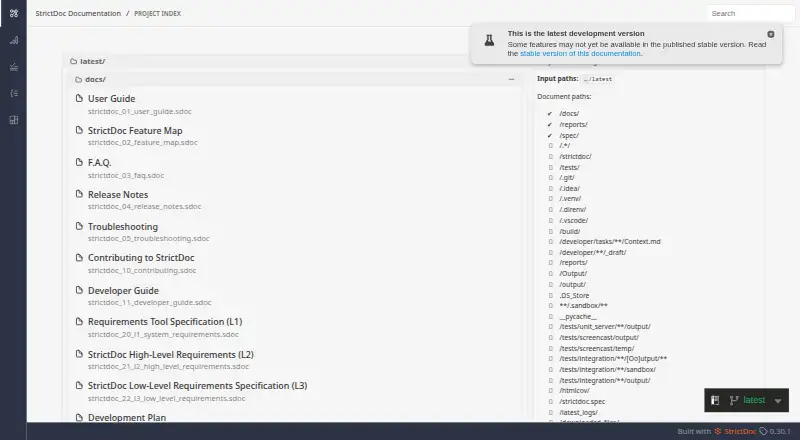
What StrictDoc is
StrictDoc is open-source software for technical documentation and requirements management. It stores documents and requirements as plain-text files that can be versioned with Git, using its SDoc format or a Markdown dialect with traceability features. Requirements can be linked to source code, tests, and test reports, then explored through a traceability graph. Teams can edit and review material in a browser, IDE, or command-line workflow. Custom document grammars allow project-specific fields, including mandatory ones. StrictDoc can report source-code coverage by requirement and generate diffs and changelogs between document-tree versions. Exports include HTML and reStructuredText, which can feed a Sphinx pipeline; PDF export is experimental. ReqIF import and export are also experimental and may require workflow changes because tools organize fields differently. The software offers a Python API, can run a local web server, and has a Docker installation path. Installation requires Python 3.10 or newer. StrictDoc is licensed under Apache License 2.0 and is intended for agile software teams, technical documentation groups, safety- and security-critical projects, and academic or research work.
Good
- Plain-text files can be versioned with Git.
- Links requirements to code, tests, and reports.
- Reports source-code coverage by requirement.
- Offers browser, IDE, and command-line workflows.
- Includes a Python API.
Watch out
- Requires Python 3.10 or newer.
- PDF export is experimental.
- ReqIF import and export are experimental.
- Some ReqIF workflows may need adjustment.
Who it suits
StrictDoc suits teams that need requirements traceability, versioned technical documentation, or custom requirement fields. It also identifies safety- and security-critical, university, and research projects as use cases.
Verdict
StrictDoc brings requirements, documentation, and traceability into a Git-friendly plain-text workflow. Its experimental PDF and ReqIF capabilities are important limits to weigh when choosing formats.
The facts
Each one read from StrictDoc's own pages, with the date it was checked.
What it does
- Coverage and change tracking
- StrictDoc can report source-code coverage by requirements and generate diffs and changelogs between document-tree versions.checked 8 Oct 2026
- Custom fields
- Custom document grammars let users define project-specific requirement fields and mark them as mandatory.checked 8 Oct 2026
- Editing
- Users can edit and review documentation in a browser or directly in an IDE or command-line workflow.checked 8 Oct 2026
- Exports
- StrictDoc can publish static HTML and export documents to PDF, ReqIF, Excel, and JSON.checked 8 Oct 2026
- Input formats
- StrictDoc supports its native SDoc format and a Markdown dialect with traceability features.checked 8 Oct 2026
- Installation
- The user guide recommends installing StrictDoc with pip and lists Python 3.10 or newer on macOS, Linux, or Windows as requirements.checked 8 Oct 2026
- Integrations
- Its reStructuredText export can feed a Sphinx documentation pipeline, and it offers a Python API for extending and integrating it into engineering workflows.checked 8 Oct 2026
- Intended users
- The project identifies agile software teams, safety- and security-critical projects, technical documentation teams, and university or research projects as users.checked 8 Oct 2026
- License
- StrictDoc is open source under the Apache 2.0 license.checked 8 Oct 2026
- Plain-text workflow
- StrictDoc stores documentation and requirements as plain-text files in Git.checked 8 Oct 2026
- Project history
- The project says it started in 2019 and is developed in Python.checked 8 Oct 2026
- Purpose
- StrictDoc is open-source software for technical documentation and requirements management.checked 8 Oct 2026
- ReqIF limitation
- ReqIF import and export are marked experimental, and workflows may need adjustment because tools structure and name fields differently.checked 8 Oct 2026
- Runtime requirement
- StrictDoc requires Python 3.10 or newer.checked 8 Oct 2026
- Security and compliance use
- StrictDoc is described for safety- and security-critical projects that need traceability under standards such as DO-178C, ECSS, and IEC 62443.checked 8 Oct 2026
- Self-hosting
- StrictDoc can run a local web server, and the project provides a Docker installation path.checked 8 Oct 2026
- Storage
- It stores documentation and requirements as plain text files that can be versioned with Git.checked 8 Oct 2026
- Support
- The project lists GitHub issues and discussions, a mailing list, Discord, email, and weekly open office hours as ways to get help or provide feedback.checked 8 Oct 2026
- Target users
- StrictDoc identifies agile software teams, safety- and security-critical projects, technical documentation teams, and university and research projects as use cases.checked 8 Oct 2026
- Traceability
- It links requirements to source code, tests, and test reports, with navigation through the traceability graph.checked 8 Oct 2026
Where it runs
- Platforms
- The user guide lists macOS, Linux, and Windows as supported operating systems and describes StrictDoc as a command-line terminal program.checked 8 Oct 2026
Alternatives to StrictDoc
- 1
RequirementONE
Free planAndroidiOSWebAPI7.9From $12 a month - 2
Doorstop
Free planOpen sourceWebAPILinuxmacOS7.5Free plan - 3

ReqView
Free planWebLinuxmacOSWindows7.1From €440 a year - 4

DocSheets
iOSWebmacOSWindows6.8$2,000 one-time - 5
in-STEP BLUE
WebAPISelf-hostedWindows6.6 - 6

CATIA
WebWindows6.5From $6,537 a year