
DFIRe
DFIRe is self-hosted case management software for digital forensics and incident response.
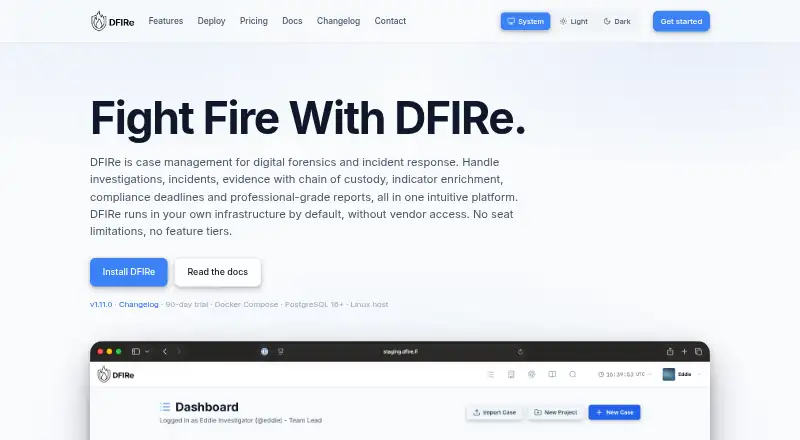
What DFIRe is
DFIRe is self-hosted case management software for digital forensics and incident response. Teams can configure case types, severities, assignments, and escalation from triage to incident response while retaining case history. Evidence records can be arranged hierarchically with configurable attributes, custody verification, printable receipts, and transfer records. The software includes customizable playbooks for fifteen common case types and timers and reminders for breach notifications, statutory reporting, and other deadlines such as SLAs. Its IOC registry supports STIX 2.1 types, enrichment from named threat intelligence providers, and sharing through MISP and TAXII. Documented integrations include Slack, bidirectional Jira synchronization, webhooks, and SIEM or log forwarding. Reports support structured sections, QA, evidence inventories, and optional LLM drafting through a provider the customer chooses. Security controls include OIDC sign-on, role-based access, encrypted attachments, and an immutable audit trail. DFIRe supports offline, air-gapped use. The annual licence is €9,900/yr and covers unlimited users and cases in one production deployment; a 90-day trial is available.
Good
- Customizable workflows preserve case history through escalation.
- Evidence custody records include receipts and transfer records.
- Playbooks cover fifteen common case types.
- Air-gapped deployments and offline licensing are supported.
- Annual licence covers unlimited users and cases.
Watch out
- Annual licence costs €9,900/yr.
- Licence covers one production deployment.
- Customers secure their own infrastructure and backups.
- Production deployment requires Docker Compose on Linux.
Who it suits
DFIRe suits digital forensics and incident response teams that need structured case and evidence workflows, including teams operating air-gapped networks. Customers must manage their own infrastructure security, storage, and backups.
Verdict
DFIRe brings case handling, evidence custody, compliance deadlines, and threat intelligence into a self-hosted workflow. Consider the infrastructure responsibilities and single-deployment licence limit alongside the €9,900/yr annual price.
Plans and prices
From DFIRe's own pricing page, checked 15 Oct 2026.
| Plan | Price | What it gives you |
|---|---|---|
| Annual licence | €9,900 a year | unlimited users and cases · one production installation · offline conversion · 90-day trial · annual; VAT 0% |
| Non-commercial | Free | individual, student, educational, charity and community non-commercial use · all features · case by case |
| Small teams | Priced on request | same deployment model and features · unlimited cases · custom |
The facts
Each one read from DFIRe's own pages, with the date it was checked.
What it does
- API
- DFIRe provides a REST API with per-user API keys, service accounts, interactive ReDoc documentation and a downloadable OpenAPI 3 schema.checked 15 Oct 2026
- Audit logging
- The audit trail is append-only and fail-closed, so an operation does not complete when its audit record cannot be written.checked 15 Oct 2026
- Case workflow
- Cases combine actions, notes, files, evidence, indicators and reports, with investigations escalatable into incidents.checked 15 Oct 2026
- Case workflows
- The product supports custom case types, severities, assignments, and escalation from triage to incident response without losing history.checked 7 Oct 2026
- Changelog news
- Version 1.12.1, released October 8, 2026, added a redesigned website, documentation search and clarified license-server data reporting.checked 15 Oct 2026
- Compliance
- Users can define compliance timers and reminders for breach notifications, statutory reporting, and other deadlines such as SLAs.checked 7 Oct 2026
- Compliance timers
- Cases can track deadlines for GDPR, NIS2, DORA, HIPAA, SEC and custom rules with reminders.checked 15 Oct 2026
- Custody hashing
- Each custody entry uses SHA-256 chaining, and failed verification stops further transfers for that item.checked 15 Oct 2026
- Database requirement
- Production deployments require PostgreSQL 16 or later managed by the customer or its provider.checked 15 Oct 2026
- Deployment
- Installation uses a release-pinned Docker Compose bundle and supports manual or air-gapped deployment.checked 15 Oct 2026
- Enrichment providers
- Official examples include VirusTotal, AbuseIPDB, Shodan, GreyNoise, MISP, urlscan and Spur.us, using customer API keys.checked 15 Oct 2026
- Evidence custody
- Evidence records include ownership, storage, custodians, runbooks, encrypted files and a verifiable chain of custody.checked 15 Oct 2026
- Indicators
- The indicator registry supports STIX 2.1 types, enrichment, cross-case correlation and sharing through TAXII 2.1 or MISP-compatible feeds.checked 15 Oct 2026
- Infrastructure responsibility
- Customers are responsible for securing their database, file storage, network, server infrastructure, and backups; case data is stored in plaintext in the database for performance and full-text search.checked 7 Oct 2026
- Integrations
- Native integrations include Slack case workflows, two-way Jira Cloud synchronization, outgoing webhooks and SIEM/SOAR forwarding.checked 15 Oct 2026
- Licence limits
- The annual licence covers unlimited users and cases but applies to a single production deployment.checked 7 Oct 2026
- Limit: incoming webhooks
- Incoming webhooks were deprecated, so systems creating cases must use API keys with the REST API or import endpoint.checked 15 Oct 2026
- Limit: infrastructure responsibility
- Customers remain responsible for securing PostgreSQL, storage, networks, servers, backups and regulatory compliance.checked 15 Oct 2026
- Limit: support SLA
- The EULA states that technical support is best effort and provides no service-level agreement or guaranteed response time.checked 15 Oct 2026
- Limit: template updates
- The independent review notes that edits to global playbooks do not automatically change existing case snapshots, requiring manual edits or a playbook swap.checked 15 Oct 2026
- LLM providers
- AI integration supports OpenAI, Anthropic, Google Gemini, Gemini Enterprise Agent Platform, Azure OpenAI and GitHub Models.checked 15 Oct 2026
Money
- Free plan
- Yeschecked 19 Sep 2026
The company
- Headquarters
- Vantaa, Finlandchecked 28 Sep 2026
- Licence ownership
- DFIRe software is proprietary and owned by Finnish limited-liability company DFIRe Oy; only third-party dependencies are open source.checked 15 Oct 2026
The full review of DFIRe
DFIRe is a self-hosted case-management system built for digital forensics and incident-response work. It fits teams that need defensible evidence handling, configurable investigations, and offline operation under their own control. The trade-off is a substantial annual commitment plus responsibility for running and securing the deployment.
Overview
DFIRe brings investigation workflow, evidence records, deadlines, threat intelligence, and reporting into one application. Custom case types, severity levels, assignments, and escalation preserve a case history as work moves from triage to response. That is more specialized than a general task tracker, but it also means teams must invest in defining and maintaining their own procedures.
Self-hosting gives organizations control over where the system runs, including air-gapped networks with offline licensing. It also makes the customer responsible for the database, file storage, network, server infrastructure, and backups. Case data remains in plaintext in the database for performance and full-text search, so infrastructure hardening and access controls are operational requirements rather than optional extras.
Key features
Fifteen default playbooks cover common case types and can be customized or replaced. They provide a useful starting framework without forcing every team into identical steps, although tailoring them still requires process ownership.
Evidence is arranged hierarchically with configurable attributes, verifiable custody records, printable receipts, and transfer records. Those capabilities suit investigations where proving who handled material, and when, is as important as recording the finding itself.
Compliance timers and reminders cover breach notifications, statutory reports, and other deadlines such as SLAs. The IOC registry supports STIX 2.1 types, enrichment from named threat-intelligence providers, and exchange through MISP and TAXII. Slack collaboration, bidirectional Jira synchronization, webhooks, and SIEM or log-forwarding integrations connect case work with surrounding operations.
Reports use structured sections and a QA workflow, can generate evidence inventories, and optionally use an LLM chosen by the customer for drafting. Security controls include OIDC single sign-on, two-tier role-based access control, AES-256-GCM attachment encryption, and an immutable fail-closed audit trail. These controls strengthen accountability, but they do not remove the need to secure the host environment.
Pricing
DFIRe uses a freemium model with a 90-day trial. The Non-commercial plan has custom, case-by-case pricing for individuals, students, educational organizations, charities, and community use, with all features included. It is the appropriate route for qualifying non-commercial users who need the complete product rather than a reduced feature set.
The Annual licence costs €9,900.00 per year, billed at €9,900 per year. VAT is 0%, with VAT added under EU rules. It includes unlimited users and cases, applies to one production deployment, can convert to an offline licence, and starts with the 90-day trial. Unlimited seats and cases make the licence easier to justify for an established response function, but the single-deployment condition limits how it can be used across separate production environments.
Small teams receive custom pricing with the same deployment model and features and unlimited cases. That option is more suitable when a smaller organization needs the full workflow but cannot use the standard annual arrangement. There is no published low-cost paid tier for teams that only need a subset of the system.
Platforms
DFIRe provides an API and web interface for Linux-based, self-hosted operation. The supported deployment model is Docker Compose on a Linux host, requiring Docker Engine 24.0 or later, Compose 2.24.4 or later, and PostgreSQL 16 or later for production. Other container platforms are not supported, so organizations standardized on a different orchestration model should account for that constraint.
Who it's for
DFIRe is a strong match for forensic and incident-response teams that need formal custody records, deadline controls, threat-intelligence exchange, and auditable reporting in an environment they administer. Air-gapped operators benefit from offline deployment and licensing. It is a poor fit for organizations seeking a hosted service, avoiding infrastructure maintenance, or needing several independent production deployments under one licence.
Pros and cons
Pros
- Investigation-specific workflow: configurable cases, escalation, and adaptable playbooks retain history from triage through response.
- Defensible evidence handling: custody verification, receipts, transfers, and generated inventories support formal investigative records.
- Broad operational connections: STIX 2.1, MISP, TAXII, Slack, Jira, webhooks, and SIEM or log forwarding link case work to existing tools.
- Offline capability: air-gapped deployment and offline licensing support isolated networks.
Cons
- High entry price: the standard licence is €9,900 per year, before any EU VAT that applies.
- Operational burden: customers must secure and back up the database, storage, network, servers, and deployment.
- Single production deployment: unlimited users and cases do not extend to multiple production installations.
- Constrained deployment choice: Docker Compose on Linux is supported, while other container platforms are not.
Alternatives
Incident Response Software, Incident Management Software, and Case Management Software provide broader category starting points.
Forensicator is a free, open-source, cross-platform incident-response toolkit, making it preferable when licence cost and operating-system breadth matter more than DFIRe's case-management scope.
LimaCharlie offers a free Community tier with up to two endpoints and EDR free, so it suits small endpoint-focused deployments rather than teams seeking DFIRe's evidence-custody workflow.
DFIR-IRIS is free and open source with self-hosted deployment, a straightforward alternative when avoiding an annual licence is the priority.
GRR Rapid Response is an Apache License 2.0 self-hosted project for organizations choosing an open-source option.
ORNA has a free self-managed plan and a custom-priced managed platform, giving buyers a choice between running it themselves and purchasing managed service.
SIFT Workstation is free and open source for Linux, Windows, and self-hosted use, suited to workstation-based forensic work.
Binalyze AIR is a paid product with a free trial and custom pricing, worth considering when that commercial model fits better.
SandsBytes is another paid option for API, Linux, self-hosted, and web environments.
Verdict
Choose DFIRe if your response or forensic team needs rigorous custody records, configurable case progression, compliance deadlines, and offline self-hosting in one system. Look elsewhere if €9,900 per year, a single production deployment, and full infrastructure responsibility outweigh the value of those specialized controls.
Alternatives to DFIRe
- 1
Tracker
Free planAndroidiOSWebmacOS8.3From $24 a month - 2
EQS Integrity Line
AndroidiOSWebAPI8.2From £85 a month - 3

DFIR-IRIS
Free planOpen sourceWebAPILinuxmacOS8.2Free plan - 4
Socianote
Free planAndroidiOSWeb8.2From $99 a month - 5

Primero
Free planAndroidiOSWebAPI8.1From $8,250 a year - 6
FAMCare
AndroidiOSWebAPI8.0From $795 a month