
DeepSource
DeepSource is an AI code review platform for teams writing code with AI.
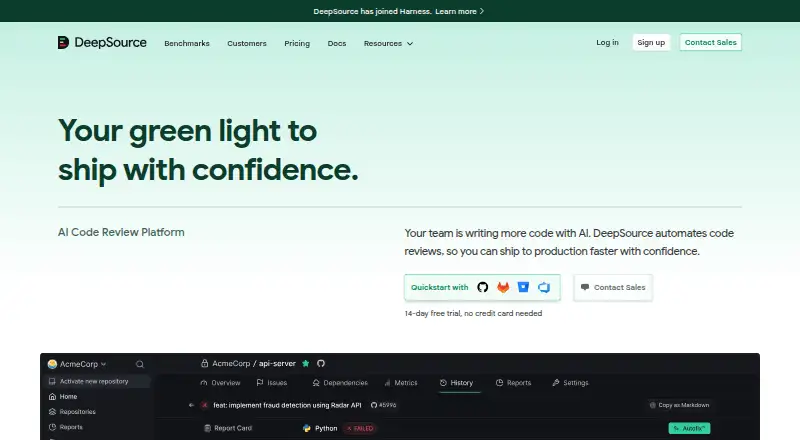
What DeepSource is
DeepSource is an AI code review platform for teams writing code with AI. It reviews pull requests using hybrid static analysis and an AI review agent to check for bugs, anti-patterns, and security vulnerabilities, drawing on more than 5,000 deterministic rules. Autofix can provide verified, pre-generated patches for many detected issues. Other tools detect secrets, scan open-source dependencies for vulnerabilities, review Terraform and CloudFormation infrastructure code, and track code coverage with configurable thresholds for tested code. Supported version-control services include GitHub, GitLab, Bitbucket, and Azure DevOps; listed integrations also include Jira, Okta, OneLogin, Slack, and Vanta. DeepSource is available through web, API, Linux, macOS, Windows, and self-hosted deployment. Its GraphQL API has a documented limit of 5,000 requests per hour per user. The Open Source plan is free; Team costs $24/user/mo billed yearly, and a 14-day trial is available. Enterprise uses custom pricing and lists cloud or self-hosted deployment, as well as airgapped deployment.
Good
- Reviews pull requests with more than 5,000 rules
- Autofix offers verified, pre-generated patches
- Scans secrets, dependencies, and infrastructure code
- Free Open Source plan is available
Watch out
- Team costs $24/user/mo billed yearly
- GraphQL API limit is 5,000 requests per hour per user
Who it suits
It suits software teams looking for pull-request review and code-security checks alongside coverage tracking. Teams can compare the free Open Source tier with Team or Enterprise, depending on their listed allowances and deployment needs.
Verdict
DeepSource combines pull-request review with security scanning and coverage controls. Review the free tier’s monthly allowances and the paid plans’ pricing and deployment terms before choosing.
Plans and prices
From DeepSource's own pricing page, checked 14 Oct 2026.
| Plan | Price | What it gives you |
|---|---|---|
| Individual | Free | public and private repositories · unlimited static-analysis and formatter runs · AI features metered · free |
| Open Source | Free | public repositories only · 1,000 static-analysis runs/month · 1,000 formatter runs/month · AI features metered · free |
| SCA add-on | $8 a month | Team and Enterprise only · three targets included in those plans · per dependency target; $96 per target annually |
| AI Review Standard | $8, paid once | default AI Review tier · per 10,000 processed lines of code after included credits |
| AI Review Advanced | $15, paid once | multi-pass analysis and extended reasoning; listed as coming soon · per 10,000 processed lines of code after included credits |
| Team | $30 a month | public and private repositories · unlimited analysis and formatter runs · $10 monthly or $100 annual AI credits per contributor · three SCA targets included · monthly per active contributor; $24 per contributor when billed annually |
| Enterprise | Priced on request | Team features · BYOK AI · SSO/SCIM · self-hosted deployment · IP allowlisting · SLA support · custom pricing |
The facts
Each one read from DeepSource's own pages, with the date it was checked.
What it does
- API
- DeepSource provides a GraphQL API with a documented limit of 5,000 requests per hour per user.checked 8 Oct 2026
- Autofix
- AI-powered Autofix supplies automated remediation for many detected code issues.checked 14 Oct 2026
- CLI
- The command-line client retrieves issues, metrics, vulnerabilities and reviews, submits coverage artifacts, and supports JSON output for automation.checked 14 Oct 2026
- CLI availability
- DeepSource CLI binaries are documented for Linux amd64 and arm64, macOS amd64 and arm64, and Windows amd64.checked 8 Oct 2026
- CLI license
- DeepSource's public CLI repository is licensed under the BSD 2-Clause Simplified License.checked 14 Oct 2026
- Compliance reporting
- Reporting includes OWASP Top 10, CWE/SANS Top 25 and MISRA C reports.checked 14 Oct 2026
- Coverage
- Code Coverage tracks line, branch and composite coverage on pull requests and can enforce merge thresholds.checked 14 Oct 2026
- Dependency security
- OSS Vulnerability Scanning performs dependency analysis with reachability information and one-click remediation.checked 14 Oct 2026
- Deployment
- Enterprise customers can choose self-hosted deployment, and the pricing page also lists airgapped deployment as an Enterprise capability.checked 8 Oct 2026
- Documentation and support
- Documentation includes product guides, API reference, CLI installation and usage, self-hosting, billing and troubleshooting FAQs.checked 14 Oct 2026
- Funding
- Wellfound reports $7.7 million raised in one round, with the latest funding dated October 2021.checked 14 Oct 2026
- GraphQL API
- DeepSource exposes a GraphQL API at https://api.deepsource.com/graphql/ for cloud accounts and a corresponding hostname-based endpoint for on-premise deployments.checked 14 Oct 2026
- Infrastructure-as-code review
- Infrastructure-as-Code Review checks Dockerfiles, Terraform plans and Ansible playbooks for security and best-practice problems.checked 14 Oct 2026
- Integrations
- The directory lists integrations for Azure DevOps Services, Bitbucket, GitHub, GitLab, Jira, Okta, OneLogin, Slack, and Vanta.checked 8 Oct 2026
- License compliance
- License Compliance evaluates full transitive dependency trees against team policies using SPDX identifiers.checked 14 Oct 2026
- Limit: advanced rules
- A Gartner-listed critical review says advanced rules can be difficult for beginners.checked 14 Oct 2026
- Limit: reporting maturity
- A G2 reviewer said insights and reporting were still early in development.checked 14 Oct 2026
- Praise: analysis depth
- Capterra's highlighted reviewer praised ease of setup, a comprehensive dashboard and customizable analysis rules.checked 14 Oct 2026
The company
- Company profile
- LinkedIn lists DeepSource as a privately held software-development company headquartered in San Francisco, with 11–50 employees and a 2018 founding year.checked 14 Oct 2026
- Company scale
- Y Combinator's profile says DeepSource has a 12-person team and serves more than 7,000 teams.checked 14 Oct 2026
- Founded
- 2018checked 28 Sep 2026
- Ownership news
- Y Combinator lists DeepSource as acquired and reports news dated September 8, 2026 that it is joining Harness.checked 14 Oct 2026
Money
- Free tier limits
- The Open Source tier lists unlimited public repositories and members, with 1,000 pull request reviews and 1,000 automated formatting runs per month.checked 8 Oct 2026
- Limit: free-plan automation
- A Software Advice reviewer complained that the free plan did not include automated analysis and required manual pull-request review.checked 14 Oct 2026
The full review of DeepSource
DeepSource is a code review and security platform for teams that want automated checks in their pull request workflow. It is strongest for teams combining code quality, security scanning, and coverage controls across major Git providers. The broad scope is useful, though the free tier’s review caps and the Team plan’s limited AI credit matter when estimating ongoing use.
Overview
Founded in 2018, DeepSource combines static analysis with an AI review agent to flag bugs, anti-patterns, and security vulnerabilities in pull requests. Its more than 5,000 deterministic rules give teams repeatable checks alongside AI review. This makes it a credible option for teams that want several review and security tasks in one workflow; it is less compelling for teams needing only a focused scanner.
Key features
Pull request review and fixes
DeepSource reviews pull requests and offers verified, pre-generated patches for many detected issues through Autofix. That can shorten the route from finding a problem to addressing it, although patches are not promised for every finding. The combination of deterministic rules and AI review gives teams more than one way to surface issues, but AI use has a cost implication: Open Source users pay as they go for AI Review and Autofix, while Team includes a defined AI Review credit.
Security and coverage
Security scanning covers exposed secrets, vulnerabilities in open-source dependencies, and infrastructure-as-code review for Terraform and CloudFormation. Coverage tracking and enforceable thresholds help teams set expectations for tested code. Taken together, these controls suit teams that want quality checks and security review alongside pull requests; teams that only need one of these functions may find the package broader than necessary.
Integrations and access
DeepSource supports GitHub, GitLab, Bitbucket, and Azure DevOps for source control, with integrations for Jira, Okta, OneLogin, Slack, and Vanta as well. Its GraphQL API allows up to 5,000 requests per hour per user. The CLI has binaries for Linux, macOS, and Windows across the documented processor architectures. The Trust Center lists SOC 2 and GDPR compliance and describes encryption, restricted production access, and penetration testing.
Pricing
Open Source
The free Open Source tier allows unlimited public repositories and team members, with 1,000 pull request reviews and 1,000 automated formatting runs each month. It is a good fit for open-source teams whose activity fits those monthly caps. Private repository access is not part of this tier, and AI Review and Autofix are pay-as-you-go, so the free price does not mean unlimited use of every feature.
Team
Team costs $24 per user/month, billed yearly. It includes unlimited repositories and pull request reviews, $100 in annual AI Review credit per user, three open-source dependency scanning targets, and priority support. Additional dependency scanning targets cost $8/month each. This is the practical choice for teams that need private repositories or have outgrown the free review quota, though AI-heavy teams may exceed the included credit.
Enterprise
Enterprise has custom pricing and includes Team features, Enterprise Cloud or self-hosted deployment, airgapped deployment, BYOK for AI Review, SSO, priority support with an SLA, a dedicated account manager, and migration assistance. It fits organizations with deployment or support requirements that call for these controls; its custom pricing means teams should weigh those needs directly against the lower tiers.
A 14-day trial is available. The Team price is stated on an annual billing basis, so it is best assessed as a yearly commitment rather than a month-to-month rate.
Platforms
DeepSource is available on the web and supports API access, Linux, macOS, Windows, and self-hosted deployment. Self-hosted and airgapped deployment are Enterprise capabilities. The documented CLI binaries cover Linux amd64 and arm64, macOS amd64 and arm64, and Windows amd64.
Who it's for
DeepSource suits development teams that want pull-request review, security checks, and coverage enforcement together, particularly those already using GitHub, GitLab, Bitbucket, or Azure DevOps. Open-source maintainers with activity below the monthly caps can start without a subscription. Teams with private repositories or unlimited review needs will need Team, while organizations requiring self-hosting, airgapping, or enterprise support should consider Enterprise. A team seeking only one narrow scanning task may prefer a more specialized tool.
Pros and cons
Pros
- More than 5,000 deterministic rules combined with AI review cover several kinds of pull-request issues.
- Security scanning spans secrets, open-source dependencies, and Terraform and CloudFormation infrastructure code.
- Coverage thresholds let teams make tested-code requirements part of review.
- The free tier permits unlimited public repositories and members, with a substantial monthly review allowance for qualifying open-source use.
Cons
- The free tier caps pull request reviews and formatting runs at 1,000 each per month.
- Open Source AI Review and Autofix are pay-as-you-go, and Team’s annual AI Review credit is limited to $100 per user.
- Team’s dependency scanning allowance covers three targets; each additional target adds $8/month.
- Enterprise pricing is custom, making costs harder to compare before discussing organizational requirements.
Alternatives
Code Quality Management Software is the wider category to compare if you want to assess tools beyond DeepSource’s combined review and scanning approach. For a more focused review-tool comparison, see AI Code Review Tools. Teams prioritizing rule-based code checks can browse Static Analysis Tools, while those chiefly looking for exposed-credential detection can compare Secrets Scanning Software.
Qlty Cloud is worth comparing for its Pro plan, which includes 20,000 analysis minutes and 5,000 AI autofixes per month for $20 a month. Qodana is another freemium option with a free Community plan and a 14-day trial. CodeScene may suit open-source projects seeking its free Community Edition, which includes automated PR reviews and hotspot reporting. Codacy offers a free Developer plan with an IDE plugin and support for 38 programming languages. GitHub Codespaces is a freemium development environment alternative. QualityGate, ReSharper, and Gitar are additional options to compare.
Verdict
Choose DeepSource if your team wants pull-request review, security scanning, and coverage controls in a single workflow, with a free path for public repositories and a clear paid step when review volume grows. Its breadth and large rule library are the main reasons to choose it. Look elsewhere if your needs are narrow, if pay-as-you-go AI costs are a poor fit, or if the Team plan’s annual billing and limited AI credit do not suit your expected usage.
Getting started
- Open the DeepSource website
- Choose the Open Source, Team, or Enterprise plan
- Connect GitHub, GitLab, Bitbucket, or Azure DevOps repositories
- Use the web interface, API, or documented CLI binaries on a supported operating system
- Select cloud, self-hosted, or airgapped Enterprise deployment when applicable
Limits worth knowing
The free Open Source plan allows 1,000 pull-request reviews and 1,000 automated formatting runs per month; AI Review and Autofix are pay-as-you-go. Team includes three open-source dependency scanning targets, with additional targets costing $8/month each.
Questions
Is DeepSource free?
Yes. The Open Source plan is free and includes unlimited public repositories and team members.
What does Team cost?
Team costs $24 per user per month when billed yearly, and includes a $100 annual AI Review credit per user.
Which version-control systems are supported?
DeepSource supports GitHub, GitLab, Bitbucket, and Azure DevOps.
Does DeepSource offer self-hosting?
Enterprise customers can choose Enterprise Cloud or self-hosted deployment; airgapped deployment is also listed as an Enterprise capability.
What platforms can run DeepSource tools?
It is available on the web, API, Linux, macOS, Windows, and self-hosted environments. CLI binaries are documented for Linux, macOS, and Windows architectures listed by DeepSource.
Is there a trial?
A 14-day trial is available.
Alternatives to DeepSource
- 1

Cubic
Free planWebAPILinuxmacOS7.9From $30 a month - 2

Sourcery
Free planWebAPIExtensionLinux7.9From $12 a month - 3

Ellipsis
Free planWebAPILinuxmacOS7.8Free plan - 4

Greptile
Free planWebAPIExtensionLinux7.7From $30 a month - 5

CodeAnt AI
Free planWebAPIExtensionSelf-hosted7.5From $20 a month - 6

CodeRabbit
Free planWebAPIExtensionLinux7.5Free plan