
Qodana
Qodana is a static code analysis tool that checks projects from the IDE through CI for code smells, duplication, complexity, vulnerabilities, and license iss…
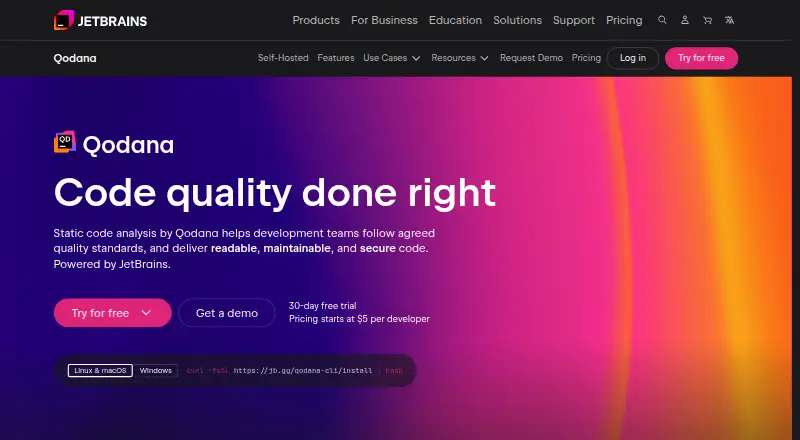
What Qodana is
Qodana is a static code analysis tool that checks projects from the IDE through CI for code smells, duplication, complexity, vulnerabilities, and license issues. Baselines distinguish findings that are new, unchanged, or resolved. Quality gates can block CI/CD pipelines based on issue counts, severity, coverage, or vulnerable and license-incompatible dependencies; taint analysis can identify risks such as SQL injection, cross-site scripting, command injection, and path traversal. Qodana supports most JetBrains IDEs, plus VS Code, Visual Studio, and Cursor. Listed CI integrations include GitHub Actions, GitLab, TeamCity, Jenkins, and Azure Pipelines, and Docker images can be used in CI/CD pipelines. Self-Hosted runs within an organization’s infrastructure, with Docker and Kubernetes deployment options. The free Community plan includes one team and 30 days of detailed history. Ultimate is $5.00 per active contributor per month, billed annually at $60.00; Ultimate Plus is $15.00 per active contributor per month, billed annually at $180.00. Licensing is based on contributors active in the past 90 days, with a three-contributor minimum.
Good
- Free Community plan.
- Works with major IDEs and listed CI systems.
- Baselines track issue status.
- Quality gates can block CI/CD pipelines.
- Self-Hosted offers Docker and Kubernetes options.
Watch out
- Paid licensing has a three-contributor minimum.
- Paid prices are per active contributor.
- Ultimate and Ultimate Plus are billed annually.
Who it suits
Qodana suits development teams that want code analysis and pipeline checks across supported IDEs and CI systems. Organizations that need the service inside their own infrastructure can consider Self-Hosted.
Verdict
Qodana combines static analysis with baselines and configurable pipeline gates. Compare the contributor-based licensing and deployment requirements with your team’s setup.
Plans and prices
From Qodana's own pricing page, checked 14 Oct 2026.
| Plan | Price | What it gives you |
|---|---|---|
| Community | Free | JVM, Android, Python, .NET, C, C++ · 1 team · 30-day Cloud history · quality gates and baseline |
| Ultimate | $5 a month | broader language coverage · unlimited projects, reports, LOC and tests · 180-day history · security analysis · code coverage · quick-fix · billed annually at $60.00; minimum 3 active contributors |
| Ultimate Plus | $15 a month | Ultimate features · unlimited historical data · global configuration · Insights · license audit · Cloud API · SSO · taint analysis · vulnerability checker · billed annually at $180.00; minimum 3 active contributors |
| Ultimate Plus Self-Hosted | Priced on request | on-premises deployment through CLI installer or Kubernetes Helm chart · custom pricing; volume discount available; minimum 5 active contributors |
The facts
Each one read from Qodana's own pages, with the date it was checked.
What it does
- Analysis coverage
- JetBrains advertises more than 2,500 inspections across supported language linters.checked 14 Oct 2026
- API
- The Qodana Cloud API can be used to create teams and projects in Qodana Cloud and Qodana Self-Hosted.checked 30 Sep 2026
- API licensing
- Qodana Cloud API access is limited to the Ultimate Plus license and requires an Owner or Admin organization role to create tokens.checked 14 Oct 2026
- Baseline
- Baseline categorizes existing findings so teams can focus on new, unchanged and resolved problems.checked 14 Oct 2026
- Baselines
- Baseline functionality categorizes code issues as new, unchanged, or resolved relative to a baseline.checked 30 Sep 2026
- CI integrations
- Native integrations cover GitHub Actions, GitLab CI/CD, TeamCity, Azure Pipelines and CircleCI; Docker supports other systems including Jenkins and Bitbucket Cloud.checked 14 Oct 2026
- CLI license
- The public qodana-cli repository is licensed under Apache License 2.0.checked 14 Oct 2026
- Code coverage
- Coverage reports can be imported, viewed in IDEs and enforced as CI quality-gate thresholds.checked 14 Oct 2026
- Gradle extensibility
- The org.jetbrains.qodana Gradle plugin exposes qodanaScan and configurable project, results and cache paths.checked 14 Oct 2026
- IDE support
- Qodana integrates with JetBrains IDEs and also supports Visual Studio Code, Visual Studio and Cursor.checked 14 Oct 2026
- Languages
- The paid editions support Groovy, Java, Kotlin, Python, C, C#, C++, VB.NET, Go, JavaScript, PHP, Ruby, Rust, and TypeScript.checked 30 Sep 2026
- License audit
- License audit checks dependency and project licenses and supports Maven, Gradle, Composer, npm, Yarn, pip, Go Modules and NuGet depending on the linter.checked 14 Oct 2026
- License limit
- The license cost is based on active contributors over the past 90 days, with a minimum of three contributors.checked 30 Sep 2026
- Limit: dashboard usability
- The DEV reviewer found report navigation click-heavy and said circular chart text was difficult to read.checked 14 Oct 2026
- Limit: Docker footprint
- The DEV reviewer reported needing Docker Desktop because Rancher Desktop was unsupported and said Qodana images started around 4 GB.checked 14 Oct 2026
- Limit: ecosystem gaps
- G2 reviewers requested better C/C++ support and learning resources and reported that support for new .NET releases can lag.checked 14 Oct 2026
- Limit: findings controls
- A G2 reviewer said individual false positives could not be disabled, while others called some analyses basic and wanted stronger security review or AI optimization.checked 14 Oct 2026
- Limit: license-audit export
- The DEV reviewer said CSV SBOM exports omitted dependency type and package manager, creating ambiguity for identical package names.checked 14 Oct 2026
- Limit: license-audit reliability
- The DEV reviewer reported license auditing failed on an NGXS Yarn repository despite the documentation listing Yarn support.checked 14 Oct 2026
The company
- Company founded
- JetBrains was founded in 2000 and is privately held, according to its LinkedIn company profile.checked 14 Oct 2026
- Company legal entity
- Crunchbase identifies the maker as JetBrains s.r.o., a private for-profit company founded by Eugene Belyaev, Sergey Dmitriev and Valentin Kipiatkov.checked 14 Oct 2026
- Company scale
- JetBrains reports more than 2,600 employees across 13 offices in its 2026 annual highlights.checked 14 Oct 2026
- Headquarters
- Amsterdam, Netherlandschecked 23 Sep 2026
Money
- Contributor billing
- Paid pricing counts people or bots committing to organization projects during the previous 90 days and applies a minimum of three contributors.checked 14 Oct 2026
The full review of Qodana
Overview
Qodana is JetBrains’ static-analysis software for teams that want code checks in both the IDE and CI/CD. It is best suited to development teams that need to manage existing findings while enforcing standards on new changes. Its breadth is a strength, though contributor-based licensing and self-hosted infrastructure requirements can complicate the fit.
Key features
Keep legacy findings in perspective
Qodana compares issues with a baseline and classifies them as new, unchanged, or resolved. That lets teams focus on findings introduced by current work rather than treating an inherited backlog as equally urgent.
Make analysis enforceable
Quality gates can block a CI/CD pipeline based on issue counts, severity, coverage, or vulnerable and license-incompatible dependencies. This makes Qodana more consequential than a report-only check, but teams should decide which thresholds are appropriate before making them release blockers.
Look for security and license risks
Taint analysis targets risks including SQL injection, cross-site scripting, command injection, and path traversal. Qodana also detects vulnerabilities and license issues, alongside code smells, duplication, and complexity; that combination is useful when teams want quality and risk checks in one workflow.
Work across IDEs and pipelines
Qodana supports most JetBrains IDEs as well as VS Code, Visual Studio, and Cursor. Listed CI integrations include GitHub Actions, GitLab, TeamCity, Jenkins, and Azure Pipelines, while Docker images can run in virtually any CI/CD pipeline. The paid editions support Groovy, Java, Kotlin, Python, C, C#, C++, VB.NET, Go, JavaScript, PHP, Ruby, Rust, and TypeScript; the broader language support spans more than 60 languages.
Choose cloud or self-hosting
Qodana offers cloud and self-hosted deployment. Self-Hosted keeps the service within an organization’s infrastructure and supports Kubernetes or Docker deployment. Docker requires a Linux server with Docker Engine and Docker Swarm, so it brings operational prerequisites that hosted use avoids. The Cloud API can create teams and projects in both Qodana Cloud and Qodana Self-Hosted.
Pricing
Qodana has a free Community plan and a 30-day trial. Licenses are priced by active contributors over the past 90 days, with a minimum of three contributors. That minimum matters even for a small team, and paid annual billing makes the actual commitment larger than a simple monthly rate suggests.
| Plan | Price and terms | Included |
|---|---|---|
| Community | free, billed FREE per active contributor*/month | 1 team, 30 days of detailed historical data, unlimited LOCs, projects, and reports |
| Ultimate | $5 a month; billed $5.00 per active contributor*/month (billed annually at $60.00) | Unlimited teams, 180 days of detailed historical data, unlimited LOCs, projects, and reports |
| Ultimate Plus | $15 a month; billed $15.00 per active contributor*/month (billed annually at $180.00) | Unlimited teams, unlimited historical data, unlimited LOCs, projects, and reports |
Community is a reasonable starting point for one team that can work within a month of detailed history; it does not cap code volume, projects, or reports. Ultimate adds unlimited teams and six months of detailed history, while Ultimate Plus is for teams that need unlimited historical data. Both paid tiers retain unlimited LOCs, projects, and reports, so the main stated distinction is team and history allowance.
Platforms
Qodana is available for API, Linux, macOS, self-hosted, web, and Windows environments. Teams can use its IDE integrations and CI options to place checks within existing development workflows.
Who it's for
Qodana is a strong fit for multi-contributor teams that want to separate new defects from inherited issues and make analysis results affect CI/CD decisions. Its deployment flexibility also suits organizations that need an on-premises option and can operate the required infrastructure. Solo developers and very small projects should weigh the three-contributor license minimum, while teams seeking only a downloadable analyzer may prefer a narrower tool.
Pros and cons
- Pros: Baselines distinguish new findings from existing ones, helping teams manage a backlog without losing sight of fresh problems.
- Pros: Configurable gates can block pipelines for code, coverage, security, and license conditions.
- Pros: Cloud and self-hosted deployment, multiple IDEs, and broad CI integrations give teams several ways to fit analysis into their workflow.
- Cons: Paid licensing has a three-contributor minimum, which can be awkward for solo users or small projects.
- Cons: Self-hosted Docker deployment requires Linux, Docker Engine, and Docker Swarm, adding infrastructure work.
- Cons: Paid plans are billed annually, and Ultimate Plus costs more for teams that need unlimited history.
Alternatives
For teams focused specifically on open-source dependency analysis, Snyk Open Source has a free tier with five projects and access to Snyk Open Source (SCA), as well as a $25.00-per-month Team plan. If a free, downloadable analyzer is the priority, Infer offers a binary, source build, or Docker image. PMD is another free downloadable static code analyzer, under a BSD-style license.
For C and C++ code specifically, Clang Static Analyzer is 100% open source and analyzes C, C++, and Objective-C. Cppcheck offers a free-to-download open-source plan with core static analysis, with a Project plan for teams considering a paid option. Semgrep Code may suit teams comfortable with a free edition capped at 10 repositories, 10 contributors, and 60 AI credits.
MATLAB Grader is free with a MATLAB license current under maintenance; LMS integration requires a qualifying academic license. CodeScene is another option to compare for automated PR reviews, hotspots, knowledge distribution, and PDF reports in its free Community Edition.
Browse Static Analysis Tools, Code Quality Management Software, or C and C++ Static Analysis Tools to compare category options.
Verdict
Choose Qodana if your multi-contributor team needs static analysis that can follow code from the IDE into CI/CD, with baselines, enforceable gates, and cloud or self-hosted deployment. Its clearest reason to look elsewhere is the contributor minimum; for a solo developer or a small project, that licensing structure may outweigh the workflow breadth.
Getting started
- Visit https://www.jetbrains.com/qodana/.
- Choose the free Community plan or review the paid Ultimate and Ultimate Plus plans.
- Connect Qodana to a supported IDE or CI/CD system.
- For self-hosting, choose Docker or Kubernetes deployment.
- For Docker deployment, use a Linux server with Docker Engine and Docker Swarm.
Limits worth knowing
Community is limited to one team and 30 days of detailed historical data. Ultimate provides 180 days of detailed history; Ultimate Plus provides unlimited historical data. Licensing is based on active contributors over the past 90 days, with a minimum of three contributors.
Questions
Is Qodana free?
Yes. The Community plan is free and includes one team, 30 days of detailed historical data, and unlimited LOCs, projects, and reports.
What do the paid plans cost?
Ultimate is $5.00 per active contributor per month, billed annually at $60.00. Ultimate Plus is $15.00 per active contributor per month, billed annually at $180.00.
How is the license calculated?
The license cost is based on active contributors over the past 90 days, with a minimum of three contributors.
Which IDEs and CI systems does it support?
It supports most JetBrains IDEs, VS Code, Visual Studio, and Cursor. Listed integrations include GitHub Actions, GitLab, TeamCity, Jenkins, and Azure Pipelines.
Can Qodana be self-hosted?
Yes. Qodana Self-Hosted runs within an organization’s infrastructure and offers Kubernetes and Docker deployment options.
Alternatives to Qodana
- 1

DeepSource
Free planWebAPILinuxmacOS8.0From $30 a month - 2

GitHub CodeQL
Free planWebExtensionLinuxmacOS7.5From $30 a month - 3

Cppcheck
Free planOpen sourceLinuxmacOSSelf-hostedWindows7.4Free plan - 4

Gitar
Free planWebAPISelf-hosted7.2From $20 a month - 5
gosec
Free planOpen sourceAPILinuxmacOSSelf-hosted7.2Free plan - 6

Understand
APIExtensionLinuxmacOS7.2From $100 a month