Clang Static Analyzer
Clang Static Analyzer finds selected bugs in C, C++, and Objective-C programs by using symbolic execution to examine execution paths across function calls.
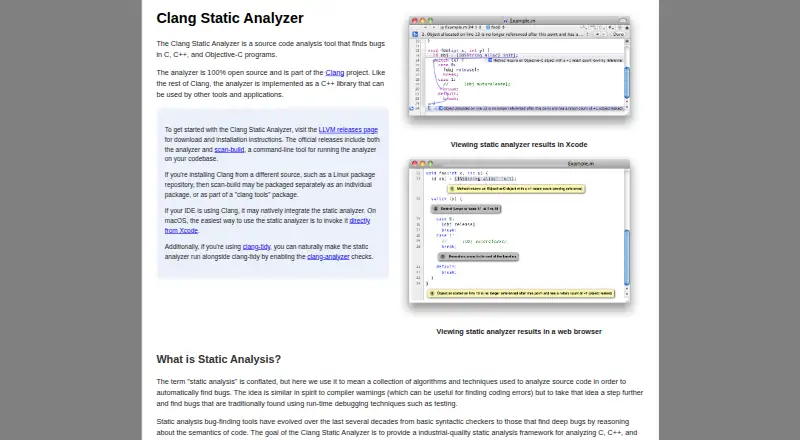
What Clang Static Analyzer is
Clang Static Analyzer finds selected bugs in C, C++, and Objective-C programs by using symbolic execution to examine execution paths across function calls. It is part of the open-source Clang project and is also available as a reusable C++ library for other tools and applications. Official releases include scan-build, a command-line tool for analyzing a codebase. On macOS, users can invoke the analyzer from Xcode; it can also run alongside clang-tidy when clang-analyzer checks are enabled. Clang-based IDEs may integrate it natively, and the documentation covers scan-build and CodeChecker. The analyzer runs on Linux, macOS, and Windows, and is self-hosted. Its scope is limited to bugs it was designed to detect. Analysis can be much slower than compilation, some algorithms have exponential worst-case time, and results may include false positives. The free plan is free.
Good
- Free and open source.
- Supports C, C++, and Objective-C.
- Includes scan-build for command-line analysis.
- Can integrate with Xcode and clang-tidy.
Watch out
- Analysis can take longer than compilation.
- Some algorithms have exponential worst-case time.
- Results may include false positives.
- Detects only bugs it was designed to find.
Who it suits
It suits developers working in C, C++, or Objective-C who want static analysis within a Clang-based workflow. It may also suit tool authors who can use its reusable C++ library.
Verdict
Clang Static Analyzer provides free static analysis for three programming languages, with command-line and IDE integration options. Its scope is specific, and analysis time and false positives are worth considering.
Plans and prices
From Clang Static Analyzer's own pricing page, checked 2 Oct 2026.
| Plan | Price | What it gives you |
|---|---|---|
| Clang Static Analyzer | Free | 100% open source · analyzes C, C++ and Objective-C |
The facts
Each one read from Clang Static Analyzer's own pages, with the date it was checked.
What it does
- Additional tooling
- The documentation provides command-line usage guidance for scan-build and CodeChecker.checked 2 Oct 2026
- Analysis method
- It implements path-sensitive, inter-procedural analysis based on symbolic execution.checked 2 Oct 2026
- clang-tidy integration
- The analyzer can run alongside clang-tidy by enabling clang-analyzer checks.checked 2 Oct 2026
- Command line
- Official releases include scan-build, a command-line tool for running the analyzer on a codebase.checked 2 Oct 2026
- Community support
- LLVM provides a Discourse forum and mailing-list announcement category for release notifications.checked 2 Oct 2026
- Contributions
- Users can report false positives, file feature requests or contribute patches.checked 2 Oct 2026
- False positives
- The analyzer can falsely flag bugs in code that behaves correctly, with frequency varying by check.checked 2 Oct 2026
- IDE integration
- An IDE using Clang may natively integrate the static analyzer.checked 2 Oct 2026
- Library
- The analyzer is implemented as a reusable C++ library for other tools and applications.checked 2 Oct 2026
- License
- Current LLVM releases are distributed under the Apache-2.0 with LLVM-exception license.checked 2 Oct 2026
- Open source
- The analyzer is 100% open source and part of the Clang project.checked 2 Oct 2026
- Performance limitation
- Static analysis can be much slower than compilation and some algorithms require exponential time in the worst case.checked 2 Oct 2026
- Purpose
- Clang Static Analyzer finds bugs in C, C++ and Objective-C programs.checked 2 Oct 2026
- Release verification
- LLVM says source packages and git tags are signed by release managers and provides GnuPG keys for verification.checked 2 Oct 2026
- Scope limitation
- The analyzer can only find bugs it has been specifically engineered to find.checked 2 Oct 2026
- Xcode integration
- On macOS, the easiest way to use the analyzer is to invoke it directly from Xcode.checked 2 Oct 2026
The full review of Clang Static Analyzer
Overview
Clang Static Analyzer is a free, open-source bug-finding tool for C, C++ and Objective-C. It is best suited to developers already working with Clang or Xcode who want static analysis in a local workflow. Its path-aware analysis and several integration routes are useful, but slower runs, false positives and a narrow, engineered scope make it a complement to—not a replacement for—testing and review.
It analyzes program paths using symbolic execution and follows behavior across function boundaries. That can help uncover bugs that a check limited to individual statements may miss, while the analyzer’s scope remains bounded by the bug patterns it was designed to find. It is also built as a reusable C++ library, making it suitable as an analysis engine for other tools and applications.
Clang Static Analyzer is self-hosted rather than a hosted analysis service. Static analysis can take much longer than compilation, and some algorithms have exponential worst-case time. Reports may also flag code that behaves correctly; the frequency varies by check, so teams should expect to review findings rather than treat every warning as a confirmed defect.
Key features
- Path-sensitive, inter-procedural analysis: Symbolic execution examines program paths and behavior across function boundaries, which is more context-aware than checking statements in isolation.
- scan-build command line: Official releases include this command-line tool for running the analyzer on a codebase, a practical route for developers who prefer a local command workflow.
- Clang and Xcode integration: An IDE using Clang may integrate the analyzer natively; on macOS, it can be invoked directly from Xcode. This makes it a natural option for existing Clang and Xcode users, rather than a reason on its own to switch development environments.
- clang-tidy checks: It can run alongside clang-tidy by enabling clang-analyzer checks, allowing teams to include its analysis in that tool’s workflow.
- Reusable C++ library: Other tools and applications can use the analyzer as a library, which is valuable for integrations beyond the supplied command-line route.
- Open development and release verification: The analyzer is part of the Clang project and 100% open source. Current LLVM releases use the Apache-2.0 with LLVM-exception license; LLVM also provides signed source packages and git tags for verification, alongside GnuPG keys. Users can report false positives, request features or contribute patches.
LLVM documentation also provides command-line guidance for scan-build and CodeChecker. Community support includes a Discourse forum and a mailing-list announcement category for release notifications.
Pricing
Clang Static Analyzer costs nothing, with a free plan and no free trial. The plan is 100% open source and analyzes C, C++ and Objective-C. There is no paid tier to unlock a larger allowance, but teams should weigh that zero price against the time required to run analyses and review false positives.
Platforms
The analyzer supports Linux, macOS and Windows and is self-hosted. IDE support is available, with direct Xcode use on macOS and potential native integration in IDEs using Clang. It also supports command-line use through scan-build and can run clang-analyzer checks alongside clang-tidy.
Who it's for
This is a strong fit for C, C++ and Objective-C developers who use Clang, want a free local analyzer, or need a reusable C++ analysis library. Xcode users have a particularly direct route on macOS, while command-line users can run scan-build over a codebase. It is less suitable as the sole safeguard for projects: slow analysis, check-dependent false positives and its limited engineered scope call for other methods of finding bugs as well.
Pros and cons
- Pro — No-cost, open-source use: The free plan covers analysis of all three supported languages, and the Apache-2.0 with LLVM-exception license applies to current LLVM releases.
- Pro — Multiple integration paths: Developers can use scan-build, invoke the analyzer from Xcode, enable clang-analyzer checks in clang-tidy, or use it through a Clang-based IDE.
- Pro — Extensible implementation: Its reusable C++ library lets other tools and applications build on the analyzer.
- Con — Potentially slow analysis: Runs can take much longer than compilation, and some algorithms have exponential worst-case time, which may complicate frequent use on large codebases.
- Con — Findings need judgment: False positives vary by check, so developers must spend time distinguishing actionable reports from code that behaves correctly.
- Con — Limited detection scope: It only finds bugs it was engineered to detect, so it cannot stand in for broader quality and testing practices.
Alternatives
For a wider comparison, browse C and C++ Static Analysis Tools or Static Analysis Tools.
- Flawfinder is another free, open-source option for Linux, macOS, Windows and self-hosted use.
- Infer is a free alternative for supported programming languages, available as a downloadable binary, source build or Docker image.
- GitHub CodeQL may suit readers looking for a free research and open-source-code plan or a paid GitHub Code Security plan at $30 a month; the free plan is limited to research use and open-source codebases.
- Frama-C is another free option for Linux, macOS and Windows, co-developed by CEA LIST and the Inria Saclay–Île-de-France Toccata team with LRI-CNRS and Université Paris-Sud 11.
- Polyspace is a paid alternative for Linux, macOS, Windows and web.
- CBMC is a free, BSD 4-clause-licensed command-line option for Linux, macOS and Windows.
- Perforce QAC (formerly Helix QAC) is a paid alternative for Linux, Windows and web.
- PVS-Studio offers a free trial and a Team plan for fewer than 10 developers, with basic support and one supported platform; its Enterprise plan is also available.
Verdict
Choose Clang Static Analyzer if you write C, C++ or Objective-C and want free, open-source analysis that fits a Clang, Xcode or command-line workflow. Its strongest reason to choose is the combination of path-aware analysis, broad integration options and a reusable library at no cost. Look elsewhere if you need analysis beyond those languages or bug categories, or if slow runs and false-positive review would outweigh the value of local static checking.
Alternatives to Clang Static Analyzer
- 1

Semgrep Code
Free planOpen sourceWebAPIExtensionLinux8.3From $15 a month - 2

Qodana
Free planWebAPIExtensionLinux7.9From $5 a month - 3

GitHub CodeQL
Free planWebExtensionLinuxmacOS7.5From $30 a month - 4

Understand
APIExtensionLinuxmacOS7.2From $100 a month - 5
Infer
Free planWebLinuxmacOSSelf-hosted6.7Free plan - 6
CBMC
Free planLinuxmacOSWindows6.5Free plan