
Cppcheck
Cppcheck is a static analysis tool for C and C++ code.
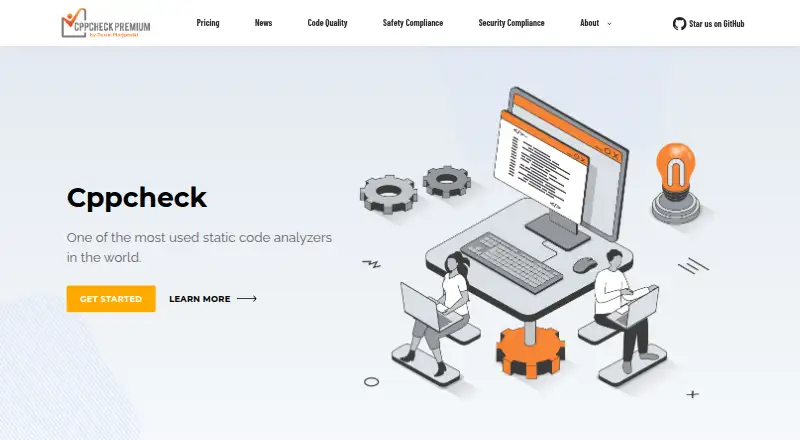
What Cppcheck is
Cppcheck is a static analysis tool for C and C++ code. It checks for bugs, undefined behavior, and dangerous coding constructs, and it can analyze non-standard syntax commonly used in embedded projects. It fully supports C++11, C++14, and C++17, with partial support for C++20. Listed integrations include Visual Studio, VSCode, Keil, Eclipse, CLion, Qt Creator, and C++ Builder. Its Soundy bug-hunting mode is intended to help identify hard-to-find bugs discovered during testing.
The Open-source plan is free to download and use, and provides core static analysis functionality. Premium plans add checks for safety standards including MISRA C:2023 and C:2025, MISRA C++ 2008 and 2023, and AUTOSAR C++ 2014, with compliance reports for supported standards. Premium also supports checks for CERT C 2016, CERT C++ 2016, and CWE Top 25. Cppcheck Premium is described as TÜV SÜD certified for safety-critical development, covering standards including IEC 61508, ISO 26262, EN 50128, EN 50657, and EN 50716. The site offers a three-week free trial without a credit card or commitment. Project licensing has a five-user minimum and one Git repository with submodules; Enterprise supports unlimited repositories and air-gapped environments. Individual licensing excludes CI environments, virtual machines, and containers.
Good
- Free Open-source plan includes core static analysis.
- Analyzes non-standard syntax used in embedded projects.
- Fully supports C++11, C++14, and C++17.
- Lists integrations with seven development tools.
- Three-week trial requires no credit card or commitment.
- Enterprise supports CI/CD, virtual machines, containers, and air-gapped environments.
Watch out
- Individual licensing excludes CI environments, virtual machines, and containers.
- Project licensing requires at least five users.
- Project and premium plan prices require a tailored quotation.
Who it suits
Cppcheck suits C and C++ developers who want static analysis, including those working with non-standard embedded syntax. Premium plans are aimed at individual developers, teams, and larger organizations, including those with safety-critical development needs.
Verdict
Choose Cppcheck if you need C and C++ static analysis, particularly for non-standard embedded syntax or listed IDE integrations. Its free plan covers core analysis, while premium plans add standards checks; look elsewhere if you need CI, virtual-machine, or container support under an Individual license.
Plans and prices
From Cppcheck's own pricing page, checked 15 Oct 2026.
| Plan | Price | What it gives you |
|---|---|---|
| Cppcheck Premium trial | Free | Three-week evaluation · no credit card · no commitment |
| Open-source | Free | Free to download and use · Core static analysis functionality |
| Open-source Cppcheck | Free | Core static analysis · free to download and use |
| Individual | Priced on request | Standard support · No CI/CD integration · No air-gapped environments · Contact for a tailored quotation |
| Project | Priced on request | Minimum 5 users · One Git repository with submodules · Users counted as repository authors · No air-gapped environments · Contact for a tailored quotation |
| Project License | Priced on request | Minimum 5 users · one Git repository with submodules · prioritized second-line support · no air-gapped use |
| Enterprise | Priced on request | Unlimited repositories · Supports CI/CD, virtual machines, containers, and air-gapped environments · Enterprise support portal · Contact for a tailored quotation |
| Enterprise License | Priced on request | Minimum 25 users · unlimited repositories · air-gapped support · onboarding and configuration · enterprise support portal |
The facts
Each one read from Cppcheck's own pages, with the date it was checked.
What it does
- Analysis speed
- The vendor describes bidirectional analysis as very fast and says installation-to-result can take at most 30 minutes.checked 15 Oct 2026
- Baseline workflow
- The manual documents content-hash XML suppressions that keep accepted warnings stable when unrelated lines move.checked 15 Oct 2026
- Bug hunting
- Its “Soundy” bug-hunting mode is intended to help identify hard-to-find bugs discovered during testing.checked 3 Oct 2026
- Certification
- Cppcheck Premium is TÜV SÜD certified for safety-critical development, with coverage including IEC 61508, ISO 26262, EN 50128, EN 50657, and EN 50716.checked 3 Oct 2026
- CI deployment
- Project and Enterprise licenses support CI/CD and virtualized environments such as Docker; only Enterprise is marked for air-gapped use.checked 15 Oct 2026
- CLI and extensibility
- The documented command-line interface supports checker selection, error exit codes, parallel jobs, platform and standard settings, suppressions, templates and XML output.checked 15 Oct 2026
- Code coverage
- The tool is designed to analyze C and C++ containing non-standard syntax often found in embedded projects.checked 15 Oct 2026
- Compliance reports
- Compliance reports are available for the supported safety and security standards.checked 15 Oct 2026
- C++ standards
- Cppcheck fully supports C++11, C++14, and C++17, and partially supports C++20.checked 3 Oct 2026
- Custom addons
- Documentation allows custom addon scripts or JSON configurations through the --addon option, including Python-based checks.checked 15 Oct 2026
- Deployment
- Cppcheck can run locally and in air-gapped environments without license servers or network configuration.checked 15 Oct 2026
- Deployment limits
- The Individual license does not support CI environments, virtual machines, or containers; Enterprise supports those environments and air-gapped use.checked 3 Oct 2026
- Documentation and support
- The project publishes a manual, bug tracker, IRC support channel and contribution guidance, while noting that only a few bugs currently have detailed documentation.checked 15 Oct 2026
- IDE integrations
- Officially listed integrations include Visual Studio, VS Code, Keil, Eclipse, CLion, Qt Creator and C++ Builder.checked 15 Oct 2026
- Independent limitation
- Slant reviewers say Cppcheck's custom parser can miss some template constructs and may be weaker than Clang for certain bug patterns.checked 15 Oct 2026
- Integrations
- The site lists integrations with Visual Studio, VSCode, Keil, Eclipse, CLion, Qt Creator, and C++ Builder.checked 3 Oct 2026
- Intended users
- The company describes Cppcheck Premium licensing for individual developers, teams, and large organizations, including safety-critical industries.checked 3 Oct 2026
- Language standards
- Cppcheck fully supports C++11, C++14 and C++17, with partial C++20 support.checked 15 Oct 2026
- Limit: complex integration
- The Gartner review identifies integrating Cppcheck with complex C++ projects as a challenge.checked 15 Oct 2026
The company
- Company founding
- Cppcheck Solutions AB was founded in 2021 by Daniel Marjamäki, Pär Jelger and Magnus Janagård.checked 15 Oct 2026
- Company headquarters
- Cppcheck Solutions AB lists S:t Göransgatan 95, 112 45 Stockholm, Sweden.checked 15 Oct 2026
- Company size
- LinkedIn lists Cppcheck as privately held with 2–10 employees.checked 15 Oct 2026
- Founded
- 2021checked 28 Sep 2026
- Headquarters
- Stockholm, Swedenchecked 28 Sep 2026
The full review of Cppcheck
Cppcheck is a focused static analyzer for C and C++ that flags bugs, undefined behavior, and risky constructs. It is best suited to embedded developers, standards-driven teams, and organizations that need editor integrations around a C/C++ codebase. The free edition is a credible starting point, while compliance, support, and deployment flexibility determine whether a paid license is justified.
Overview
Cppcheck concentrates on two languages rather than spreading its analysis across a broad stack. Its ability to parse non-standard syntax commonly found in embedded projects is a meaningful practical advantage when conventional analyzers reject or misunderstand device-specific code. Language coverage is strongest through C++17: C++11, C++14, and C++17 are fully supported, while C++20 is only partially supported, so newer-standard projects should treat that as a constraint.
The Soundy bug-hunting mode is designed to surface difficult defects that may only emerge during testing. That makes it a useful complement to ordinary compile-time checks, although it does not turn Cppcheck into a complete testing system. Custom rules and security rules let teams adapt analysis beyond the built-in checks.
Key features
- Embedded-oriented parsing: Analysis of non-standard C and C++ syntax suits firmware and other embedded code that does not follow purely conventional language patterns.
- IDE coverage: Integrations are listed for Visual Studio, VSCode, Keil, Eclipse, CLion, Qt Creator, and C++ Builder, giving developers several ways to surface findings in their existing workflow.
- Bug hunting: Soundy targets hard-to-find bugs identified during testing, adding a deeper investigative mode for teams willing to review more demanding findings.
- Safety compliance: Premium checks MISRA C:2023 and C:2025, MISRA C++ 2008 and 2023, and AUTOSAR C++ 2014, with compliance reports for supported standards.
- Security compliance: Premium adds CERT C 2016, CERT C++ 2016, and CWE Top 25 checks, which is more relevant to governed software programs than to casual personal projects.
- Certified development: Premium is TÜV SÜD certified for safety-critical development, covering IEC 61508, ISO 26262, EN 50128, EN 50657, and EN 50716. That certification is a strong reason for regulated engineering groups to evaluate the paid offering.
Pricing
Cppcheck uses a freemium model with a three-week, or 21-day, trial that requires no credit card or commitment. The free Open-source plan costs free and includes download access and core static analysis. It is the sensible choice for individual developers and open-source work that needs fundamental C/C++ checks without commercial support or premium compliance coverage.
The Project plan has custom pricing, billed as “Contact for a tailored quotation.” It requires a minimum of five users, covers one Git repository with submodules, and counts users as repository authors. Onboarding and prioritized second-line support add value for a defined team, but the single-repository scope and lack of air-gapped environments limit it for larger or isolated programs.
Individual also uses custom pricing and includes standard support. It does not support CI/CD integration or air-gapped environments, making it a better fit for a developer working on a local installation than for an automated build estate.
Enterprise is custom-priced and offers unlimited repositories, CI/CD, virtual-machine and container support, air-gapped deployment, an enterprise support portal, and onboarding and configuration support. It is the appropriate tier for organizations with complex infrastructure or safety-critical governance. The Individual license specifically excludes CI environments, virtual machines, and containers, so those deployment requirements should be settled before purchase.
Platforms
Cppcheck runs on Linux, macOS, Windows, and self-hosted environments. CI support exists at the product level, but the Individual license excludes CI/CD; Enterprise is the plan that explicitly supports CI/CD, virtual machines, containers, and air-gapped use.
Who it's for
Choose Cppcheck first for embedded C/C++ teams, developers working with unusual syntax, and organizations mapping code to MISRA, AUTOSAR, CERT, or CWE requirements. The free plan also suits solo users who want a dedicated C/C++ analyzer. It is less suitable when a project depends heavily on complete C++20 coverage or when local licensing must include automated pipelines and isolated infrastructure without moving to Enterprise.
Pros and cons
- Pros: Handles embedded non-standard syntax; covers major C/C++ IDEs; offers custom and security rules; Premium provides named safety and security standards with reports; TÜV SÜD certification supports safety-critical procurement; a genuinely free core edition and no-commitment trial lower the entry barrier.
- Cons: C++20 support is only partial; premium prices are quotation-based; Project is limited to five-user minimums and one repository; Individual excludes CI/CD, virtual machines, containers, and air-gapped deployment; standards compliance and enterprise capabilities require paid licensing.
Alternatives
For a wider directory of language-focused checking tools, browse Linters or Static Analysis Tools. SwiftLint is the better pick for free, MIT-licensed Swift linting. Biome suits web projects needing an open-source toolchain. Hadolint is the focused free choice for Dockerfiles, while JSHint targets JavaScript with no paid plans stated. PMD is a downloadable, BSD-style static analyzer for other supported code workflows. Ruff is aimed at Python tooling. ShellCheck is for shell scripts, and actionlint checks GitHub Actions workflows through a command-line tool and browser playground.
Verdict
Cppcheck is a strong choice for C and C++ developers who need embedded-aware analysis, broad IDE integration, and a path to formal safety or security compliance. Its free core handles the fundamentals well; look elsewhere, or budget for Enterprise, if full C++20 coverage or CI, container, virtual-machine, and air-gapped deployment under an Individual license is essential.
Getting started
- Visit https://www.cppcheck.com/.
- Download and use the Open-source plan for core static analysis.
- Start the three-week free trial without a credit card or commitment.
- For Project, Individual, or Enterprise licensing, contact Cppcheck for a tailored quotation.
- Use an IDE integration such as Visual Studio, VSCode, Keil, Eclipse, CLion, Qt Creator, or C++ Builder.
Limits worth knowing
The free Open-source plan provides core static analysis functionality. Individual licensing excludes CI environments, virtual machines, and containers; Project excludes air-gapped environments and is limited to one Git repository with submodules. Enterprise supports unlimited repositories and air-gapped use.
Questions
What does Cppcheck analyze?
It performs static analysis of C and C++ code to detect bugs, undefined behavior, and dangerous coding constructs. It can also analyze non-standard syntax commonly found in embedded projects.
Is there a free plan?
Yes. The Open-source plan is free and provides core static analysis functionality.
How long is the trial?
The site offers a three-week free trial without a credit card or commitment.
Which C++ standards does it support?
Cppcheck fully supports C++11, C++14, and C++17, and partially supports C++20.
Which tools does it integrate with?
Listed integrations include Visual Studio, VSCode, Keil, Eclipse, CLion, Qt Creator, and C++ Builder.
What do premium plans add?
Premium supports checks for listed MISRA, AUTOSAR C++, CERT, and CWE standards, with compliance reports available for supported safety standards. Enterprise also supports CI/CD, virtual machines, containers, and air-gapped environments.
Alternatives to Cppcheck
- 1
JSHint
Free planOpen sourceWebAPIExtensionLinux7.4Free plan - 2
Flake8
Free planOpen sourceAPILinuxmacOSSelf-hosted7.3Free plan - 3
PMD
Free planLinuxmacOSSelf-hostedWindows6.8Free plan - 4
SwiftLint
Free planLinuxmacOSWindows6.6Free plan - 5

Ruff
Free planWebLinuxmacOSSelf-hosted6.5Free plan - 6

Biome
Free planWebExtensionLinuxmacOS6.4Free plan