
Daytona
Daytona provides an isolated runtime for running AI-generated code and agent workflows, with sandbox creation stated at under 90ms.
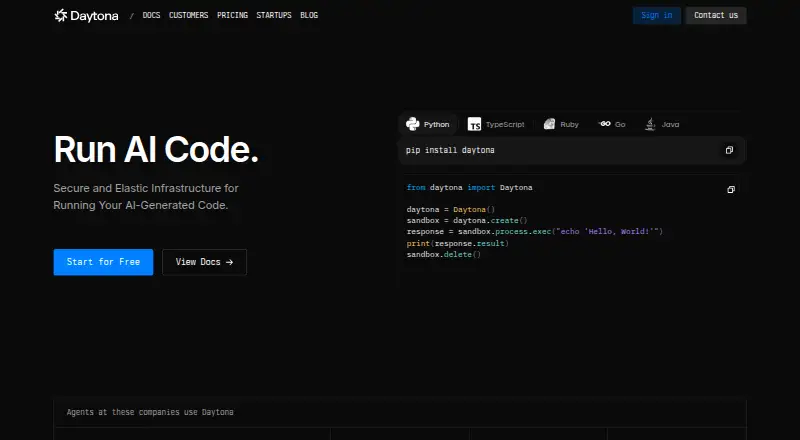
What Daytona is
Daytona provides an isolated runtime for running AI-generated code and agent workflows, with sandbox creation stated at under 90ms. Its execution controls cover processes, file operations and Git, alongside built-in language-server support. SDK interfaces are shown for Python, TypeScript, Ruby, Go and Java. Listed uses include AI evaluations, code interpreters, coding agents and data analysis. Daytona supports API, Linux, macOS, self-hosted, web and Windows environments, and its CLI supports macOS, Linux and Windows. The MCP server documentation lists Claude, Cursor and Windsurf as supported agents. Network controls include IP and domain allow lists, blocking outbound traffic and chained proxies; organization secrets are encrypted at rest and restricted to approved HTTPS destinations. Daytona offers a free plan and paid usage options. The usage-based plan lists rates for compute, memory, storage and Windows, with the first 5 GiB of storage free and $200 in free compute included. Enterprise pricing is by contacting sales.
Good
- Sandbox creation stated at under 90ms
- Supports multiple SDK languages
- Network allow lists and outbound controls
- Self-hosted and GPU workspaces available
- Free plan and free compute included
Watch out
- VPN connectivity requires Tier 3 or higher
- Enterprise pricing requires contacting sales
- Usage-based compute and storage rates apply
Who it suits
Daytona suits developers and teams running AI-generated code, coding agents, evaluations or data analysis in controlled workspaces. It may also fit teams that need self-hosting, GPU workspaces or JetBrains support.
Verdict
Daytona combines isolated code execution with APIs, SDKs and network controls for AI workflows. Its free offering and usage-based charges are distinct options, while VPN connections have a tier requirement.
Plans and prices
From Daytona's own pricing page, checked 22 Sep 2026.
| Plan | Price | What it gives you |
|---|---|---|
| Pay-as-you-go | — | 5 GiB storage free before storage charges |
| Start-ups | Free | Up to $50k in credits for free · Credits |
| Free compute credit | Free | $200 compute credit · included for new signups |
| Storage | Free | disk storage · pay-as-you-go · per GiB per hour after first 5 free GiB; billing calculated per second |
| Memory | $0.02 a month | RAM · pay-as-you-go · per GiB per hour; billing calculated per second |
| Compute vCPU | $0.05 a month | vCPU compute · pay-as-you-go · per hour; billing calculated per second |
| Windows compute | $0.09 a month | Windows sandbox surcharge · per vCPU per hour; billing calculated per second |
| Pay as you go | — | First 5 GiB storage free · $200 in free compute included · GPU rates vary by model and preemptible/on-demand · Usage-based; billed per second · vCPU $0.0504/h · Memory $0.0162/h · Storage $0.000108/h · Windows $0.0858/vCPU/h |
| Enterprise | Priced on request | custom resources · custom limits · contact sales |
The facts
Each one read from Daytona's own pages, with the date it was checked.
What it does
- Agent integration
- The MCP server documentation lists Claude, Cursor, and Windsurf as supported AI agents.checked 1 Oct 2026
- AI use cases
- Daytona lists AI evaluations, code interpreter workloads, coding agents, and data analysis as use cases.checked 1 Oct 2026
- Code execution
- The platform runs commands and code with real-time output streaming and configurable execution controls.checked 14 Oct 2026
- Compliance
- Daytona's Trust Center lists GDPR, HIPAA, SOC 2, ISO/IEC 27001, SOC 2 Type 1, and SOC 2 Type 2 compliance materials.checked 1 Oct 2026
- Documentation depth
- The official docs cover platform concepts, sandbox classes, agent tools, human tools, webhooks, security, observability, deployments, SDK references and CLI usage.checked 14 Oct 2026
- Documentation license
- The public documentation repository states that its documentation website is covered by Apache License 2.0 while the product is distributed under commercial terms.checked 14 Oct 2026
- Execution APIs
- Its programmatic control includes process execution, file-system operations, Git integration, and built-in LSP support.checked 1 Oct 2026
- Filesystem API
- Daytona exposes programmatic filesystem CRUD operations with granular permissions.checked 14 Oct 2026
- Funding
- Ry Walker Research reports a $24 million Series A in February 2026 led by FirstMark, with Datadog and Figma Ventures participating.checked 14 Oct 2026
- Git integration
- Native Git operations and credential handling are built into the sandbox tooling.checked 14 Oct 2026
- GPU capability
- GPU sandboxes support NVIDIA and AMD accelerators, with up to eight GPUs for a sandbox.checked 14 Oct 2026
- Isolation
- Daytona describes separated and isolated runtime protection for executing AI-generated code.checked 1 Oct 2026
- Limit: enterprise access
- Softwr reports that SSO, audit logs and BYOC require contacting sales rather than being self-serve.checked 14 Oct 2026
- Limit: G2 differentiation
- One G2 reviewer said Daytona did not provide enough differentiation from competing products.checked 14 Oct 2026
- Limit: pricing predictability
- An independent Softwr review says usage-only pricing without a flat monthly plan can make steady-workload costs harder to predict.checked 14 Oct 2026
- Limits model
- Organizations are assigned verification-based tiers with compute pools, per-sandbox limits and API rate limits.checked 14 Oct 2026
- LSP support
- Built-in language-server support provides completion and real-time code analysis.checked 14 Oct 2026
Where it runs
- CLI platforms
- The Daytona CLI installation documentation supports macOS, Linux, and Windows.checked 1 Oct 2026
The company
- Company founding
- Daytona's own about page says the company was founded in 2023.checked 14 Oct 2026
- Company headquarters
- Crunchbase lists Daytona's headquarters in New York, New York, United States.checked 14 Oct 2026
- Company legal name
- Crunchbase lists the legal name as Daytona Platforms Inc.checked 14 Oct 2026
- Company size
- LinkedIn lists Daytona as a privately held software-development company with 11–50 employees.checked 14 Oct 2026
- Founded
- 2023checked 28 Sep 2026
- Headquarters
- New York, New York, United Stateschecked 28 Sep 2026
The full review of Daytona
Daytona is an elastic runtime for executing AI-generated code and coordinating agent workflows. It suits teams embedding controlled code execution into products, developer tools, or evaluation pipelines. The strongest case is its unusually broad programmatic control; the main caution is that costs track resource use and some connectivity features are restricted to higher tiers.
Overview
Daytona combines isolated sandboxes with APIs, SDKs, network policy, and operational options ranging from hosted use to self-hosting. Its stated sub-90ms sandbox creation can help interactive agents start work quickly, while persistent storage, prebuilds, Dockerfile configuration, multiple version-control hosts, GPU workspaces, and JetBrains support make it more than a bare code runner. Those capabilities are most useful when a team needs repeatable environments and direct integration rather than a standalone playground.
Key features
Separated runtimes are designed to contain AI-generated code for evaluations, code interpreters, coding agents, and data analysis. Execution APIs expose process execution, filesystem operations, Git integration, and built-in language-server protocol support. SDK interfaces cover Python, TypeScript, Ruby, Go, and Java, giving teams several integration paths instead of forcing one language choice.
The CLI supports macOS, Linux, and Windows. Daytona's MCP server documentation names Claude, Cursor, and Windsurf, so teams using those agents can connect their workflows without building an entirely separate integration layer. VPN connections support Tailscale, OpenVPN, and Netbird, but require Tier 3 or higher; that qualification matters for organizations that need private-network access from the outset.
Security controls are unusually granular. Teams can permit traffic by IPv4 CIDR or domain, block outbound traffic completely, or send it through chained outbound proxies. Organization-scoped secrets are encrypted at rest and delivered to sandboxes as opaque placeholders; plaintext is substituted only for allowed HTTPS hosts. This limits accidental exposure while preserving access to approved services. Daytona's Trust Center materials cover GDPR, HIPAA, SOC 2, ISO/IEC 27001, SOC 2 Type 1, and SOC 2 Type 2. Support may be provided through email, Slack, in-app chat, video support, and community forums.
Pricing
Daytona uses a freemium model with a free plan and free trial. The Start-ups plan is free and is billed in credits, with up to $50,000 in credits free. It is the clearest starting point for qualifying early-stage teams that can work within credit-based usage.
The Pay-as-you-go plan has no listed standing price and bills usage by the second. vCPU costs $0.0504 per hour, memory $0.0162 per hour, storage $0.000108 per hour, and Windows $0.0858 per vCPU hour. The first 5 GiB of storage is free, and $200 in free compute is included; GPU rates vary by model and by preemptible or on-demand use. This suits variable workloads, but teams must track runtime, memory, storage, operating-system, and GPU consumption rather than rely on a fixed subscription.
A separate Pay-as-you-go listing includes 5 GiB of storage free before storage charges, with price not listed. Enterprise uses custom pricing and adds larger limits, SSO, audit logs, and bring-your-own-cloud deployment. It is the sensible route for organizations that need governance and capacity beyond the usage plans. The cheaper options do not provide those enterprise controls.
Platforms
Daytona supports API, Linux, macOS, self-hosted, web, and Windows deployments. Self-hosting is important for teams with infrastructure or data-residency requirements, while hosted access avoids operating the runtime yourself. GPU workspaces and persistent storage broaden the workloads beyond short-lived scripts.
Who it's for
Choose Daytona for AI product teams, platform engineers, and organizations building agents that must execute untrusted or generated code with explicit network and secret controls. It is a strong fit when APIs, SDK choice, prebuilt environments, and private deployment matter. It is less suitable for a simple personal coding sandbox if the extra policy, integration, and usage accounting would go unused.
Pros and cons
- Pros: sub-90ms sandbox creation supports responsive agents; isolated runtimes and detailed egress rules reduce execution risk; APIs and SDKs cover several languages and developer operations; self-hosting, GPUs, persistent storage, and prebuilds support demanding environments.
- Cons: usage-based billing can be difficult to forecast, especially with GPUs and Windows; VPN connectivity requires Tier 3 or higher; enterprise features such as SSO and audit logs require custom pricing.
Alternatives
For a broad directory of Sandbox Software, compare Daytona with tools focused more narrowly on sandboxing. Cloud Development Environments are a better starting point when the priority is a complete hosted development workspace, while Coding Playgrounds fit lightweight experimentation.
ANY.RUN is worth choosing for interactive malware and file-analysis environments across Android, Linux, macOS, web, and Windows. Docker Desktop is the simpler local container choice, with a free Personal plan and a $9.00 USD monthly Pro plan. Context Agent Sandboxes fits teams wanting a straightforward per-person agent allowance, including one concurrent agent free and three on Plus for $20.00 per month.
Northflank is preferable when you need an application platform with free services, a database, cron jobs, and always-on compute. Anthropic Sandbox Runtime is a free option for supported local environments. microsandbox suits small, explicitly capped workloads with a free tier of three sandboxes and fixed vCPU, memory, and disk allowances. E2B is an Apache-2.0-licensed, self-hostable runtime with a free Hobby plan and usage credits. Zscaler Private Access is the alternative when the central requirement is managed private application access rather than code-execution sandboxes.
Verdict
Daytona is a strong recommendation for teams building AI agents or services that need fast, isolated execution with API-level control over files, processes, Git, secrets, and network traffic. Pick it when integration breadth and deployment flexibility justify metered billing. Look elsewhere if you need predictable subscription pricing, unrestricted VPN connectivity, or only a basic local playground.
Alternatives to Daytona
- 1

Replit
Free planAndroidiOSWebLinux9.2From $18 a month - 2

StackBlitz
Free planAndroidiOSWebAPI8.9Free plan - 3

Playcode
Free planAndroidiOSWebAPI8.9From $25 a month - 4
Paperspace Gradient
Free planOpen sourceWebAPIExtensionLinux8.7From $8 a month - 5
GitHub Codespaces
Free planAndroidiOSWebAPI8.6Free plan - 6

JDoodle
Free planAndroidiOSWebAPI8.6From $4 a month