
JDoodle
JDoodle is an online programming platform for learning, teaching, and practicing code.
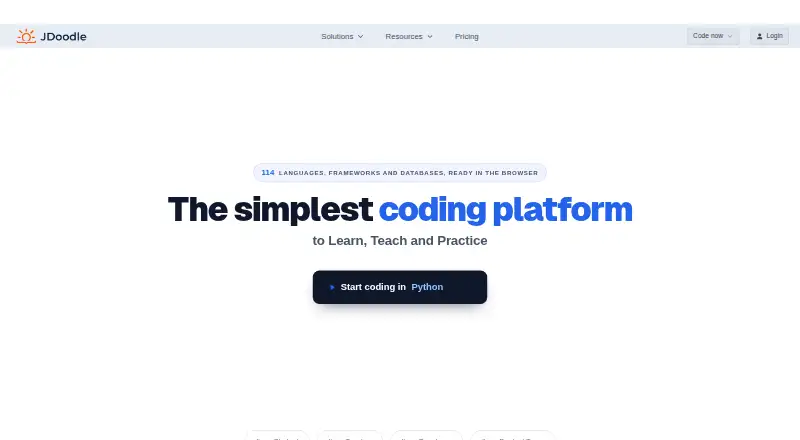
What JDoodle is
JDoodle is an online programming platform for learning, teaching, and practicing code. Its browser IDE runs programs on JDoodle machines, so users can work without installing an IDE. It supports 114 languages, frameworks, and databases. The platform also offers a Compiler API, with REST for final results and WebSocket for streaming output and interactive programs; submitted code runs with time and memory limits. Runnable IDEs can be embedded in websites, course materials, and learning management systems using three lines of HTML. Education features include assignments, automated correction and grading, varied question types, roles, and result disclosures. Mobile apps let people write and run code on iOS and Android phones and tablets. A free Chrome browser extension is available, but not a Firefox or Safari version. The free platform plan does not expire and does not require a card; it includes 1,000 code executions per day and 100 saved projects. A separate free API plan includes 20 credits per day and no internet access. Paid plans include options for students, teachers, organizations, and API users.
Good
- Browser IDE runs without installation
- Supports 114 languages, frameworks, and databases
- Free plan includes 1,000 daily code executions
- Mobile apps support iOS and Android
Watch out
- Free Chrome extension has no Firefox or Safari version
- Free API plan has no internet access
- Free plan limits saved projects to 100
Who it suits
JDoodle suits learners, teachers, and developers who want to write or run code in a browser or on mobile. Educators can use its assignment and grading tools or embed runnable IDEs in learning materials.
Verdict
JDoodle brings a browser IDE, mobile apps, education features, and API options together. Its free platform plan has meaningful usage limits, and extension support is limited to Chrome.
Plans and prices
From JDoodle's own pricing page, checked 20 Sep 2026.
| Plan | Price | What it gives you |
|---|---|---|
| Enterprise | — | SSO · Payment by invoice · Advanced user management · Priority support |
| API Free | Free | 20 credits/day · no internet access · REST and WebSocket · all languages · $0/month |
| Free | Free | 1,000 executions/day · latest language versions · 100 saved projects · 15 AI credits/day (30/month) · 3 collaborators · unlimited embeds, students, assessments and questions · US$0; no expiry |
| Student | $4 a month | Unlimited executions and projects · every language version · internet access · 10 collaborators · 50 AI credits/month · 2× workspace · US$4/month billed yearly (US$48/year) |
| API Starter | $10 a month | 1,000 credits/day · internet access · REST and WebSocket · all languages · $10/month |
| Pro | $12 a month | Unlimited executions and projects · every language version · internet access · 10 collaborators · 150 AI credits/month · 4× workspace · advanced settings · US$12/month billed yearly (US$144/year) |
| Teacher | $20 a month | Unlimited executions and projects · every language version · internet access · unlimited collaborators, students, assessments and questions · 150 AI credits/month · US$20/month billed yearly (US$240/year) |
| API Growth | $20 a month | 2,000 credits/day · internet access · REST and WebSocket · all languages · $20/month |
| API Scale | $50 a month | 5,000 credits/day · internet access · REST and WebSocket · all languages · $50/month |
| API Business | $100 a month | 10,000 credits/day · internet access · REST and WebSocket · all languages · $100/month |
| Custom | Priced on request | Custom SSO · admin dashboard · invoice billing · white-label embeds · priority support · Contact sales |
The facts
Each one read from JDoodle's own pages, with the date it was checked.
What it does
- API credit rules
- A normal run costs one credit; WebSocket startup, multi-file upload and internet access add credits.checked 15 Oct 2026
- API exhaustion
- Calls made after the daily allowance is exhausted return HTTP 429 and are not queued or charged.checked 15 Oct 2026
- API extensibility
- The documented backend integration uses POST /v1/execute with client credentials, script, language and version index.checked 15 Oct 2026
- API protocols
- The Compiler API offers REST for final results and WebSocket connections for streaming and interactive input.checked 15 Oct 2026
- API response
- Execution responses include output, status code, memory use and CPU time.checked 15 Oct 2026
- API sandbox
- Each API execution runs in an isolated filesystem and process environment without a route to the network.checked 15 Oct 2026
- Code isolation
- API and embed submissions run on JDoodle machines, with bounded execution time and memory limits.checked 1 Oct 2026
- Collaboration
- Projects can be shared by link and edited collaboratively in real time.checked 15 Oct 2026
- Debugger and GUI
- The IDE supports step debugging for 23 language/version combinations and live GUI windows for supported programs.checked 15 Oct 2026
- Documentation depth
- Documentation is organized into teacher, student, coder, writer and builder guides plus references for IDE, API, embeds, assessments, AI, extension, mobile and teams.checked 15 Oct 2026
- Education
- The education platform supports assignments, automated correction and grading, varied question types, roles and result disclosures.checked 1 Oct 2026
- Embed integration
- An embedded IDE renders JDoodle's editor inside another page, while the API lets a product keep its own interface.checked 15 Oct 2026
- Embeds
- JDoodle embeds can place a runnable IDE in websites, course materials and learning management systems with three lines of HTML.checked 1 Oct 2026
- Funding news
- TechCrunch reported on June 14, 2023 that JDoodle raised about A$3.2 million from Main Sequence after bootstrapping to 800,000 users.checked 15 Oct 2026
- Hosted execution
- Submitted code executes on JDoodle machines, so the documentation describes no self-hosted runtime package.checked 15 Oct 2026
- IDE frameworks and databases
- The IDE documentation lists React, Vue, Express, Flask, Spring Boot, Laravel, PostgreSQL, MySQL and MongoDB.checked 15 Oct 2026
- Language coverage
- The platform lists 114 supported languages, frameworks and databases.checked 15 Oct 2026
- Language support
- JDoodle supports 114 languages, frameworks and databases.checked 1 Oct 2026
Where it runs
- Browser extension
- The free browser extension works with Google Chrome and has no Firefox or Safari version.checked 1 Oct 2026
- Browser extension limits
- The Chrome extension runs one selected snippet at a time and does not provide projects, multiple files or library management.checked 15 Oct 2026
- Browser IDE
- The IDE runs in a web browser, executes programs on JDoodle machines, and requires nothing to be installed.checked 1 Oct 2026
The company
- Company profile
- LinkedIn lists JDoodle as privately held, headquartered in Canberra, founded in 2013, with 11–50 employees.checked 15 Oct 2026
Money
- Free plan
- Yeschecked 20 Sep 2026
- Free plan status
- JDoodle says the Free platform plan is not a trial, does not expire and does not require a card.checked 1 Oct 2026
The full review of JDoodle
Overview
JDoodle brings together a browser IDE, classroom tools, runnable code embeds and a compiler API for working with programs in many languages. It is best suited to students and teachers who need coding and assessment in one place, and to developers who want hosted execution or an embeddable editor. Its lasting free tier is useful, but project caps and distinct platform and API quotas make the right plan depend on how you intend to use it.
Key features
The browser IDE runs programs on JDoodle machines, so there is no local installation to manage. Support for 114 languages, frameworks and databases gives learners and developers room to try different technologies in one workspace. Full-stack runtime scope, real-time collaboration and public sharing extend it beyond solo snippet experiments; hosted execution, however, means programs run within bounded time and memory rather than on your own machine.
For teaching, JDoodle combines assignments, automated correction and grading with multiple question types, roles and result disclosures. That makes it more appropriate for structured coursework than a simple code runner, particularly where teachers need to manage assessment as well as practice. The education features are less compelling for someone who only needs to run occasional snippets.
Embeds add a runnable IDE to websites, course materials or learning management systems with three lines of HTML. The Compiler API offers REST for final results and WebSocket for streamed output and interactive programs. Both API and embed submissions execute on JDoodle machines under time and memory bounds, a useful managed setup that may not suit workloads needing unrestricted execution. The mobile apps let users write and run code on iOS and Android phones and tablets, though a phone-sized workspace may be less convenient for extended coding.
The free browser extension is limited to Google Chrome, so it is not an option for Firefox or Safari users. JDoodle Labs Pty Ltd says it primarily stores personal information in Australia and the United States and uses safeguards against unauthorized access. Stripe processes credit card payments; JDoodle says it does not store or handle card details in its own systems. The company also says its support team answers customer questions directly and provides documentation.
Pricing
JDoodle is freemium, with no free trial. The Free platform plan costs nothing, remains free forever and requires no credit card. It allows 1,000 code executions per day, 100 saved projects and one collaborator per project. That is a practical starting point for regular individual use, but the project ceiling and single-seat collaboration constrain larger or shared work.
Pro costs $15 a month, billed monthly, and includes 150 AI credits a month, 10 collaborators per project and five Premium Embed IDEs. It suits users who need more collaboration or premium embeds, but the listed inclusions do not state higher execution or saved-project allowances than Free. Student costs $4 a month, billed yearly at US$48 a year, and adds unlimited executions and saved projects, 50 AI credits per month, twice the standard workspace and 10 collaborators per project. It is the clearest fit for an individual student expecting sustained use; the annual billing commitment is the trade-off.
Teacher has custom pricing and includes unlimited collaborators per project plus unlimited assessments and students, making it the education-focused choice for organized classes. Enterprise also has custom pricing and adds SSO, invoice payment, advanced user management and priority support for organizations that need those controls.
API Free costs nothing and provides 20 credits per day, no internet access, REST and WebSocket APIs, and all languages. It is suitable for small-scale or offline-connected API experiments, not services that need internet access or a larger daily allowance. API Starter costs $10 a month for 1,000 credits per day and internet access; Growth costs $20 a month for 2,000 credits per day and internet access; Scale costs $50 a month for 5,000 credits per day and internet access. Choose among them by expected daily volume, since the stated distinction is the quota.
Platforms
JDoodle is available on the web, Android and iOS, with an API and a Chrome extension. That range supports browser, mobile and integration use, but the extension's Chrome-only availability narrows its usefulness for other browsers.
Who it's for
JDoodle is a strong match for students who want a broad-language coding environment, teachers who need assignments and grading, and developers embedding runnable code or integrating hosted compilation. The free plan suits individual practice and modest collaboration. Users who need more saved projects, unlimited executions, internet-enabled API calls or class-wide assessment should compare the relevant paid tiers. It is less suitable for those requiring a local execution environment or a browser extension outside Chrome.
Pros and cons
- Pros: 114 supported languages, frameworks and databases make one browser workspace useful across varied learning and development tasks.
- Pros: The permanent, no-card Free plan allows 1,000 daily executions and 100 saved projects, making ongoing individual use possible without a trial deadline.
- Pros: Education tools combine assignments, automated grading, roles and result disclosures, while embeds and REST/WebSocket APIs support teaching and integration use.
- Cons: Free platform projects cap at 100 and each project allows only one collaborator, limiting shared work unless users move to a plan with more seats.
- Cons: API Free is capped at 20 credits daily and has no internet access, so connected applications need a paid API tier.
- Cons: The browser extension supports Chrome only, and execution occurs on JDoodle machines with time and memory bounds rather than locally.
Alternatives
For a broader comparison, browse Code Playground Software or Coding Playgrounds.
Choose Playcode if its free trial and wider listed platform support, including Linux, macOS and Windows, better fit your devices; its free plan limits you to three projects or published sites and requires Playcode branding.
OneCompiler is worth considering if unlimited code executions on a free plan matter more than JDoodle's 100 saved projects; OneCompiler's free tier includes 20 AI credits per day.
Pick StackBlitz if you specifically need a self-hosted option or want its listed private-project and file-upload options on Personal+.
Observable may suit work centered on self-hosted use or file attachments; its free tier includes 1 GB per month, but embeds carry a watermark.
Choose Google Colab if notebook work and GPU access are the priority; its free plan has limited GPU access and no guaranteed compute units, while Colab Pro is $8.33 a month on an annual or fixed-term plan.
CodePen is an alternative for public web snippets: its free plan includes unlimited public Pens, with three files per Pen.
Val Town is a better fit if scheduled runs and public vals are central to your use; its free tier allows 100,000 runs per day and unlimited public vals, with one-minute run time and three-day log retention.
Consider CodeSandbox if its listed VM-credit and member allowances better match your team's requirements.
Verdict
JDoodle is a sound choice for learners, teachers and developers who want browser-based coding alongside education tools, embeddable IDEs or compiler APIs. Its permanent free plan and unusually broad language coverage make it easy to adopt for practice and small projects. Look elsewhere if you need local execution, a non-Chrome extension or more generous free collaboration; choose a paid tier when project, execution, seat or API limits become the constraint.
Getting started
- Open the JDoodle website in a browser
- Use the browser IDE without installing local software
- Choose the Free, Pro, Student or another available plan
- Use the iOS or Android app when coding on a phone or tablet
- Connect through the Compiler API or embed an IDE when needed
Limits worth knowing
The Free platform plan includes 1,000 code executions per day, 25 projects and one collaborator per project. API Free provides 20 credits per day and no internet access.
Questions
Is JDoodle free?
Yes. The Free platform plan costs nothing, lasts forever and requires no credit card. API Free also costs nothing.
Which platforms does JDoodle support?
JDoodle is available on Android, iOS, web, API and extension. The free browser extension works with Google Chrome.
How many languages does JDoodle support?
JDoodle supports 114 languages, frameworks and databases.
What does the Compiler API provide?
It offers REST for final results and WebSocket for streaming output and interactive programs.
Does JDoodle offer education features?
Yes. Education tools include assignments, automated correction and grading, question types, roles and result disclosures.
Alternatives to JDoodle
- 1

Replit
Free planAndroidiOSWebLinux9.2From $18 a month - 2

StackBlitz
Free planAndroidiOSWebAPI8.9Free plan - 3

Playcode
Free planAndroidiOSWebAPI8.9From $25 a month - 4
Paperspace Gradient
Free planOpen sourceWebAPIExtensionLinux8.7From $8 a month - 5
GitHub Codespaces
Free planAndroidiOSWebAPI8.6Free plan - 6
Lightning AI Studios
Free planWebAPILinuxmacOS8.5From $20 a month