
Observable
Observable is a notebook platform for analyzing and visualizing data, explaining ideas with code, and building data-driven workflows and custom apps.
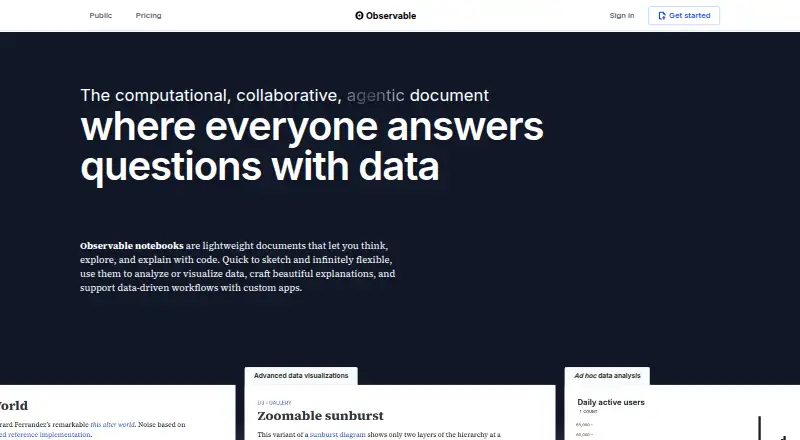
What Observable is
Observable is a notebook platform for analyzing and visualizing data, explaining ideas with code, and building data-driven workflows and custom apps. Notebooks are organized into cells, show live values next to code, and include a dataflow panel for following program behavior. Users can collaborate through real-time editing, comments, fork-and-merge workflows, access controls, and version history. Built-in capabilities include file attachments, databases, secrets, libraries, and inputs; hosted database connectors cover services including Redshift, BigQuery, PostgreSQL, Snowflake, and SQL Server. Database clients are available in private notebooks, but sharing or publishing a notebook that uses a connector revokes its database access. Observable also supports local development and self-hosting, and its free open-source tools can generate static sites. Notebooks use a readable plain-text format and can import web-compatible npm libraries. Free is available at no cost. Pro is billed at $22 per month annually or $25 billed monthly; both Free and Pro list 1 GB monthly file attachments, while Pro lists 50 minutes of monthly compute.
Good
- Cells show live values alongside code
- Supports real-time collaborative editing
- Includes hosted connectors for multiple databases
- Plain-text notebooks can use web-compatible npm libraries
Watch out
- Free plan has few tokens per day
- Free plan embeds include a watermark
- Database connectors are limited to private notebooks
- Pro compute is limited to 50 minutes monthly
Who it suits
Observable suits people who want to explore data in code-based notebooks and collaborate on explanations or data workflows. It may also fit developers who want local development, self-hosting, or static-site generation.
Verdict
Observable combines data notebooks, collaboration, and database connections, with local development and self-hosting also available. Check the plan limits and private-notebook restriction before relying on database connectors in shared work.
Plans and prices
From Observable's own pricing page, checked 29 Sep 2026.
| Plan | Price | What it gives you |
|---|---|---|
| Free | Free | Few tokens / day · 1 GB / mo. file attachments · Embed with watermark · Standard support |
| Pro | $22 a month | More tokens / day · 1 GB / mo. file attachments · 50 min. / mo. compute · Priority support · $22 per month or $25 billed monthly |
| Team | — | More tokens / editor / day · 1 GB / editor / mo. file attachments · 50 min. / editor / mo. compute · $10 / viewer / mo. private viewers · Priority support · $40 per editor per month or $45 billed monthly |
| Enterprise | Priced on request | Custom agent, file attachments, compute, and private viewers · Dedicated support · Custom |
The facts
Each one read from Observable's own pages, with the date it was checked.
What it does
- Collaboration
- Observable supports real-time multiplayer editing, fork-and-merge workflows, comments, fine-grained access, and version history.checked 29 Sep 2026
- Connection security
- Observable recommends SSL-encrypted connections and read-only database users; its documentation says SSL connections are encrypted but not yet verified.checked 29 Sep 2026
- Database access
- Database clients are accessible from a user's or team's private notebooks, and sharing or publishing a notebook that uses a database connector revokes that notebook's database access.checked 29 Sep 2026
- Database integrations
- Observable documentation lists hosted connectors for Amazon Redshift, BigQuery, Databricks, Mongo SQL, MySQL, Oracle, PostgreSQL, Snowflake, and SQL Server.checked 29 Sep 2026
- Data inputs
- The product lists file attachments, databases, secrets, libraries, and inputs among its built-in capabilities.checked 29 Sep 2026
- File format and libraries
- Notebooks use a human-readable plain-text format, and Observable says users can import any npm library that runs on the web.checked 29 Sep 2026
- Local development and publishing
- Observable says notebooks can be used for local development and self hosting, and its free open-source tooling can generate static sites.checked 29 Sep 2026
- Notebook features
- Notebooks use cells, show live values alongside code, and include a dataflow panel to help users understand program behavior.checked 29 Sep 2026
- Private projects
- Yeschecked 20 Sep 2026
- Purpose
- Observable notebooks are lightweight documents for analyzing and visualizing data, explaining ideas with code, and supporting data-driven workflows with custom apps.checked 29 Sep 2026
- Support
- The pricing page lists standard support for Free, priority support for Pro and Team, and dedicated support for Enterprise.checked 29 Sep 2026
The company
- Founded
- 2016checked 28 Sep 2026
Money
- Free plan
- Yeschecked 20 Sep 2026
- Plan limits
- The pricing page lists 1 GB per month of file attachments for Free and Pro, and 50 minutes per month of compute for Pro.checked 29 Sep 2026
- Team plan limits
- The Team plan lists 1 GB per editor per month of file attachments, 50 minutes per editor per month of compute, and private viewers at $10 per viewer per month.checked 29 Sep 2026
Alternatives to Observable
- 1

Replit
Free planAndroidiOSWebLinux8.4From $18 a month - 2

Playcode
Free planAndroidiOSWebAPI8.2From $25 a month - 3

StackBlitz
Free planAndroidiOSWebAPI8.2Free plan - 4

JDoodle
Free planAndroidiOSWebAPI8.0From $4 a month - 5

CodeHS
Free planAndroidiOSWeb7.6From $990 a year - 6

Google Colab
Free planWebAPIExtensionSelf-hosted7.6Free plan