
Crashpad
Crashpad is a crash-reporting system and client-side library that captures and stores reports when registered processes fail, then can send them to a collect…
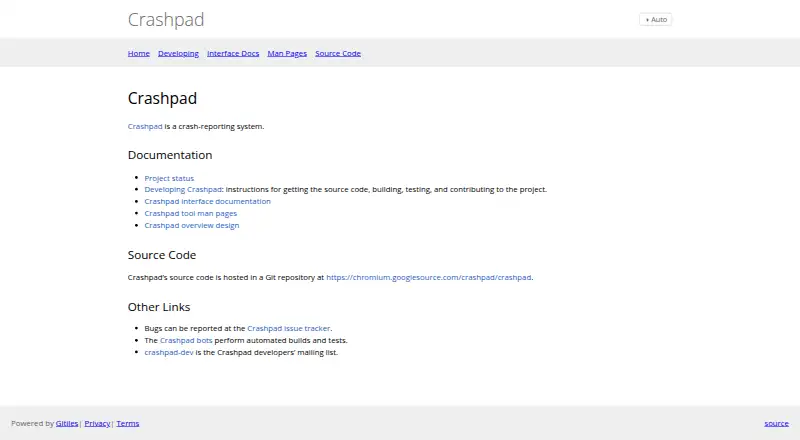
What Crashpad is
Crashpad is a crash-reporting system and client-side library that captures and stores reports when registered processes fail, then can send them to a collection server configured by the embedding application. It can also capture process state on demand for diagnostics. Applications can add key/value annotations, application-specific metadata, and custom minidump streams. Reports use the Windows minidump format with Crashpad extensions and generally contain module, thread, operating-system, and selected memory information, which may include sensitive data. The client application is responsible for obtaining and honoring consent before uploading. Uploads can use HTTP or HTTPS, and the design recommends HTTPS. Crashpad is a client-side component; a crash-report processor is planned, with no completion timeline set. The project provides build instructions and automated builds and tests, and directs bug reports to its issue tracker and developer discussion to the crashpad-dev mailing list. It is open source and free, with clients listed for Android, iOS, Linux, macOS, and Windows.
Good
- Captures process state on demand for diagnostics
- Applications can add annotations and custom minidump streams
- Supports Android, iOS, Linux, macOS, and Windows
- Open source and free
Watch out
- Client application must obtain and honor upload consent
- Collection-server URL must be configured by the embedding application
- Crash-report processor is planned, with no timeline set
- iOS handler cannot catch some crash groups, including out-of-memory crashes
Who it suits
Crashpad suits developers embedding crash reporting in applications who need diagnostic dumps and configurable report metadata. Teams should account for user consent and configure their own collection-server URL.
Verdict
Crashpad provides client-side crash capture, configurable metadata, and report uploads for applications across several platforms. It does not include a completed crash-report processor, and applications must handle consent and server configuration.
Plans and prices
From Crashpad's own pricing page, checked 9 Oct 2001.
| Plan | Price | What it gives you |
|---|---|---|
| Crashpad | Free | No pricing or plan limits stated |
The facts
Each one read from Crashpad's own pages, with the date it was checked.
What it does
- Annotations
- Client applications can add key/value annotations and extend reports with application-specific metadata or custom minidump streams.checked 4 Oct 2001
- Backend scope
- Crashpad is a client-side component; its status page says a crash-report processor is planned, with no completion timeline set.checked 4 Oct 2001
- Build and test
- The project provides build instructions and says Crashpad Buildbot performs automated builds and tests.checked 9 Oct 2001
- Collection server
- The embedding application configures the collection server URL, and Crashpad can upload reports over HTTP or HTTPS.checked 9 Oct 2001
- Consent and privacy
- The design says the client application must obtain and honor user consent for uploads, because reports may contain sensitive data from process memory.checked 4 Oct 2001
- Crash metadata
- Applications can add key/value annotations and extend reports with application-specific metadata or custom minidump streams.checked 9 Oct 2001
- Diagnostics
- It can capture process state on demand for diagnostic purposes.checked 9 Oct 2001
- Integration
- Crashpad is embedded into client applications; outside Chromium it depends on mini_chromium, while Chromium builds use Chromium's base library.checked 9 Oct 2001
- On-demand dumps
- Crashpad can capture dumps of process state on demand for diagnostic purposes.checked 4 Oct 2001
- Privacy
- Crashpad's design says the client application must obtain and honor user consent before uploading reports, which may contain arbitrary data from process memory.checked 9 Oct 2001
- Process architecture
- Crashpad uses a handler that snapshots a client process after a crash, saves a crash dump, and can transmit it to an upstream server if configured.checked 4 Oct 2001
- Project support
- The README directs users to the issue tracker for bugs and the crashpad-dev mailing list for project discussion.checked 9 Oct 2001
- Purpose
- Crashpad is a library for capturing, storing, and transmitting postmortem crash reports from an application to a collection server.checked 9 Oct 2001
- Report contents
- Crash dumps generally include loaded modules, thread registers and stack memory, selected operating-system state, and selected memory referenced by registers and stacks.checked 4 Oct 2001
- Report format
- Crash reports use the Windows minidump format with extensions for Crashpad additions such as annotations.checked 4 Oct 2001
- Security
- The handler reads client address spaces through accessors designed to check pointer validity and enforce access bounds.checked 9 Oct 2001
- Support and project contact
- The README points users to the Crashpad issue tracker for bugs and the crashpad-dev mailing list for developer discussion.checked 4 Oct 2001
- Transport
- The embedding client sets the collection-server URL, and the handler can upload over HTTP or HTTPS; the design strongly suggests HTTPS to protect privacy in transit.checked 4 Oct 2001
- Upload behavior
- The documented client-side throttling currently limits uploads to one per hour, and failed uploads are aborted without retry.checked 9 Oct 2001
- Upload protocol
- Crashpad uses the Breakpad wire protocol, sending a MIME multipart request that can be gzip-compressed.checked 9 Oct 2001
Where it runs
- iOS limitations
- The iOS handler cannot catch some crash groups, including out-of-memory crashes, and writes intermediate dumps that are converted to minidumps later.checked 9 Oct 2001
- iOS status
- The project status page says work has begun on an iOS client; iOS uses an in-process handler because its sandbox restricts delegating work to separate processes.checked 9 Oct 2001
- Platforms
- The project status page lists complete crash-reporting clients and related tools for macOS, Windows, Fuchsia, and Linux, including Android and Chromium OS.checked 4 Oct 2001
- Supported platforms
- The project status page describes completed crash-reporting clients for macOS, Windows, Fuchsia, and Linux, including Android and Chromium OS.checked 9 Oct 2001
The full review of Crashpad
Crashpad is an open-source client library for developers who need crash capture inside applications they control. It suits teams prepared to operate or integrate a collection service and to make privacy decisions themselves. Its technical reach is broad, but it is not a finished crash-analysis product.
Overview
Crashpad embeds into an application and uses a handler to snapshot a registered process after a crash, save the resulting dump, and optionally transmit it to a configured server. It also supports on-demand process-state dumps for diagnostics. This makes it a strong foundation for teams that want ownership of capture and transport, rather than a hosted dashboard selected for them.
The important qualification is architectural: Crashpad is client-side. A crash-report processor is planned, but no completed processor is included, so teams need their own collection and processing arrangement. Outside Chromium, integration depends on mini_chromium; Chromium builds use Chromium’s base library.
Key features
Crash dumps generally contain loaded modules, thread registers and stack memory, selected operating-system state, and selected memory referenced by registers and stacks. That breadth can expose the context needed to diagnose difficult failures, while also creating a real privacy obligation because process memory may contain sensitive data.
Applications can attach key/value annotations and custom minidump streams, allowing product-specific context to travel with a report. The format is Windows minidump with Crashpad extensions. The handler reads client address spaces through accessors intended to validate pointers and enforce access bounds.
The embedding application chooses the collection-server URL. Crashpad uploads with the Breakpad wire protocol as MIME multipart requests, optionally gzip-compressed, over HTTP or HTTPS; HTTPS is the sensible choice for protecting data in transit. The documented strategy permits one upload per hour and aborts failed uploads, with retry behavior expected to change. Only processes registered with the handler are uploaded, although registration can be inherited by child processes on some operating systems.
Consent belongs to the client application: it must obtain and honor permission before sending reports. On iOS, work on a client has begun; the handler runs in-process, cannot catch some crash groups such as out-of-memory failures, and writes intermediate dumps that are converted to minidumps later. Project support is provided through the issue tracker and crashpad-dev mailing list, while Crashpad Buildbot performs automated builds and tests.
Pricing
Crashpad is free and open source. The Crashpad plan costs free. There are no stated seat, quota, trial, or renewal terms. Free licensing removes a software fee, but it does not remove the engineering and infrastructure work required for a collection server, processing pipeline, consent flow, and data governance.
Platforms
Crashpad supports Android, iOS, Linux, macOS, and Windows. Project status also describes completed crash-reporting clients for macOS, Windows, Fuchsia, and Linux, including Android and Chromium OS; iOS remains subject to the limitations of its in-process, developing client.
Who it's for
Choose Crashpad when your development team needs embedded capture, custom annotations, configurable transport, and control over where reports are sent. It is particularly appropriate for software spanning desktop and mobile platforms, or for organizations that can operate their own backend and define their own consent policy.
Look elsewhere when you need a ready-to-use crash processor, hosted retention, dashboards, or a packaged support workflow. Crashpad’s client component alone does not provide those services.
Pros and cons
Pros
- Broad platform coverage: Android, iOS, Linux, macOS, and Windows enable a common capture approach across varied applications.
- Control over report content: annotations and custom minidump streams let teams add application-specific diagnostic context.
- Flexible transport: the application selects its server and can use HTTP or HTTPS with the Breakpad protocol.
- No software charge: the open-source plan avoids per-seat or event pricing.
Cons
- No completed processor: teams must supply the service that receives and makes sense of reports.
- Privacy burden: dumps can contain arbitrary process-memory data, so consent and handling controls are the application’s responsibility.
- Limited documented upload behavior: one-upload-per-hour throttling and aborted failed uploads may not suit urgent or high-volume reporting.
- iOS gaps: the developing client misses some crash groups and uses an intermediate-dump conversion path.
Alternatives
For a broader directory of options, see Game Crash Reporting Software.
- AccelByte Development Toolkit is a freemium, multi-platform choice with unlimited basic seats and build and playtest workflows.
- Backtrace is better suited when a hosted freemium service with monthly error capacity, retention, and storage is preferable.
- BugSnag fits teams seeking a freemium service with a free tier, trial, and broad integration coverage.
- BugSplat offers a free tier with three logins, 100GB storage, 15,000 crashes per month, and one-month retention.
- GameAnalytics is an alternative for game teams wanting dashboards, funnels, cohorts, retention, and real-time reporting.
- Breakpad is the closest open-source alternative for teams wanting self-built and self-hosted crash-reporting components.
- Tombstack is a freemium option for Linux, macOS, web, and Windows applications.
- Unity Version Control is a freemium development-platform option with unlimited cloud seats and a 25GB storage allowance in its free tier.
Verdict
Crashpad is a good choice for developers who want free, embeddable crash capture and are willing to own the server, processing, and consent work around it. Its metadata controls and platform coverage are compelling. Choose a hosted alternative instead if you need finished report analysis, retention, and operational tooling without building that backend yourself.
Alternatives to Crashpad
- 1

Countly
Free planOpen sourceAndroidiOSWebAPI8.6From $175 a month - 2

GameAnalytics
Free planAndroidiOSWebAPI8.2From $49 a month - 3

Unity Version Control
Free planWebAPILinuxmacOS8.1Free plan - 4

AppMetrica
Free planOpen sourceAndroidiOSWebAPI8.0Free plan - 5

BugSplat
Free planAndroidiOSWebAPI8.0From $37 a month - 6

Embrace
Free planAndroidiOSWebAPI8.0From $0.80 a month