
Covexe
Covexe is a browser-based platform for systematic reviews, meta-analysis, evidence synthesis, and applied statistics.
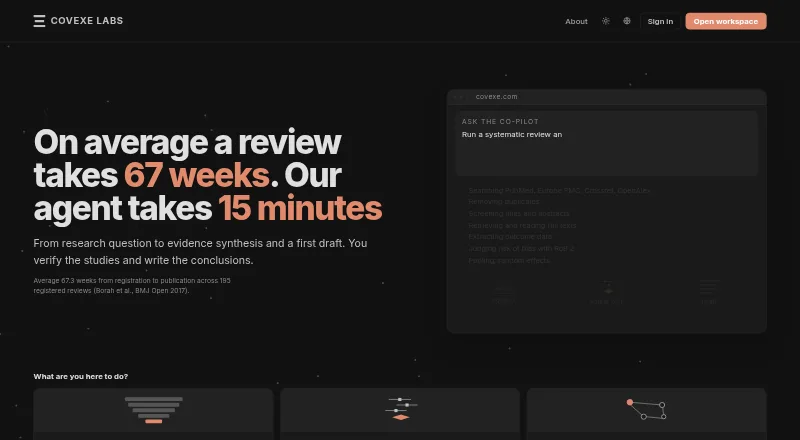
What Covexe is
Covexe is a browser-based platform for systematic reviews, meta-analysis, evidence synthesis, and applied statistics. Its review workflow spans research questions and searches, screening, full-text review, data extraction, appraisal, synthesis, and reporting. It supports review types including systematic, scoping, rapid, umbrella, narrative, network meta-analysis, and diagnostic accuracy reviews. Methods include pairwise and network meta-analysis, GRADE ratings, risk-of-bias tools, and a PRISMA 2020 flow diagram. The statistics suite covers regression, survival analysis, diagnostic accuracy, and other methods checked against R packages and implementations. References can be imported from RIS, NBIB, BibTeX, PubMed XML, CSV, and Excel, with duplicates detected by DOI and PMID. Users can connect their own OpenAI, Anthropic, or Google AI key; the co-pilot pauses for approval, and AI screening does not exclude studies without it. The free plan costs nothing, while Pro costs $99 a year. Signed-out work stays in the browser; signed-in reviews are stored for cloud sync and sharing.
Good
- Imports references in six listed formats.
- Detects duplicates using DOI and PMID.
- AI screening requires user approval before exclusion.
- Free plan includes all tools.
Watch out
- Free plan limits extraction to 40 studies per month.
- Free plan limits screening to 2,000 references per month.
- Pro costs $99 a year.
- Team plan requires a minimum of 3 seats.
Who it suits
Covexe is intended for evidence-synthesis researchers and organizations such as universities, research laboratories, public health institutes, hospitals, and independent researchers. It may suit teams that need structured review workflows alongside statistical methods.
Verdict
Covexe brings review stages, analysis methods, and reference imports into a browser-based platform. Compare the plan limits with the size of your review and reviewer group.
Plans and prices
From Covexe's own pricing page, checked 28 Sep 2026.
| Plan | Price | What it gives you |
|---|---|---|
| Free | Free | All tools · AI co-pilot 100 messages/day · extraction 40 studies/month · screening 2,000 references/month · library up to 5 papers · 1 reviewer per review · forever |
| Pro | $99 a year | AI extraction 1,500 studies/month · screening 5,000 references/month · AI advisor and figures 200/month · 15 agent reviews/month · library 100 papers · up to 5 reviewers per review · yearly |
| Team | $150 a year | 5 seats · up to 25 reviewers per review · shared AI pool: extraction 5,000/month, screening 20,000/month, 50 agent reviews/month · 1,000-paper library · yearly; per seat, minimum 3 seats |
| Institution | Priced on request | Unlimited reviews and projects · up to 100 reviewers per review · unlimited PDF library · Contact sales |
The facts
Each one read from Covexe's own pages, with the date it was checked.
What it does
- AI data handling
- Covexe says AI inputs are sent to providers for processing and are not stored on its own servers after processing.checked 28 Sep 2026
- AI providers
- Users can connect their own API key for OpenAI, Anthropic, or Google AI features.checked 28 Sep 2026
- AI review controls
- The co-pilot pauses for user approval at checkpoints, and AI screening does not exclude a study without approval.checked 28 Sep 2026
- Data handling
- The privacy policy says signed-out work stays in the browser, while signed-in reviews are stored for cloud sync and sharing.checked 28 Sep 2026
- Intended users
- Covexe says it is built for evidence-synthesis researchers and organizations including universities, research laboratories, public health institutes, hospitals, and independent researchers.checked 28 Sep 2026
- Methods
- The platform includes pairwise and network meta-analysis, GRADE ratings, risk-of-bias tools, and a PRISMA 2020 flow diagram.checked 28 Sep 2026
- Privacy
- Covexe says it does not use tracking or advertising cookies or third-party analytics scripts.checked 28 Sep 2026
- Purpose
- Covexe is a browser-based platform for systematic reviews, meta-analysis, evidence synthesis, and applied statistics.checked 28 Sep 2026
- Reference imports
- Screening can import references in RIS, NBIB, BibTeX, PubMed XML, CSV, and Excel formats and detects duplicates by DOI and PMID.checked 28 Sep 2026
- Review workflow
- Its review module covers question and search, screening, full-text review, extraction, appraisal, synthesis, and reporting.checked 28 Sep 2026
- Statistics
- Its statistics suite includes regression, survival analysis, diagnostic accuracy, and other statistical methods, with methods checked against R packages and implementations.checked 28 Sep 2026
- Support
- Email support is available at [email protected], with replies stated to arrive within 1–2 business days.checked 28 Sep 2026
The company
- Headquarters
- Taipei, Taiwanchecked 23 Sep 2026
- Maker
- Covexe is built by Covexe Labs, described as an independent software team based in Taipei, Taiwan.checked 28 Sep 2026
The full review of Covexe
Covexe is a browser-based workspace for systematic reviews, evidence synthesis, and applied statistics. It suits researchers who need review stages and analysis methods in one place, especially teams importing references from varied formats. Its free tier is useful for a small, tightly capped project; larger libraries and reviewer groups call for a paid plan.
Overview
Covexe spans the review process from formulating a question and searching through screening, full-text review, extraction, appraisal, synthesis, and reporting. That breadth makes it a candidate for teams seeking one workspace rather than separate tools for review management and statistical analysis. It supports systematic, scoping, rapid, umbrella, and narrative reviews, as well as network meta-analysis and diagnostic accuracy reviews.
Reference imports cover RIS, NBIB, BibTeX, PubMed XML, CSV, and Excel, with duplicate detection by DOI and PMID. Double-blinded screening, protocol support, extraction, and full-text storage address practical review needs. The trade-off is that the free plan allows just one reviewer per review and a library of five papers.
Key features
Analysis includes pairwise and network meta-analysis, GRADE ratings, risk-of-bias tools, and a PRISMA 2020 flow diagram. The statistics suite also includes regression, survival analysis, and diagnostic accuracy; its methods are checked against R packages and implementations. This combination is valuable for evidence-synthesis work that needs both review management and applied statistics, though the feature range alone does not remove the need for researchers to judge methods and results.
Users can connect their own OpenAI, Anthropic, or Google AI API key. The co-pilot pauses for approval at checkpoints, and AI screening will not exclude a study without user approval. That keeps consequential screening decisions under human control, while adding setup and oversight responsibilities for users supplying API access.
Signed-out work stays in the browser; signed-in reviews are stored for cloud sync and sharing. AI inputs go to the chosen providers for processing and are not retained on Covexe's servers afterward. Covexe says it does not use tracking or advertising cookies or third-party analytics scripts. Email support is available at [email protected], with replies stated to arrive within 1–2 business days.
Pricing
The Free plan costs nothing, billed forever. It includes all tools, 100 AI co-pilot messages per day, extraction for 40 studies per month, screening for 2,000 references per month, a five-paper library, and one reviewer per review. Those caps make it suitable for an individual evaluating the workflow or handling a small project, not a larger collaborative review.
Pro costs $99 a year, billed yearly. It raises extraction to 1,500 studies per month and screening to 5,000 references per month, adds 200 AI advisor and figures uses per month and 15 agent reviews per month, expands the library to 100 papers, and allows up to five reviewers per review. This is the clearest fit for an individual or small group that has outgrown Free's library and reviewer limits.
Team costs $150 a year per seat, billed yearly, with a minimum of three seats; the plan provides five seats. It allows up to 25 reviewers per review and provides a shared AI pool of 5,000 extractions per month, 20,000 screened references per month, and 50 agent reviews per month, plus a 1,000-paper library. The seat minimum makes it a more substantial commitment than Pro, but the larger shared quotas and review group support make it the better fit for organized teams.
Institution has custom pricing and is billed through Contact sales. It offers unlimited reviews and projects, up to 100 reviewers per review, and an unlimited PDF library. It is aimed at organizations needing scale beyond the fixed plans; the custom-price model is less straightforward for individual buyers comparing costs.
Platforms
Covexe runs on the web, so its review and analysis workspace is browser-based. It is not the pick for someone who requires a native mobile or desktop app.
Who it's for
Covexe is built for evidence-synthesis researchers and organizations such as universities, research laboratories, public health institutes, hospitals, and independent researchers. Pro suits solo and small-group work; Team is more appropriate when multiple reviewers and shared quotas matter. The Free plan is a sensible starting point for an individual, provided its five-paper library and single-reviewer cap are enough.
Pros and cons
- Pro: One workflow covers review stages, reference imports, synthesis methods, and applied statistics, reducing the need to split those tasks across separate workspaces.
- Pro: Approval checkpoints prevent AI screening from excluding studies on its own, keeping screening decisions with the user.
- Pro: Free access includes all tools, making a small project possible without a subscription.
- Con: Free is sharply constrained by its five-paper library and one-reviewer limit, even though monthly screening and extraction allowances are available.
- Con: Team requires at least three paid seats, a poor fit for a small group that only needs a few additional reviewers.
- Con: AI features send inputs to external providers for processing, and using them requires the user's API key.
Alternatives
Browse the Systematic Review Software category to compare more options. Choose Rayyan if Android or iOS access matters: it supports both as well as web and API, and its free plan allows three active reviews and two free reviewers, but has limited mobile app access. Parsifal is worth considering for free web access when an optional AI assistant using your own Anthropic or OpenAI API key is the relevant draw.
Silvi may fit readers prioritizing unlimited reviews on its free Basic plan, which also includes screening and data extraction. Catchii is a free web alternative with no paid upgrades or advertisements and support for multiple users. Buhos is an option for readers seeking a free tool across web, desktop, API, or self-hosted platforms.
PICO Portal offers a free plan with one project, unlimited citations, and unlimited collaborators; its ScholarIQ plans include a two-week trial. ReviQ is a free alternative available on web and self-hosted platforms. CADIMA is another free web option, with no topic restrictions and no stated reviewer limit.
Verdict
Covexe is a strong fit for evidence-synthesis researchers who want review management, reference handling, and statistical methods in a single browser-based platform. Its approval-gated AI and broad method set are compelling reasons to choose it, while the Free plan's small library and one-reviewer cap make it a limited home for collaborative work. Choose Pro for a small group that needs more room; look elsewhere if you need native mobile or desktop access, or if Team's three-seat minimum is too much commitment.
Alternatives to Covexe
- 1
RevMan
Free planWebLinuxmacOSWindows7.8From £80 a year - 2

ASReview
Free planOpen sourceWebAPILinuxmacOS7.7Free plan - 3
LASER AI
AndroidiOSWeb7.6From $3,000 a year - 4

Rayyan
Free planAndroidiOSWebAPI7.5From $4.99 a month - 5
Sysrev
Free planWebAPISelf-hosted7.5From $50 a month - 6
Universal SLR Assistant
Free planOpen sourceWebAPILinuxmacOS7.5Free plan