ReviQ
ReviQ is a locally deployed workbench for systematic and multivocal literature reviews.
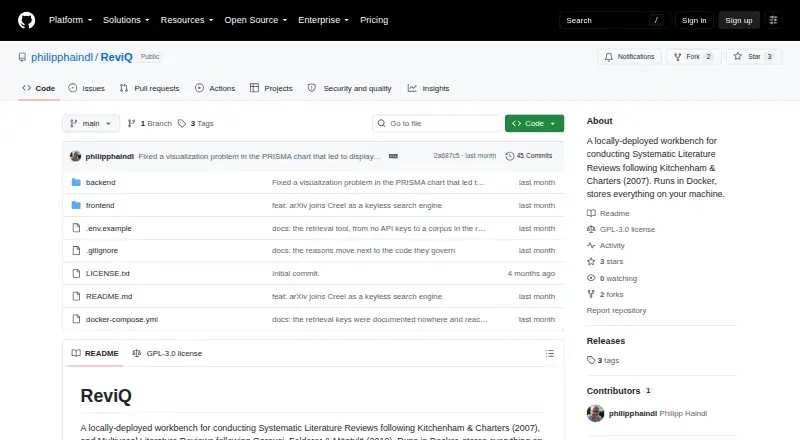
What ReviQ is
ReviQ is a locally deployed workbench for systematic and multivocal literature reviews. It guides projects through eight phases, from setup and importing material to results. During title and abstract screening, reviewers can mark items Include, Exclude, or Uncertain, record reasons by criterion, and use conflict detection plus Cohen’s κ with a 95% confidence interval and PABAK. A project can support up to five reviewers, who can exchange decisions as JSON files. Results include a PRISMA 2020 flow diagram, publication charts, venue and taxonomy summaries, a PDF protocol report, BibTeX exports, and a replication package. ReviQ runs in Docker and keeps data in a Docker volume on the user's machine; ports bind to loopback by default. It has no authentication, so anyone able to reach its port can access projects and resolve conflicts. Optional grey-literature retrieval can use SearchApi.io-backed engines or arXiv and uses ScrapingBee to fetch and archive sources. Those retrieval services consume third-party API credits billed to the user, with no budget ceiling. ReviQ is free and identifies its license as GNU GPL v3.
Good
- Guides reviews through eight phases.
- Supports screening decisions, rationales, and conflict statistics.
- Exports PRISMA diagrams, reports, and replication packages.
- Stores project data in a local Docker volume.
Watch out
- Has no authentication for reachable ports.
- Third-party retrieval credits are billed to the user.
- Retrieval has no budget ceiling.
- Optional grey-literature retrieval uses external services.
Who it suits
ReviQ is intended for researchers conducting systematic or multivocal literature reviews. It may suit teams of up to five reviewers comfortable with Docker and local deployment.
Verdict
ReviQ offers a structured review process and a broad set of research outputs in a free, locally deployed package. Its lack of authentication and uncapped retrieval spending are important considerations before use.
The facts
Each one read from ReviQ's own pages, with the date it was checked.
What it does
- Authentication limitation
- The README states that ReviQ has no authentication, so anyone who can reach its port can access projects and resolve conflicts.checked 3 Oct 2026
- Collaboration
- Reviewers can exchange decisions as JSON files, and grey-literature corpora can be shared through an interchange package.checked 3 Oct 2026
- Deployment and data
- ReviQ runs in Docker, stores data in a local Docker volume, and binds its ports to loopback by default.checked 3 Oct 2026
- Deployment and storage
- ReviQ runs in Docker and stores its data in a Docker volume on the user's machine.checked 2 Oct 2026
- Integrations
- Grey-literature retrieval can use SearchApi.io-backed search engines or arXiv’s API, and uses ScrapingBee to fetch and archive sources.checked 2 Oct 2026
- Intended users
- The project describes its workflow for researchers conducting systematic or multivocal literature reviews, including reviews with up to five reviewers.checked 3 Oct 2026
- License
- The repository lists the GNU General Public License v3.checked 3 Oct 2026
- Optional features
- OCR and figure descriptions are off by default; figure descriptions use an optional Anthropic API key.checked 3 Oct 2026
- Purpose
- ReviQ is a locally deployed workbench for systematic and multivocal literature reviews.checked 3 Oct 2026
- Results and exports
- Results include a PRISMA 2020 flow diagram, publication charts, a PDF protocol report, BibTeX exports, and a replication package.checked 3 Oct 2026
- Retrieval integrations
- The optional grey-literature retrieval tool can use SearchApi.io-backed search engines or arXiv, and uses ScrapingBee to fetch and archive results.checked 3 Oct 2026
- Review capacity
- A project setup supports up to five reviewers.checked 2 Oct 2026
- Review workflow
- It supports eight phases, from project setup and importing references through screening, quality assessment, data extraction, and results.checked 3 Oct 2026
- Screening
- Title and abstract screening supports Include, Exclude, and Uncertain decisions, per-criterion rationale, conflict detection, Cohen’s κ with 95% CI, and PABAK.checked 2 Oct 2026
- Screening statistics
- Screening includes automatic conflict detection, Cohen’s κ with a 95% confidence interval, and PABAK.checked 3 Oct 2026
- Security limitation
- ReviQ has no authentication; the README warns that anyone able to reach its ports can read projects and resolve conflicts.checked 2 Oct 2026
Money
- Retrieval costs
- SearchApi.io and ScrapingBee API keys are needed for the corresponding retrieval engines and fetching; their usage is billed to the user, and ReviQ has no budget ceiling for the tool.checked 3 Oct 2026
Alternatives to ReviQ
- 1
RevMan
Free planWebLinuxmacOSWindows7.8From £80 a year - 2

ASReview
Free planOpen sourceWebAPILinuxmacOS7.7Free plan - 3
LASER AI
AndroidiOSWeb7.6From $3,000 a year - 4

Rayyan
Free planAndroidiOSWebAPI7.5From $4.99 a month - 5
Sysrev
Free planWebAPISelf-hosted7.5From $50 a month - 6
Universal SLR Assistant
Free planOpen sourceWebAPILinuxmacOS7.5Free plan