
config.XO
config.XO extends Microsoft PowerShell Desired State Configuration to manage configurations across Windows and Linux nodes.
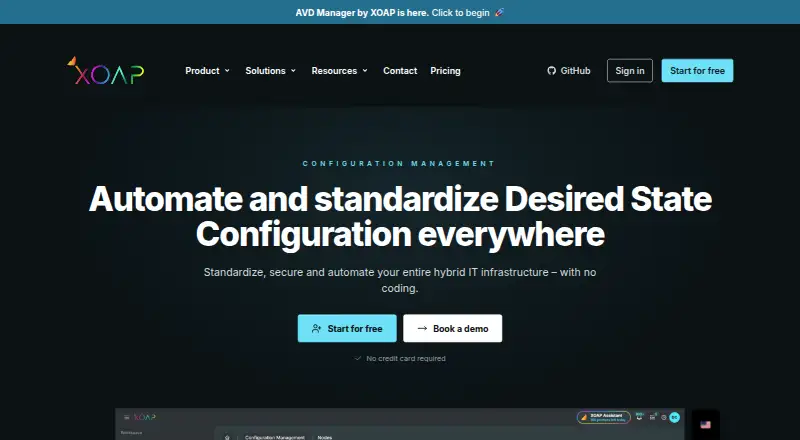
What config.XO is
config.XO extends Microsoft PowerShell Desired State Configuration to manage configurations across Windows and Linux nodes. It continuously evaluates managed servers and clients against their desired state and corrects configuration drift automatically. Configurations can be assigned to groups or individual hosts, and users can create their own configurations or modules. A web wizard can also produce DSC configurations without requiring users to write code. Supported environments include on-premises physical hosts and virtual machines, plus public-cloud virtual machines with internet access; proxy configuration is possible. Listed Windows versions include Server 2022, 2019, and 2016, as well as Windows 11 and 10. Configuration runs can install packages through application.XO. The cloud service is agent-based and lists drift detection, patch management, policy as code, and compliance reporting. Uploaded PowerShell DSC configurations are encrypted with a certificate provided by XOAP, while user-uploaded compiled MOF files are not encrypted. XOAP says the service is hosted in Europe, is GDPR compliant, encrypts management connections, and does not store actual user credentials. The Free plan includes three managed systems. Standard costs €449 per month or €4,999 billed annually and includes ten managed systems, with more available.
Good
- Automatically corrects configuration drift
- Assigns configurations to groups or hosts
- Wizard creates DSC configurations without code
- Supports Windows and Linux nodes
- Free plan includes 3 managed systems
Watch out
- Free plan is limited to 3 managed systems
- Uploaded compiled MOF files are not encrypted
- Standard includes 10 systems before add-ons
Who it suits
It suits teams managing desired configurations across Windows and Linux nodes, including on-premises and internet-connected public-cloud systems. The wizard may help administrators who want to create DSC configurations without writing code.
Verdict
config.XO offers drift correction and configuration management across listed Windows and Linux environments. Review the managed-system limits and the distinction in encryption for uploaded DSC configurations and MOF files.
Plans and prices
From config.XO's own pricing page, checked 29 Sep 2001.
| Plan | Price | What it gives you |
|---|---|---|
| Free | Free | 1 workspace · 1 admin user · 1 cloud connection · 1 hypervisor · 3 managed systems · 1 API key · Free forever |
| Standard | €449 a month | 10 admin users · Unlimited cloud connections · Unlimited hypervisors · 10 managed systems, with more available · Or €4,999 billed annually |
| Custom | Priced on request | Customized plan · Extended enterprise support · Technical engineering · Contact sales |
The facts
Each one read from config.XO's own pages, with the date it was checked.
Where it runs
- Application integration
- Configuration runs can run package installations using application.XO, which is based on PowerShell App Deployment Toolkit.checked 29 Sep 2001
- Windows versions
- The documentation lists Windows Server 2022, 2019, and 2016, plus Windows 11 and Windows 10 as supported versions.checked 29 Sep 2001
What it does
- Configuration wizard
- A web-based wizard can create DSC configurations without requiring users to write code.checked 29 Sep 2001
- Custom modules
- Users can create their own configurations or modules and apply them where needed.checked 29 Sep 2001
- Data security
- XOAP says its service is hosted in Europe, is GDPR compliant, encrypts management connections, and does not store actual user credentials.checked 29 Sep 2001
- Drift correction
- Managed servers and clients are continuously evaluated against their desired state, and configuration drift is corrected automatically.checked 29 Sep 2001
- Grouping
- Configurations can be assigned to groups or individual hosts.checked 29 Sep 2001
- Node registration
- Windows nodes are registered by running a PowerShell script that installs the XOAP DSC module and configures the local configuration manager.checked 29 Sep 2001
- Pricing limit
- The Free XOAP plan includes 3 managed systems, and the Standard plan includes 10 with additional systems available.checked 29 Sep 2001
- Purpose
- config.XO extends Microsoft PowerShell Desired State Configuration to manage Windows and Linux node configurations.checked 29 Sep 2001
- Security
- Uploaded PowerShell DSC configurations are encrypted using a certificate provided by XOAP; compiled MOF files uploaded by users are not encrypted.checked 29 Sep 2001
- Supported environments
- The module supports on-premises virtual machines, physical hosts, and public-cloud virtual machines with internet access; proxy configuration is possible.checked 29 Sep 2001
The company
- Headquarters
- Cologne, Germanychecked 28 Sep 2001
The full review of config.XO
config.XO is a cloud service for managing Windows and Linux configurations through Microsoft PowerShell Desired State Configuration. It is best for teams already using DSC that want continuous drift correction, though its managed-system limits make it a poor fit for larger estates unless the paid plan’s allowance works for them.
Overview
config.XO compares managed servers and clients with their desired state and automatically corrects configuration drift. Teams can target groups or individual hosts and build reusable configurations or modules, giving administrators control over how settings are organized and applied. It is a focused choice for DSC-based management rather than a general-purpose configuration system.
The cloud service supports on-premises virtual machines, physical hosts and public-cloud virtual machines with internet access; proxy configuration is possible. Windows node registration requires running a PowerShell script that installs the XOAP DSC module and configures the local configuration manager. XOAP says its service is hosted in Europe, is GDPR compliant, encrypts management connections and does not store actual user credentials.
Key features
Configuration authoring and enforcement
A web-based wizard can create DSC configurations without requiring users to write code, while custom configurations and modules let teams apply their own setup where needed. The wizard can lower the barrier to authoring, but it does not change the product’s reliance on DSC or eliminate the registration work required for Windows nodes.
Continuous evaluation and automatic drift correction are valuable where systems must stay aligned with a defined configuration. Configurations can be assigned to groups or individual hosts, which supports both shared policy and host-specific needs.
Application deployment and security
Configuration runs can trigger package installations through application.XO, which is based on PowerShell App Deployment Toolkit. This is useful for teams that want configuration and application installation to work together, but it ties that workflow to XOAP’s application management product.
Uploaded PowerShell DSC configurations are encrypted with a certificate provided by XOAP, while user-uploaded compiled MOF files are not encrypted. That distinction matters when choosing how to upload configuration artifacts. XOAP also says management connections are encrypted and actual user credentials are not stored.
Pricing
The Free plan costs nothing, billed Free forever. It includes 1 workspace, 1 admin user, 1 cloud connection, 1 hypervisor, 3 managed systems and 1 API key. This is a meaningful starting point for a small evaluation or a very small deployment, but the three-system cap and single admin user limit its usefulness for a growing team.
Standard costs €449 a month, or €4,999 billed annually. It includes 10 admin users, unlimited cloud connections, unlimited hypervisors and 10 managed systems, with more systems available. The plan expands team and infrastructure allowances, but the 10-system baseline remains a consideration for organizations managing a larger fleet.
Custom pricing is available by contacting sales. The plan is customized and includes extended enterprise support and technical engineering, making it the relevant route for organizations that need those services or a tailored arrangement. There is no free trial.
Platforms
config.XO is a cloud deployment with an agent-based model. It supports API, Linux, web and Windows, including Windows Server 2022, 2019 and 2016, and Windows 11 and 10. Supported environments include on-premises virtual machines, physical hosts and internet-connected public-cloud virtual machines. Linux support is included, though the Windows documentation names specific releases.
Who it's for
config.XO fits teams that already use PowerShell DSC and need central assignment, ongoing drift correction and optional application.XO package installation. The wizard may suit administrators who want to create configurations without writing code. The Free plan is suited to up to three managed systems; teams with more nodes should assess Standard’s 10-system base and the cost of expanding beyond it. Organizations seeking a non-DSC approach or broad free fleet capacity should look elsewhere.
Pros and cons
- Pro: Automatic drift correction keeps managed systems aligned with desired state without relying only on manual checks.
- Pro: Group and individual-host targeting, plus custom modules, gives teams flexibility in applying configurations.
- Pro: The forever-free plan includes three managed systems, providing a real small-scale entry point.
- Con: Free is limited to three managed systems and one admin user, while Standard starts with 10 systems.
- Con: Uploaded compiled MOF files are not encrypted, unlike uploaded PowerShell DSC configurations.
- Con: Windows node setup requires a PowerShell registration script and local configuration manager setup.
Alternatives
For a broader comparison, browse Configuration Management Tools. Consider Salt if a free, Apache 2.0-licensed option across Linux, macOS, self-hosted and Windows platforms better suits your deployment. CFEngine is another freemium option, with a free Community Edition and a free trial. Choose AWS Systems Manager State Manager if its free service and Linux, macOS, web and Windows platform coverage suit your needs.
Google Cloud VM Manager may fit teams looking at a VM-focused option with a free tier and usage-based billing after it. Rudder is worth considering for its downloadable, modifiable open-source code and free plan. cdist is a free alternative for Linux, macOS and self-hosted environments. OpenVox is a free, community-maintained option with agent/server or standalone use. pyinfra is free and MIT licensed, and may suit teams using Python 3.10 or later.
Verdict
Choose config.XO if your team already works with PowerShell DSC and wants hosted, continuous drift correction with a configuration wizard and group-based targeting. Its main advantage is focused DSC enforcement across Windows and Linux; its main reason to look elsewhere is the modest managed-system allowance relative to the paid price, alongside the unencrypted handling of uploaded MOF files.
Getting started
- Open the config.XO website
- Choose the Free, Standard, or Custom plan
- Create a workspace and administrator account
- Connect a cloud or hypervisor environment
- Register Windows nodes with the supplied PowerShell script
- Assign configurations to groups or individual hosts
Limits worth knowing
The Free plan includes one workspace, one admin user, one cloud connection, one hypervisor, three managed systems, and one API key. Standard includes ten managed systems, with additional systems available, and costs €449 per month or €4,999 billed annually.
Questions
Is there a free plan?
Yes. The Free plan costs nothing and is available indefinitely.
How much is Standard?
Standard costs €449 per month or €4,999 when billed annually.
Which operating systems are supported?
Supported systems include Windows Server 2022, 2019, and 2016, Windows 11, Windows 10, and Linux.
Can it correct configuration drift automatically?
Yes. Managed servers and clients are continuously checked against their desired state, and drift is corrected automatically.
Is config.XO cloud-based?
Yes. Its deployment model is cloud and its agent model is agent-based.
Does it provide compliance features?
The service lists policy as code and compliance reporting, along with drift detection and patch management.
Alternatives to config.XO
- 1

Puppet
Free planOpen sourceWebAPILinuxmacOS8.3From $120 a month - 2

Rudder
Free planOpen sourceWebAPILinuxSelf-hosted8.2From $3.33 a month - 3

CFEngine
Free planOpen sourceWebAPILinuxmacOS7.7Free plan - 4

Uyuni
Free planOpen sourceWebAPILinuxSelf-hosted7.4Free plan - 5

Google Cloud VM Manager
Free planWebAPILinuxWindows7.1Free plan - 6

Salt
Free planAPILinuxmacOSSelf-hosted7.0Free plan