
Civo Block Storage
Civo Block Storage provides persistent NVMe volumes for Civo compute instances and Kubernetes clusters.
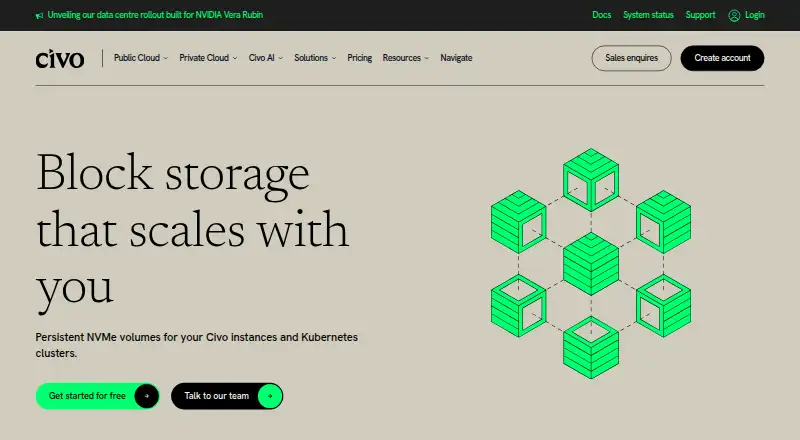
What Civo Block Storage is
Civo Block Storage provides persistent NVMe volumes for Civo compute instances and Kubernetes clusters. Civo describes it as suitable for databases, application back ends, and persistent capacity for compute or Kubernetes workloads. Kubernetes volumes can be provisioned through Civo’s CSI driver using a PersistentVolumeClaim. Volumes can be grown, detached from one instance, and attached to another in seconds. The service uses NVMe drives across a 25GbE network and is described as tuned for sustained workloads including AI training, analytics, and production databases. Civo states that each volume has a 99.95% uptime SLA, with data redundancy in the underlying architecture and two additional mirrors across distributed nodes. Transfer is unlimited, with no egress fees or per-IOP charges. Dashboard operations are also available through an API and CLI, with Terraform provisioning and CI pipeline snapshots given as automation examples. The maximum listed volume size is 1 TB. Snapshots, autoscaling, rolling updates, and policy controls are listed; multi-attach is not supported. The service is managed and listed for API, Linux, macOS, web, and Windows.
Good
- Persistent NVMe volumes for compute and Kubernetes
- 99.95% uptime SLA stated for each volume
- Unlimited transfer without egress or per-IOP fees
- Supports snapshots, autoscaling, and rolling updates
- Volumes can be detached and reattached
Watch out
- Maximum listed volume size is 1 TB
- Multi-attach is not supported
- Pricing facts list differing starting amounts
Who it suits
It suits teams running Civo compute instances or Kubernetes clusters that need persistent NVMe storage for databases, back ends, or other workloads. API, CLI, and Terraform examples may also interest teams automating provisioning.
Verdict
Civo Block Storage offers persistent NVMe volumes with stated redundancy, transfer terms, and Kubernetes provisioning support. Confirm which listed starting price applies and whether the 1 TB limit and lack of multi-attach fit your workload.
Plans and prices
From Civo Block Storage's own pricing page, checked 15 Oct 2026.
| Plan | Price | What it gives you |
|---|---|---|
| Free trial credit | Free | $250 service credit · standard fees after trial · 31 calendar days; one trial per customer |
| Volumes | Free | Hourly billing · volume size minimum 1GB · maximum limited by account quota · per GB per hour |
| Block storage | $10.86 a month | NVMe storage · unlimited transfer · no egress or per-IOP fees · 99.95% SLA · per 1TB per month |
The facts
Each one read from Civo Block Storage's own pages, with the date it was checked.
What it does
- API authentication
- API calls use bearer API keys, and Civo also documents short-lived JWT authentication with authorization-code and client-credentials flows.checked 15 Oct 2026
- API operations
- The public API documents list, create, attach, detach and delete operations for volumes.checked 15 Oct 2026
- Attachment limit
- The API documentation states that a volume can be attached to only one instance at a time.checked 15 Oct 2026
- Automation
- Civo says dashboard actions are also available through its API and CLI, and gives Terraform provisioning and CI pipeline snapshots as automation examples.checked 7 Oct 2026
- Data mirroring
- Civo’s pricing page says persistent volumes have two additional data mirrors stored across multiple distributed nodes.checked 7 Oct 2026
- Documentation depth
- Official guides cover creation, attachment, partitioning, formatting, mounting, resizing, detachment and deletion of volumes.checked 15 Oct 2026
- Funding record
- Crunchbase lists two corporate funding rounds involving THG Ingenuity but hides the amounts behind an account wall.checked 15 Oct 2026
- Kubernetes
- Volumes can be provisioned for Kubernetes through Civo’s CSI driver using a PersistentVolumeClaim.checked 7 Oct 2026
- Kubernetes integration
- Civo supplies a CSI driver and a default Kubernetes storage class named civo-volume.checked 15 Oct 2026
- Legal name
- Civo’s service terms identify the contracting company as Civo Limited, registered in England and Wales.checked 15 Oct 2026
- Licence
- The managed block-storage service is proprietary; Civo’s terms prohibit copying, modifying, distributing or sublicensing its software services.checked 15 Oct 2026
- Limit: Gartner documentation
- The Gartner review specifically noted limited documentation support.checked 15 Oct 2026
- Limit: Trustpilot account suspension
- A Trustpilot reviewer alleged that Civo suspended an account after issuing $250 credit and repeatedly declined to explain the decision.checked 15 Oct 2026
- Online management
- Civo says volumes can be created, attached, resized and reattached on demand without disrupting running applications.checked 15 Oct 2026
- Operating system setup
- Civo’s configuration guide demonstrates partitioning, formatting, mounting, and resizing a volume on a Linux instance using tools including parted, mkfs, and resize2fs.checked 7 Oct 2026
- Outage: API 2024
- Civo reported website, dashboard and API timeouts on November 19, 2024; the incident was resolved after 40 minutes.checked 15 Oct 2026
- Outage: FRA1 2026
- The status page records a FRA1 service disruption beginning June 30, 2026, resolved after 26 hours 1 minute.checked 15 Oct 2026
- Outage: LON1 2026
- Civo’s status page records degraded storage and network performance in LON1 on July 28, 2026, resolved after 20 hours 5 minutes.checked 15 Oct 2026
- Performance
- The service uses NVMe drives across a 25GbE network and is described as tuned for sustained workloads such as AI training, analytics, and production databases.checked 7 Oct 2026
Where it runs
- CLI platforms
- The Go-based Civo CLI is distributed as binaries for multiple operating systems and can be installed with Homebrew on macOS.checked 15 Oct 2026
The company
- Company
- Civo identifies Mark Boost as its founder and CEO.checked 7 Oct 2026
- Company founding
- LinkedIn states that Civo was founded in 2015.checked 15 Oct 2026
- Company size
- LinkedIn lists Civo as a privately held IT-services company with 51–200 employees.checked 15 Oct 2026
- Headquarters
- London, Englandchecked 28 Sep 2026
The full review of Civo Block Storage
Civo Block Storage is managed NVMe storage for Civo compute and Kubernetes. It is a strong fit for teams keeping databases or application data on Civo, but the 1 TB volume limit and lack of multi-attach narrow its reach.
Overview
Volumes provide persistent capacity for databases, application back ends, and other compute workloads. In Kubernetes, Civo’s CSI driver provisions storage through a PersistentVolumeClaim. Volumes can also be grown, detached, and attached to another instance in seconds, which is useful when capacity or instance placement changes. On Linux, administrators still need to partition, format, mount, and resize volumes using operating-system tools.
The service uses NVMe drives across a 25GbE network and is positioned for sustained workloads such as AI training, analytics, and production databases. Civo states a 99.95% uptime SLA for each volume, with redundancy built into the architecture and two additional data mirrors across distributed nodes. Unlimited data transfer, no egress fees, and no per-IOP charges make costs less sensitive to moving data or storage activity.
Key features
- Kubernetes provisioning: CSI and PersistentVolumeClaim support provide a direct way to request persistent storage for workloads in Civo Kubernetes clusters.
- Resize and reattach: Growing a volume or moving it between instances in seconds is practical for changing capacity needs and instance maintenance. The 1 TB maximum remains a firm ceiling.
- Automation and snapshots: Dashboard operations are also available through the API and CLI. Civo cites Terraform provisioning and CI pipeline snapshots as automation examples; snapshots are supported.
- Transfer terms: Unlimited transfer without egress or per-IOP charges removes two common sources of variable storage cost.
- Security credentials: The product page displays AICPA SOC 2, Cyber Essentials Plus, ISO 27001, Crown Commercial Service, and UK Government G-Cloud badges.
Pricing
Civo presents two volume plans, and its pricing model is marked freemium even though there is no free plan.
- Volumes — free: Usage is calculated hourly and billed monthly, per GB. The plan describes persistent volumes with two additional data mirrors across distributed nodes. It suits variable or modest capacity needs, but the zero monthly figure is not a free allowance: usage is billed.
- Block storage — $10.86 a month: Billed at $10.86/month per 1TB, this includes 1TB of NVMe block storage, unlimited data transfer, no egress fees, and no per-IOP charges. It suits workloads that need a full terabyte and value predictable transfer costs. The cap is 1 TB per volume.
The pricing summary also says paid plans start at $5.43/mo, while the named Block storage plan is priced at $10.86 a month for 1TB. Confirm which starting price applies to the intended capacity before budgeting. There is no free plan, and no trial, renewal term, or seat allowance is stated.
Platforms
Civo lists API, Linux, macOS, web, and Windows platforms. The documented Linux setup involves partitioning, formatting, mounting, and resizing with tools such as parted, mkfs, and resize2fs, so this is managed storage rather than a substitute for operating-system volume administration.
Who it's for
Choose Civo Block Storage when persistent NVMe capacity for Civo compute or Kubernetes matters, especially for databases and application back ends that benefit from snapshots, automation, and transfer costs without egress or per-IOP fees. It is less suitable for designs needing volumes larger than 1 TB or simultaneous multi-attach.
Pros and cons
- Pro: CSI provisioning, API and CLI access, and Terraform and CI snapshot examples support automated infrastructure workflows.
- Pro: Two additional mirrors, a stated 99.95% uptime SLA, and unlimited transfer without egress or per-IOP fees address resilience and cost concerns.
- Con: A 1 TB maximum volume size limits larger datasets or single-volume growth.
- Con: Multi-attach is not supported, ruling out workloads that require one volume attached to multiple instances at once.
- Con: The Linux setup still requires manual partitioning and filesystem work, despite the managed deployment model.
Alternatives
For broader infrastructure choices, browse Container Orchestration Software.
Choose Kubermatic Kubernetes Platform instead if you need an open-source Kubernetes platform with a free Community Edition under Apache License 2.0; Enterprise Edition uses custom pricing.
MicroK8s is worth considering for free Kubernetes on Linux, macOS, or Windows, with no license fees and an Ubuntu Pro Personal option covering up to five machines.
Pick .NET instead when you need its free software plan for up to 1,000 nodes rather than Civo-managed block volumes.
Google Kubernetes Engine is an alternative for managed Kubernetes with a free tier that applies $74.40 in monthly credits per billing account to zonal and Autopilot clusters.
Kubernetes is the free, open-source platform option for teams seeking orchestration software rather than managed Civo block storage.
Consider Docker Swarm if you want orchestration built into Docker Engine without additional orchestration software.
KubeSphere is another open-source Kubernetes container platform option.
Rancher offers a free open-source platform with community support, with Rancher Prime available under custom pricing.
Verdict
Civo Block Storage is a sensible choice for teams running Civo compute or Kubernetes workloads that need persistent NVMe volumes, snapshots, and transfer costs without egress or per-IOP fees. Its stated redundancy and quick resize or reattach options strengthen the case. Look elsewhere if a workload needs a volume above 1 TB or multi-attach, and verify the applicable starting price before committing.
Getting started
- Open the Civo Block Storage website
- Create or access a Civo compute instance or Kubernetes cluster
- Provision a volume through the dashboard, API, or CLI
- For Kubernetes, create a PersistentVolumeClaim through Civo’s CSI driver
- On Linux, partition, format, mount, and resize the volume with the demonstrated tools
- Use snapshots, Terraform, or CI automation as needed
Limits worth knowing
Volumes are limited to 1 TB and do not support multi-attach. Pricing information lists paid service from $5.43/mo, while the Block storage plan is shown at $10.86 a month for 1TB.
Questions
What does Civo Block Storage provide?
It provides persistent managed NVMe volumes for Civo compute instances and Kubernetes clusters.
Is there a free plan?
The pricing model is labeled freemium, but the listed Free plan is no.
How much does it cost?
A Block storage plan is listed at $10.86 a month for 1TB.
What platforms are supported?
The listed platforms are API, Linux, macOS, web, and Windows.
Does it support Kubernetes?
Yes. Volumes can be provisioned through Civo’s CSI driver using a PersistentVolumeClaim.
Are snapshots and multi-attach available?
Snapshots are listed as supported. Multi-attach is listed as unsupported.
Alternatives to Civo Block Storage
- 1
Google Slides
Free planAndroidiOSWeb7.8From $7 a month - 2

Amazon Web Services (AWS)
Free planAndroidiOSWebAPI7.3Free plan - 3
Tencent Cloud Text to Speech
Free planAndroidiOSWebAPI7.1Free plan - 4

IBM Aspera on Cloud
WebAPI6.7From $22.10 a month - 5

VEXXHOST Public Cloud
WebAPI6.4$7.50 usage-based - 6

Hetzner Web Hosting
WebLinux5.8