.NET
.NET is listed as open-source software with a hybrid deployment model and a centralized control plane.
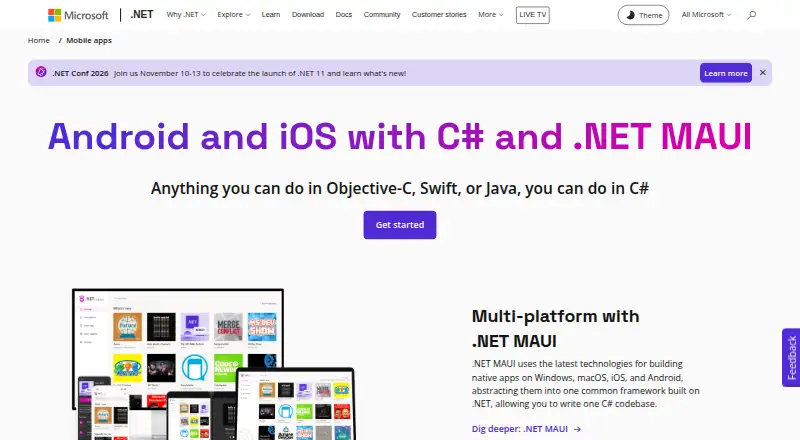
What .NET is
.NET is listed as open-source software with a hybrid deployment model and a centralized control plane. Its listed platforms are Windows, Mac, Linux, iOS, and Android. The management capabilities include multi-cluster management, autoscaling, rolling updates, policy controls, and policy segmentation. The listed node limit is 5,000, and the supported protocols are TCP, UDP, ICMP, ESP, AH, and any protocols. A northbound API is also available. Plans include Free, Standard, and Premium, as well as subscription-based and virtual network-based billing options. Free covers up to 1,000 nodes; Standard and Premium each cover up to 5,000 nodes. Subscription-based billing charges per managed subscription for Azure Virtual Network Manager instances created before virtual-network-based billing. Virtual network-based billing is the default for instances created after that change and charges per managed virtual network. Additional options include Network verifier, which provides reachability analysis in a Virtual Network Manager verifier workspace, and IP address management, which charges per active IP address managed by that feature. The listed website is the .NET mobile apps page.
Good
- Listed as open-source software with a free plan.
- Supports Windows, Mac, Linux, iOS, and Android.
- Includes multi-cluster management and autoscaling.
- Rolling updates, policy controls, and policy segmentation are listed.
- Supports TCP, UDP, ICMP, ESP, AH, and any protocols.
- A northbound API is available.
Watch out
- The Free plan covers up to 1,000 nodes.
- Standard and Premium each cover up to 5,000 nodes.
- Some billing options charge per managed subscription or virtual network.
- IP address management charges per active managed IP address.
Who it suits
.NET suits users seeking a hybrid, centralized approach to managing nodes across its listed desktop and mobile platforms. Its listed capabilities may fit teams that need multi-cluster management, policy controls, autoscaling, or rolling updates.
Verdict
Consider .NET if its listed hybrid deployment, centralized control plane, and node-management capabilities match your needs. The Free plan is limited to 1,000 nodes, while higher node capacity and billing options are described in separate plans.
Plans and prices
From .NET's own pricing page, checked 22 Sep 2026.
| Plan | Price | What it gives you |
|---|---|---|
| Free | Free | Up to 1,000 nodes |
| Subscription-based billing | Priced on request | For Azure Virtual Network Manager instances created before virtual-network-based · Charges per managed subscription |
| Standard | Priced on request | Up to 5,000 nodes |
| Virtual network-based billing | Priced on request | Default for Azure Virtual Network Manager instances created after virtual-networ · Charges per managed virtual network |
| Premium | Priced on request | Up to 5,000 nodes |
| Network verifier | Priced on request | Reachability analysis in a Virtual Network Manager verifier workspace |
| IP address management | Priced on request | Charges per active IP address managed by the IP address management feature |
The full review of .NET
Overview
.NET is a network-management option for teams coordinating clusters and network resources across hybrid environments. It is best suited to operators who need centralized policy and node management, rather than teams looking for a simple standalone networking tool.
Its strongest case is the combination of multi-cluster management, policy controls, and scaling and update capabilities. The main constraint is capacity: the Free plan covers up to 1,000 nodes, while the stated ceiling for higher tiers is 5,000.
Key features
- Centralized hybrid management: A centralized control plane and hybrid deployment model let teams manage network resources across environments. This is useful when a single operational view matters; it may be more than a small, single-cluster setup needs.
- Cluster operations: Multi-cluster management, autoscaling, and rolling updates support coordinated administration as deployments change. These capabilities make .NET a stronger fit for growing or actively maintained environments than for users who only need basic connectivity.
- Policy and integration: Policy controls and segmentation provide ways to govern network behavior, and a northbound API offers an integration point for other systems. Teams that need network-level controls can make use of this breadth, though the 5,000-node limit remains a consideration for larger estates.
- Protocol support: Supported protocols include TCP, UDP, ICMP, ESP, AH, and any protocols. That range is useful for networks with varied traffic requirements.
Pricing
.NET is open source and has a free plan, but the pricing structure also includes distinct billing options and feature-specific plans. Paid plans use custom pricing, so organizations should establish which billing basis applies before planning costs.
- Free — free: Supports up to 1,000 nodes. It is the sensible starting point for smaller deployments, but teams that exceed the cap will need a higher-capacity option.
- Standard — custom pricing: Supports up to 5,000 nodes. It is the higher-capacity tier for deployments that outgrow Free.
- Premium — custom pricing: Also supports up to 5,000 nodes. The stated capacity matches Standard, so the plan choice should depend on requirements beyond node count.
- Subscription-based billing — custom pricing: For Azure Virtual Network Manager instances created before virtual-network-based billing, charges are per managed subscription.
- Virtual network-based billing — custom pricing: The default for Azure Virtual Network Manager instances created after virtual-network-based billing, with charges per managed virtual network.
- Network verifier — custom pricing: Covers reachability analysis in a Virtual Network Manager verifier workspace.
- IP address management — custom pricing: Charges are based on each active IP address managed by the feature.
The billing distinction matters: subscription-based and virtual-network-based charges use different units, while IP address management adds a per-active-address basis. The free cap is clear, but paid costs depend on usage and the applicable billing model.
Platforms
.NET is listed for Windows, Mac, Linux, iOS, and Android. That breadth suits teams managing environments across different operating systems and device platforms.
Who it's for
.NET is a strong fit for network operators who need to coordinate multiple clusters, apply policy controls, and manage up to 5,000 nodes under the higher-capacity plans. It is less compelling for a small deployment that can stay within the Free limit but does not need centralized, hybrid management, or for a larger estate that would exceed the stated node ceiling.
Pros and cons
- Pros: Centralized control, hybrid deployment, multi-cluster management, autoscaling, and rolling updates combine in one offering, giving operators a broad set of network-management capabilities.
- Pros: The free plan supports up to 1,000 nodes, providing a meaningful starting capacity before moving to a paid tier.
- Pros: Protocol support spans TCP, UDP, ICMP, ESP, AH, and any protocols, accommodating varied network traffic.
- Cons: Standard and Premium both top out at 5,000 nodes, which may not meet the needs of larger deployments.
- Cons: Paid prices are custom, and billing may depend on managed subscriptions, virtual networks, or active IP addresses, making costs harder to estimate without understanding the relevant basis.
Alternatives
For a different approach, consider the ONOS, which is free and published under the Apache License 2.0. VMware Workstation Pro is a free option for Windows or Linux hosts on 64-bit Intel or AMD PCs, with no subscription or license key required. The free Omada Cloud Essentials plan in TP-Link Omada Cloud-Based Controller offers unlimited devices and sites with core management features and no ongoing fees.
Antrea is free but requires a Kubernetes cluster and Open vSwitch kernel module on every Kubernetes node. OpenDaylight is a free open-source SDN platform distributed as tar or zip downloads and Docker images. Cilium is free, self-hosted software for Linux requiring kernel 5.10 or equivalent and AMD64 or AArch64 hardware. Kube-OVN is a free, Apache-2.0-licensed Kubernetes networking project, while Open Virtual Network is free open-source software under the Apache 2 license.
Explore more options in Software-Defined Networking Software, Container Orchestration Software, and IP Address Management Software.
Verdict
Choose .NET if your team needs centralized hybrid management, multi-cluster operations, and policy controls within a 5,000-node ceiling. Its free tier gives smaller deployments room to start, but custom pricing and usage-based billing make it a weaker choice when predictable costs are the priority.
Getting started
- Visit the .NET mobile apps website.
- Choose the Free plan for up to 1,000 nodes, or review Standard and Premium, each covering up to 5,000 nodes.
- For Azure Virtual Network Manager instances, select the applicable billing model: per managed subscription or per managed virtual network.
- Review Network verifier for reachability analysis or IP address management for active managed IP addresses.
Limits worth knowing
The Free plan covers up to 1,000 nodes. Standard and Premium each cover up to 5,000 nodes.
Questions
Is .NET open source?
It is listed with an open-source pricing model.
Is there a free plan?
Yes. The Free plan is free and covers up to 1,000 nodes.
Which platforms are listed?
Windows, Mac, Linux, iOS, and Android.
What node capacity do the plans cover?
Free covers up to 1,000 nodes. Standard and Premium each cover up to 5,000 nodes.
How do the billing options work?
Subscription-based billing charges per managed subscription for instances created before virtual-network-based billing. Virtual network-based billing is the default for later instances and charges per managed virtual network.
What are Network verifier and IP address management?
Network verifier provides reachability analysis in a Virtual Network Manager verifier workspace. IP address management is charged per active IP address managed by the feature.
Alternatives to .NET
- 1
Antrea
Free planOpen sourceAPILinuxSelf-hostedWindows7.2Free plan - 2
ONOS
Free planWebAPILinuxmacOS6.9Free plan - 3
TP-Link Omada Cloud-Based Controller
Free planAndroidiOSWeb6.7Free plan - 4
OpenDaylight
Free planAPILinuxmacOSSelf-hosted6.3Free plan - 5
Cisco Catalyst Center
WebAPILinuxmacOS6.2 - 6

Nutanix Flow Virtual Networking
WebAPISelf-hosted6.2