Antrea
Antrea is an open-source networking and security project for Kubernetes workloads.
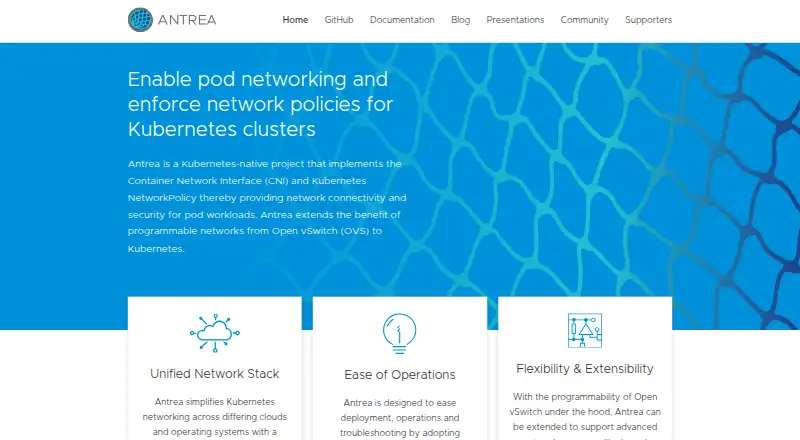
What Antrea is
Antrea is an open-source networking and security project for Kubernetes workloads. It implements the Container Network Interface and Kubernetes NetworkPolicy to provide pod networking, using Open vSwitch as its data plane, including for Kubernetes Service load balancing. It supports overlay networking with VXLAN or Geneve, and can also run without an overlay depending on infrastructure and use case. Antrea extends Kubernetes policy controls with tiers, rule priorities, cluster-level policies and Node policies. It can federate clusters using a unified data plane, multi-cluster Services and security posture. Diagnostics include command-line and UI tools for packet tracing, policy analysis and flow inspection, with metrics export to Prometheus. Linux nodes can use IPsec or WireGuard encryption for pod traffic between nodes; traffic encryption is not supported on Windows nodes. The project is free under Apache License 2.0. It requires a Kubernetes cluster and the Open vSwitch kernel module on every node; the overview says it has been tested with Kubernetes 1.23 or later.
Good
- Extends Kubernetes policies with tiers and priorities
- Supports VXLAN and Geneve overlay networking
- Federates clusters with multi-cluster Services
- Diagnostics include tracing, policy analysis and flow inspection
- Free under Apache License 2.0
Watch out
- Requires a Kubernetes cluster and Open vSwitch on every node
- Traffic encryption is unsupported on Windows nodes
- Azure support is no longer tested from Antrea 2.5
Who it suits
Antrea suits Kubernetes operators who need pod networking, network policy controls or multi-cluster capabilities. It requires Open vSwitch on every node, and its traffic encryption feature applies to Linux nodes rather than Windows nodes.
Verdict
Antrea brings networking, policy controls and diagnostics to Kubernetes environments, with multi-cluster support also available. Its node requirements and Windows encryption limitation are important deployment considerations.
Plans and prices
From Antrea's own pricing page, checked 3 Oct 2026.
| Plan | Price | What it gives you |
|---|---|---|
| Antrea | Free | Apache License 2.0 · requires a Kubernetes cluster and Open vSwitch kernel module on every Kubernetes node |
The facts
Each one read from Antrea's own pages, with the date it was checked.
What it does
- API documentation
- The documentation lists Antrea API groups and a generated Antrea API reference for developers.checked 15 Oct 2026
- Azure support
- The AKS guide says Azure support is no longer tested starting with Antrea 2.5 and Azure-related issues are handled on a best-effort basis.checked 3 Oct 2026
- CLI
- The project documents antctl, a command-line tool for diagnostics and operational inspection.checked 15 Oct 2026
- Cloud deployment
- The documentation provides deployment guides for Amazon EKS, Azure AKS, and Google GKE, with GKE marked Alpha.checked 3 Oct 2026
- CNCF community
- CNCF reports 313 contributors and 71 contributing organizations.checked 15 Oct 2026
- CNCF health
- CNCF reports a health score of 38, describing it as concerning.checked 15 Oct 2026
- CNCF origin
- CNCF records the first commit as 14 June 2019.checked 15 Oct 2026
- CNCF status
- CNCF accepted Antrea on 28 April 2021 at Sandbox maturity.checked 15 Oct 2026
- Deployment
- A standard installation is performed by applying one YAML manifest, with Helm and cloud-specific guides also documented.checked 15 Oct 2026
- Documentation depth
- Documentation covers installation, cloud deployment, configuration, policies, encryption, troubleshooting, APIs, Windows, integrations, multicluster and developer workflows.checked 15 Oct 2026
- Encryption
- Inter-node pod traffic can be encrypted with IPsec or WireGuard tunnels.checked 15 Oct 2026
- GitHub activity
- The public repository shows about 1.8k stars, 502 forks and more than 4,600 commits.checked 15 Oct 2026
- Integrations
- The documentation lists integrations and guides for Prometheus, Octant, Multus, and Fluentd.checked 3 Oct 2026
- Latest release
- GitHub lists Antrea v2.7.0 as the latest release and dates it 15 August 2026.checked 15 Oct 2026
- Layer 7 policy
- Antrea supports application-aware Layer 7 HTTP and TLS network policies.checked 15 Oct 2026
- Licence
- The repository is released under the Apache License 2.0.checked 15 Oct 2026
- Limit: operational complexity
- The documented prerequisites, node kernel-module requirement and extensive configuration surface make deployment dependent on Kubernetes and host-level expertise.checked 15 Oct 2026
- Limit: production maturity
- CNCF classifies Antrea as a Sandbox project, a category intended for experimental projects that are not yet widely tested in production.checked 15 Oct 2026
- Multi-cluster
- It can federate clusters with shared data-plane and multi-cluster Service capabilities.checked 15 Oct 2026
- Network modes
- It supports overlay networking with VXLAN or Geneve and can also run without an overlay, depending on the infrastructure and use case.checked 3 Oct 2026
- Network policies
- The policy model adds tiers, rule priorities, cluster-wide policies and node policies to Kubernetes NetworkPolicy.checked 15 Oct 2026
- Observability
- The project includes packet tracing, policy analysis, flow inspection, Prometheus metrics and flow export tools.checked 15 Oct 2026
- Origin news
- VMware announced Antrea's CNCF Sandbox acceptance on 5 May 2021 and said the project was originally released in November 2019.checked 15 Oct 2026
Money
- Data plane
- It uses Open vSwitch as the programmable networking data plane.checked 15 Oct 2026
The full review of Antrea
Overview
Antrea is Kubernetes networking software for teams that need pod connectivity and more control over workload traffic. It is strongest for platform teams that want policy tools and diagnostics built around Kubernetes; it is a poor fit for deployments that cannot meet its node requirements or need encrypted traffic on Windows.
Open source and free to use, Antrea combines flexible networking modes with policy extensions and multi-cluster capabilities. The trade-off is operational: every Kubernetes node needs the Open vSwitch kernel module, and deployment support varies by platform.
Key features
Antrea uses Open vSwitch as its data plane, including for Kubernetes Service load balancing. It supports VXLAN or Geneve overlays, as well as operation without an overlay when the infrastructure suits that design. This gives teams room to match networking to their environment, but the required kernel module on every node is a prerequisite, not an optional optimization.
Its policy model extends Kubernetes NetworkPolicy with policy tiers, rule priorities, cluster-level policies, and Node policies. Those additions help teams structure and apply controls beyond the base workload policy model, particularly when cluster-wide rules are important.
Antrea can federate Kubernetes clusters with a unified data plane, multi-cluster Services, and security posture. That makes it relevant to operators managing connectivity and policy across clusters, rather than only a single-cluster installation.
CLI and UI diagnostics cover packet tracing, policy analysis, and flow inspection, with metrics exported to Prometheus. Integrations and guides also cover Octant, Multus, and Fluentd. IPsec or WireGuard can encrypt pod traffic between Linux nodes, but Windows nodes do not support traffic encryption; mixed environments should account for that gap.
Deployment guides cover Amazon EKS, Azure AKS, and Google GKE, although GKE is marked Alpha. Antrea has been tested with Kubernetes 1.23 or later. Azure support is no longer tested starting with Antrea 2.5, and Azure-related issues receive best-effort handling, so teams planning AKS deployments should weigh that reduced assurance.
Pricing
| Plan | Price | What it includes |
|---|---|---|
| Antrea | free | Open-source software under Apache License 2.0; requires a Kubernetes cluster and the Open vSwitch kernel module on every Kubernetes node. |
There is no paid tier or trial to weigh against the free plan. The main cost is operational: teams must run the required Kubernetes and Open vSwitch infrastructure themselves.
Platforms
Antrea is available for API, Linux, self-hosted, and Windows environments, but platform support is not uniform. Traffic encryption is limited to communication between Linux nodes, and the cloud guidance marks GKE Alpha while Azure testing has ended from Antrea 2.5. Its overview says it has been tested with Kubernetes 1.23 or later.
Who it's for
Antrea fits Kubernetes platform and network-security teams that want richer policy organization, traffic diagnostics, Prometheus metrics, or multi-cluster networking without adopting a paid product. Its hybrid deployment, centralized control plane, policy segmentation, and northbound API suit organizations integrating network policy into a broader cluster operations model.
It is less suitable for teams without control over node configuration, for Windows-heavy environments requiring encrypted pod traffic, or for operators who need stronger tested cloud support on Azure or a stable GKE path.
Pros and cons
- Pro: More expressive policy controls. Tiers, priorities, cluster-level policies, and Node policies extend the standard Kubernetes NetworkPolicy model.
- Pro: Flexible network design. VXLAN and Geneve overlays are supported, as is operation without an overlay where infrastructure permits.
- Pro: Useful operational visibility. Packet tracing, policy analysis, flow inspection, and Prometheus metrics support troubleshooting and monitoring.
- Pro: Multi-cluster features. Federation, multi-cluster Services, and a unified data plane address needs that a single-cluster design cannot.
- Con: Node-level prerequisite. Open vSwitch kernel modules must be installed on every Kubernetes node.
- Con: Uneven platform assurances. Windows lacks traffic encryption, GKE is Alpha, and Azure testing ended with Antrea 2.5.
Alternatives
Calico Open Source is another free, Linux and Windows-capable option, with community-driven support and maintenance, in-memory data retention, and unlimited clusters. Consider it when those stated cluster and support characteristics better match your priorities.
Cilium is a free Linux and self-hosted alternative for environments meeting its Linux kernel 5.10-or-equivalent requirement on AMD64 or AArch64. Choose it if those platform requirements suit your infrastructure.
Istio is a free open-source service mesh with Linux, macOS, and self-hosted platforms. It is the alternative to consider when a service mesh is the priority.
Hopr offers a free Lane7 Blueprints plan and a $35 a month Korvette-S WoSPs plan, alongside a free trial. It may suit readers comparing freemium software or one with a paid monthly plan.
VMware Workstation Pro is free for Windows or Linux hosts on 64-bit Intel or AMD PCs, with no subscription or license key required. Consider it for that host-based use case rather than Kubernetes networking.
Zscaler Private Access is a paid private-access product with Android, iOS, Linux, macOS, web, and Windows platforms. Its plans include a limited private-access Essentials option for 5% of users and a broader ZPA Platform plan.
ColorTokens Xshield is a paid alternative with a free trial and API, Linux, macOS, self-hosted, web, and Windows platforms.
Trellix Data Loss Prevention is an enterprise DLP alternative for protecting endpoints, email, web, networks, and data storage, with on-premises or SaaS management.
For broader category comparisons, see Microsegmentation Software, Software-Defined Networking Software, and Container Networking Software.
Verdict
Choose Antrea if you run Kubernetes and want free, open-source networking with richer policy controls, diagnostics, and multi-cluster capabilities. Its strongest reason to choose is that combination within a Kubernetes-focused design; look elsewhere if the required Open vSwitch module is impractical, Windows traffic encryption is essential, or your cloud deployment depends on stronger Azure or GKE assurances.
Getting started
- Visit https://antrea.io/.
- Use the Linux, Windows, API, or self-hosted platform options as applicable.
- Prepare a Kubernetes cluster and the Open vSwitch kernel module on every Kubernetes node.
- Choose an overlay mode with VXLAN or Geneve, or run without an overlay, based on infrastructure and use case.
- Follow the deployment guide for Amazon EKS, Azure AKS, or Google GKE, noting GKE is marked Alpha.
- Use the Kubernetes Slack channel, mailing lists, community meetings, or office hours for project support.
Limits worth knowing
Antrea requires a Kubernetes cluster and the Open vSwitch kernel module on every Kubernetes node. Its overview reports testing with Kubernetes 1.23 or later; encryption of pod traffic is unavailable on Windows nodes.
Questions
What does Antrea cost?
The Antrea plan costs nothing and is licensed under Apache License 2.0.
What does Antrea do?
It implements the Container Network Interface and Kubernetes NetworkPolicy to provide pod networking and security for Kubernetes workloads.
What networking modes and protocols does it support?
It supports VXLAN or Geneve overlay networking and can also run without an overlay. Listed protocols include VXLAN, Geneve, STT, GRE, IPsec, WireGuard, BGP, and IPFIX.
Can it encrypt pod traffic?
It supports IPsec or WireGuard encryption between Linux nodes. Traffic encryption is not supported on Windows nodes.
What deployment guides are available?
Guides cover Amazon EKS, Azure AKS, and Google GKE; GKE is marked Alpha. Azure support is no longer tested starting with Antrea 2.5, and Azure-related issues are handled on a best-effort basis.
What does Antrea require?
It requires a Kubernetes cluster and the Open vSwitch kernel module on every Kubernetes node. The overview reports testing with Kubernetes 1.23 or later.
Alternatives to Antrea
- 1

Akamai Guardicore Segmentation
WebAPILinuxSelf-hosted6.4 - 2
Hopr
Free planLinuxSelf-hosted6.4From $35 a month - 3

ColorTokens Xshield
WebAPILinuxmacOS6.3 - 4
Cisco Catalyst Center
WebAPILinuxmacOS6.2 - 5

Istio
Free planLinuxmacOSSelf-hosted6.2Free plan - 6

Calico Open Source
Free planLinuxSelf-hostedWindows6.1Free plan