Cisco Catalyst Center
Cisco Catalyst Center is a centralized controller and management dashboard for enterprise network operations.
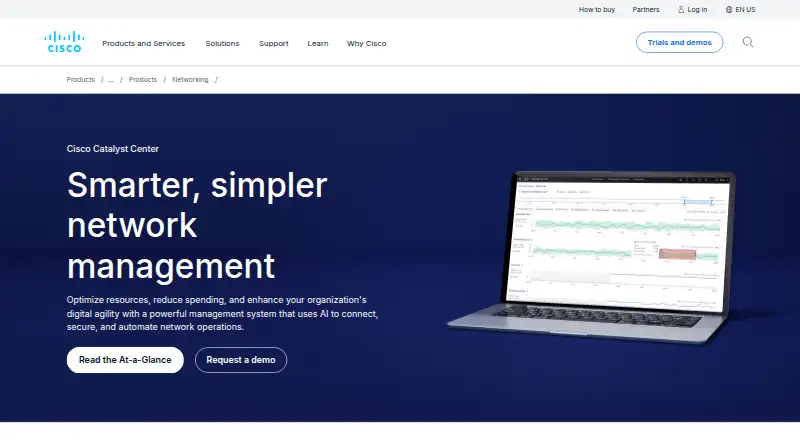
What Cisco Catalyst Center is
Cisco Catalyst Center is a centralized controller and management dashboard for enterprise network operations. It brings together network discovery, zero-touch provisioning, software image management, configuration compliance checks, and remediation. Its assurance capabilities use streaming telemetry and path tracing to monitor application performance and user connectivity, with guided remediation available for issues. Teams can connect it with Cisco ISE, ThousandEyes, Webex, Microsoft Teams, ServiceNow, Infoblox, and BlueCat, or use generic APIs for other ITSM and IPAM systems. Northbound REST APIs cover discovery, inventory, topology, provisioning, assurance, and other network operations. The platform supports predefined and custom fine-grained roles, including administrator, network administrator, and observer. Deployment choices include hardware and virtual appliances; Cisco's Ubuntu KVM minimums are 32 vCPUs, 256 GiB of memory, and a 3-TB SSD. Pricing is on request, there is no free plan, and managed devices require a Cisco DNA subscription.
Good
- Automates discovery, provisioning, and configuration remediation.
- REST APIs cover core network operations.
- Offers fine-grained predefined and custom user roles.
- Integrates with listed Cisco and third-party systems.
Watch out
- No free plan; pricing is on request.
- Ubuntu KVM minimums include 32 vCPUs and 256 GiB memory.
- Managed devices require a subscription.
- A Cisco Service Contract is required to open support cases.
Who it suits
It suits enterprise network teams that need centralized operations, automation, and assurance across managed devices. Teams should be prepared for substantial virtual-appliance requirements and subscription-based licensing.
Verdict
Cisco Catalyst Center combines network automation and assurance in one enterprise management platform. Its pricing is not published, and the listed Ubuntu KVM requirements are substantial.
Plans and prices
From Cisco Catalyst Center's own pricing page, checked 3 Oct 2026.
| Plan | Price | What it gives you |
|---|---|---|
| Cisco DNA Advantage | Priced on request | Complete Catalyst Center functionality · subscription required for managed devices · 3- and 5-year terms for wireless, switching, and SD-WAN/routing; 7-year terms for wireless and switching |
| Cisco DNA Essentials | Priced on request | Limited Catalyst Center functionality · subscription required for managed devices · 3- and 5-year terms for wireless, switching, and SD-WAN/routing; 7-year terms for wireless and switching |
The facts
Each one read from Cisco Catalyst Center's own pages, with the date it was checked.
What it does
- Access controls
- It supports predefined and custom fine-grained user roles, including administrator, network administrator, and observer roles.checked 3 Oct 2026
- API
- The platform exposes northbound REST APIs for discovery, inventory, topology, provisioning, assurance, and other network operations.checked 3 Oct 2026
- Assurance
- Its assurance features use streaming telemetry, path tracing, and guided remediation to monitor application performance and user connectivity.checked 3 Oct 2026
- Automation
- It supports network discovery, zero-touch provisioning, software image management, configuration compliance checks, and remediation.checked 3 Oct 2026
- Deployment
- Cisco describes hardware and virtual appliance deployments, including current guides for VMware ESXi and Ubuntu KVM.checked 3 Oct 2026
- Deployment requirements
- The Ubuntu KVM virtual appliance minimums include 32 vCPUs, 256 GiB of memory, and a 3-TB SSD.checked 3 Oct 2026
- Integrations
- Cisco documents integrations with ISE, ThousandEyes, Webex, Microsoft Teams, ServiceNow, Infoblox, and BlueCat, plus generic APIs for other ITSM and IPAM systems.checked 3 Oct 2026
- Purchase
- Cisco directs buyers to a sales representative or certified partner for purchasing guidance; the opened pages do not state a product price.checked 3 Oct 2026
- Purpose
- Cisco Catalyst Center is a centralized network controller and management dashboard for enterprise network operations.checked 3 Oct 2026
- Release support
- Cisco states that Catalyst Center 2.3.7.x follows a 24-month support timeline, with support for that release listed through June 17, 2027.checked 3 Oct 2026
- Scale limit
- For Ubuntu KVM, Cisco lists maximum nonfabric scale of 1,000 devices, 4,000 access points, and 25,000 endpoints.checked 3 Oct 2026
- Security
- Catalyst Center supports FIPS 140-2-compliant cryptography modules, and Cisco recommends deploying it behind a firewall on a private internal network.checked 3 Oct 2026
- Support
- Cisco says Catalyst and Cisco DNA software subscriptions include embedded software support and downloads; opening a support case requires a Cisco Service Contract.checked 3 Oct 2026
The company
- Founded
- 1984checked 28 Sep 2026
- Headquarters
- San Jose, California, United Stateschecked 28 Sep 2026
The full review of Cisco Catalyst Center
Overview
Cisco Catalyst Center is a centralized controller and management dashboard for enterprise network operations. It suits organizations managing Cisco networks that need automation, monitoring, and role-based operational control in one platform. Its breadth is compelling, but substantial virtual-appliance requirements and subscription-based access make it a poor fit for small or lightly managed environments.
Key features
Network discovery, zero-touch provisioning, software image management, configuration compliance checks, and remediation bring recurring network tasks into a single operational workflow. That can reduce manual work for teams managing many devices, while the platform's broad scope may be more than a small network needs.
Assurance combines streaming telemetry, path tracing, and guided remediation to help teams investigate application performance and user connectivity. Northbound REST APIs cover discovery, inventory, topology, provisioning, assurance, and other network operations, making it possible to connect Catalyst Center to custom tooling.
Documented integrations include ISE, ThousandEyes, Webex, Microsoft Teams, ServiceNow, Infoblox, and BlueCat, alongside generic APIs for other ITSM and IPAM systems. Fine-grained predefined and custom roles include administrator, network administrator, and observer, which gives larger teams ways to separate responsibilities. Catalyst Center supports FIPS 140-2-compliant cryptography modules; Cisco recommends placing it behind a firewall on a private internal network.
Pricing
Catalyst Center is paid software with custom pricing. Buyers are directed to a Cisco sales representative or certified partner, and a subscription is required for managed devices. The two plans have no published prices:
- Cisco DNA Advantage: Includes complete Catalyst Center functionality. Wireless, switching, and SD-WAN/routing subscriptions are offered for 3- and 5-year terms; wireless and switching also have 7-year terms. It is the fit for organizations that need the platform's full functionality.
- Cisco DNA Essentials: Provides limited Catalyst Center functionality, with the same stated subscription categories and term options. It may suit buyers whose needs fit the reduced feature set, but those giving up functionality should compare it carefully with Advantage before committing.
There is no free plan. Cisco says Catalyst and Cisco DNA software subscriptions include embedded software support and downloads, but opening a support case requires a Cisco Service Contract. Release 2.3.7.x has a 24-month support timeline, with support listed through June 17, 2027.
Platforms
Catalyst Center supports API, Linux, macOS, web, and Windows platforms, with self-hosted deployment. Cisco describes hardware and virtual appliances, including VMware ESXi and Ubuntu KVM options. The Ubuntu KVM minimums—32 vCPUs, 256 GiB of memory, and a 3-TB SSD—are substantial, so this deployment is best suited to organizations with the infrastructure to dedicate to network management.
For Ubuntu KVM, the stated maximum nonfabric scale is 1,000 devices, 4,000 access points, and 25,000 endpoints. Those caps help define a deployment boundary, but they do not establish scale limits for other deployment types.
Who it's for
Catalyst Center is best for enterprise network teams that want centralized Cisco network discovery, provisioning, configuration management, and assurance, particularly where integrations and APIs matter. Its subscription requirement, paid plans, and resource-intensive Ubuntu KVM deployment are barriers for smaller teams, budget-conscious buyers, or organizations seeking a free management platform.
Pros and cons
- Pro: Automation spans discovery, provisioning, image management, compliance, and remediation, covering several operational tasks in one controller.
- Pro: Telemetry, path tracing, and guided remediation give network teams tools to investigate connectivity and application-performance issues.
- Pro: REST APIs, named integrations, and custom user roles support integration with existing systems and division of operational duties.
- Con: Pricing is custom, and managed devices require a subscription, complicating budget comparisons.
- Con: Ubuntu KVM's minimum CPU, memory, and storage requirements demand significant dedicated infrastructure.
- Con: Essentials limits functionality, while support-case access requires a Cisco Service Contract.
Alternatives
For a wider comparison, browse Software-Defined Networking Software, Network Automation Software, Network Management Software, Network Provisioning Software, Wireless Network Management Software, and Cloud Network Management Software.
- OpenDaylight is a free, open-source SDN platform with downloadable archives and Docker images; choose it if free software and those deployment formats suit your needs better than Catalyst Center's paid subscriptions.
- HPE Aruba Networking Fabric Composer offers paid, per-switch Device Management Service Tier 3 subscriptions; consider it when that switch-based subscription model is a better fit.
- Netris is a paid option for API, Linux, web, and self-hosted environments; consider it if you want to evaluate another network platform with those deployment options.
- VMware NSX is another paid option.
- Cisco Nexus Dashboard Fabric Controller offers a paid DCN Essentials subscription for fabric inventory and provisioning, fabric and switch upgrades, and basic alerts; consider it for those fabric-management needs.
- Nutanix Flow Virtual Networking is a paid option with Flow Virtual Networking included in the NCI Ultimate plan; consider it if that plan is a fit.
- Cilium is free, open-source software for Linux systems using kernel 5.10 or equivalent on AMD64 or AArch64; choose it if those platform requirements fit and you want a free option.
- Antrea is free under Apache License 2.0 and requires a Kubernetes cluster and the Open vSwitch kernel module on every node; consider it if that environment matches your needs.
Verdict
Cisco Catalyst Center is a strong choice for enterprise teams managing Cisco networks that need centralized automation, assurance, and integration with other operational systems. Its breadth is the main reason to choose it; custom pricing, subscriptions for managed devices, and demanding virtual-appliance requirements are the main reasons to look elsewhere.
Alternatives to Cisco Catalyst Center
- 1
Antrea
Free planOpen sourceAPILinuxSelf-hostedWindows7.2Free plan - 2

Akamai Guardicore Segmentation
WebAPILinuxSelf-hosted6.4 - 3
Hopr
Free planLinuxSelf-hosted6.4From $35 a month - 4

ColorTokens Xshield
WebAPILinuxmacOS6.3 - 5

Istio
Free planLinuxmacOSSelf-hosted6.2Free plan - 6

Calico Open Source
Free planLinuxSelf-hostedWindows6.1Free plan