OpenDaylight
OpenDaylight is an open-source software-defined networking controller for centralized, programmable network control and monitoring.
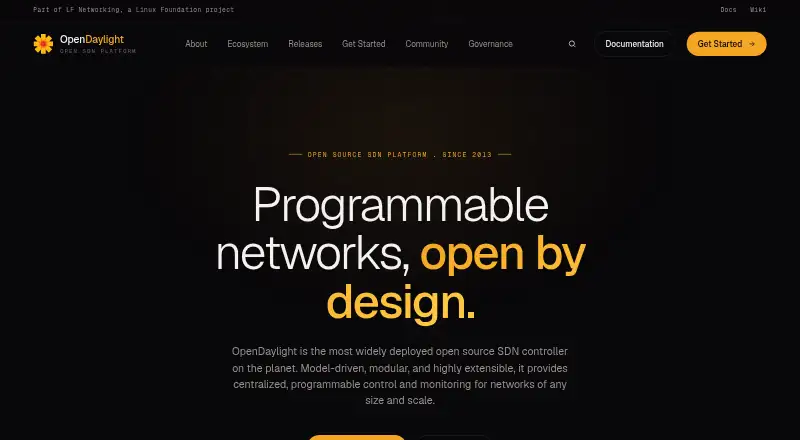
What OpenDaylight is
OpenDaylight is an open-source software-defined networking controller for centralized, programmable network control and monitoring. Its modular architecture uses YANG models and MD-SAL to connect applications with network hardware through REST APIs and southbound plugins. Listed protocols include OpenFlow, NETCONF, BGP-LS, PCEP, OVSDB, LISP, and SNMP. Clustering, sharded data stores, and leader-based consensus support operation across multiple nodes. The project describes use in optical transport, service-provider WAN automation, data center SDN, network telemetry, enterprise network control, and ONAP. Its AAA project provides authentication, authorization, accounting, and role-based access control for northbound interfaces. OpenDaylight is self-hosted and runs on Linux, macOS, and Windows, with Java 21 or later required. The downloads page names Chromium-SR0 as the current release and also lists Vanadium-SR1 and Titanium-SR3 as supported releases. The project provides documentation, Zulip chat, mailing lists, a wiki, and weekly Technical Steering Committee meetings. OpenDaylight is free and open source.
Good
- Supports a broad set of network protocols
- Clustering supports scaling across nodes
- Includes role-based access control for northbound interfaces
- Runs on Linux, macOS, and Windows
Watch out
- Requires Java 21 or later
- Requires self-hosted deployment
Who it suits
OpenDaylight suits network teams that need programmable control across supported network protocols and hardware. Its described use cases include service-provider WAN automation, data center SDN, and enterprise network control.
Verdict
OpenDaylight offers a free, modular controller for organizations building programmable network control. Teams should account for its Java requirement and self-hosted setup.
Plans and prices
From OpenDaylight's own pricing page, checked 3 Oct 2026.
| Plan | Price | What it gives you |
|---|---|---|
| OpenDaylight | Free | Open source SDN platform · downloadable tar or zip · Docker images |
The facts
Each one read from OpenDaylight's own pages, with the date it was checked.
What it does
- APIs
- OpenDaylight's YANG models generate REST APIs, and the setup instructions name RESTCONF as an installable feature for REST APIs.checked 3 Oct 2026
- Architecture
- Its modular architecture uses YANG models and MD-SAL to connect applications with network hardware through northbound REST APIs and southbound plugins.checked 3 Oct 2026
- Community support
- The project points users to documentation, Zulip chat, mailing lists, a wiki, and open weekly Technical Steering Committee meetings.checked 3 Oct 2026
- Current download
- The downloads page labels Chromium-SR0 as the current release and offers tar and zip downloads.checked 3 Oct 2026
- License
- The technical charter says outbound code is made available under the Eclipse Public License 1.0, with documentation under Creative Commons Attribution 4.0.checked 3 Oct 2026
- Network use cases
- The site describes use in optical transport, service provider WAN automation, data center SDN, network telemetry, enterprise network control, and ONAP.checked 3 Oct 2026
- Protocols
- The site lists support for OpenFlow, NETCONF, BGP-LS, PCEP, OVSDB, LISP, and SNMP, among other protocols.checked 3 Oct 2026
- Purpose
- OpenDaylight is an open source SDN controller for centralized, programmable network control and monitoring.checked 3 Oct 2026
- Release support
- The downloads page lists Chromium-SR0, Vanadium-SR1, and Titanium-SR3 under supported releases.checked 3 Oct 2026
- Runtime
- The site's setup instructions require Java 21 or later and state that OpenDaylight runs on Linux, macOS, and Windows.checked 3 Oct 2026
- Scaling
- The platform includes clustering, sharded data stores, and leader-based consensus for horizontal scaling across nodes.checked 3 Oct 2026
- Security
- The AAA project provides authentication, authorization, accounting, and role-based access control for OpenDaylight northbound interfaces.checked 3 Oct 2026
The company
- Founded
- 2013checked 28 Sep 2026
The full review of OpenDaylight
Overview
OpenDaylight is an open-source software-defined networking controller for centralized, programmable network control and monitoring. It is best suited to organizations that need to build network control around multiple protocols and have the skills to run the controller themselves. Its flexibility is a strong reason to consider it; the self-hosted deployment and Java 21-or-later requirement are meaningful operational commitments.
Key features
Programmable network control
YANG models and MD-SAL connect applications to network hardware through northbound REST APIs and southbound plugins. The models generate REST APIs, and RESTCONF is an installable feature for REST API access. Support includes OpenFlow, NETCONF, BGP-LS, PCEP, OVSDB, LISP and SNMP, while the supported-platform list also names gNMI, OpenROADM and SONiC. This breadth can accommodate varied network technologies, but it matters most to teams whose infrastructure and automation workflows can make use of those interfaces.
Scale and access control
Clustering, sharded data stores and leader-based consensus provide a path to horizontal scaling across nodes, which is useful for deployments that must grow beyond a single controller node. The AAA project adds authentication, authorization, accounting and role-based access control for northbound interfaces. These capabilities support larger, shared control environments, though they do not remove the work of designing and operating a self-hosted system.
Network use cases and tooling
OpenDaylight is used for optical transport, service-provider WAN automation, data-center SDN, network telemetry, enterprise network control and ONAP. Configuration management, workflow orchestration and network testing are supported capabilities, making it relevant beyond basic device control. Teams should choose it for the programmable platform and use-case range, rather than expecting a preconfigured managed service.
The project provides documentation, Zulip chat, mailing lists, a wiki and open weekly Technical Steering Committee meetings. Those channels give operators and developers several ways to seek community guidance. The technical charter places outbound code under the Eclipse Public License 1.0 and documentation under Creative Commons Attribution 4.0.
Pricing
OpenDaylight costs nothing. The open-source platform is downloadable as a tar or zip archive, with Docker images also offered. There is no free trial because the software is free; there is no paid tier or seat-based plan described. That makes it accessible for evaluation and deployment without a subscription, but organizations take responsibility for hosting, configuration and ongoing operations.
The downloads page labels Chromium-SR0 as the current release and also lists Vanadium-SR1 and Titanium-SR3 under supported releases. The setup instructions require Java 21 or later. Teams should account for that runtime alongside the effort involved in selecting features and maintaining their own deployment.
Platforms
OpenDaylight supports Linux, macOS and Windows, with API access and self-hosted deployment. The operating-system support makes it usable across common server environments, but self-hosting means it is not a hosted controller that can be adopted without infrastructure responsibility.
Who it's for
OpenDaylight is a strong fit for network engineering organizations building programmable control across varied hardware or protocols, particularly in data centers, service-provider WANs, optical transport and telemetry deployments. It also suits teams contributing to or integrating with ONAP. The project’s modular architecture and scaling features reward teams that need to tailor control rather than accept a fixed interface.
It is less suitable for teams seeking a managed, turnkey networking product or those without capacity to operate Java-based software. Organizations that need tightly packaged network management and are not prepared to configure a controller should look at commercial alternatives instead.
Pros and cons
- Pros: Free, open-source access avoids subscription cost and allows self-hosted use.
- Pros: Broad protocol support and REST APIs enable programmable control across heterogeneous networks.
- Pros: Clustering, sharded data stores and leader-based consensus support horizontal growth.
- Pros: AAA provides role-based access control and related security functions for northbound interfaces.
- Cons: Self-hosted deployment places infrastructure and operational work on the adopting organization.
- Cons: Java 21 or later is a runtime requirement that teams must accommodate.
- Cons: Its modular, configurable approach is a poor match for teams wanting a managed, ready-made controller.
Alternatives
For an open-source alternative, Cilium is free and self-hosted on Linux, with a Linux kernel 5.10 or equivalent requirement and AMD64 or AArch64 support; choose it when those platform constraints fit your environment. Antrea is another free, self-hosted option for Linux and Windows, but it requires a Kubernetes cluster and the Open vSwitch kernel module on every Kubernetes node.
For commercial options, Cisco Catalyst Center requires a subscription for managed devices and offers 3- and 5-year terms for wireless; it is worth considering when a paid, subscription-based controller is acceptable. HPE Aruba Networking Fabric Composer has switch subscriptions billed per switch, including a Tier 3 single-node option, so it may suit teams evaluating that device-based licensing approach. Cisco Nexus Dashboard Fabric Controller offers a DCN Essentials subscription with 3-, 5- or 7-year terms and fabric inventory, provisioning, upgrades and basic alerts; consider it when those included management functions align with the deployment.
Netris, VMware NSX and Nutanix Flow Virtual Networking are other commercial alternatives.
Explore Software-Defined Networking Software and Network Automation Software for more options.
Verdict
Choose OpenDaylight if your organization needs a free, extensible controller for programmable network control and can manage its own Java-based deployment. Its protocol range and scaling architecture are compelling for complex environments; look elsewhere if you need a managed service or a turnkey product with less operational responsibility.
Alternatives to OpenDaylight
- 1
ONOS
Free planWebAPILinuxmacOS6.9Free plan - 2
Cisco Catalyst Center
WebAPILinuxmacOS6.2 - 3
Open Virtual Network
Free planLinuxSelf-hosted5.9Free plan - 4
Netris
WebAPILinuxSelf-hosted5.5 - 54.9
- 64.8