
ColorTokens Xshield
ColorTokens Xshield is an enterprise microsegmentation platform that creates micro-perimeters around network assets to limit the spread of malware and ransom…
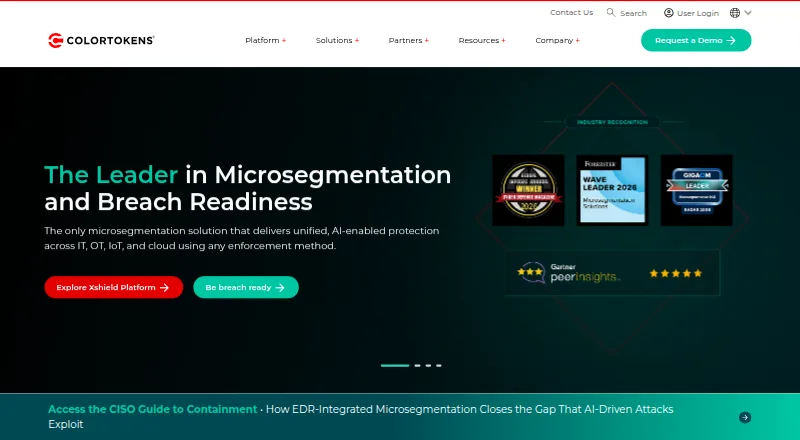
What ColorTokens Xshield is
ColorTokens Xshield is an enterprise microsegmentation platform that creates micro-perimeters around network assets to limit the spread of malware and ransomware. It covers data center and cloud workloads, endpoints, containers, and IoT and OT devices. AWS, Azure, and GCP are named as cloud environments managed from one console. Depending on the asset, Xshield applies agent-based or agentless enforcement; its agents are available for Windows, Ubuntu, and Red Hat OS families. For Kubernetes, it controls communications at the API level. AI-assisted guided workflows use LLM-driven discovery and rule synthesis to help create segmentation policies, which teams can simulate and test on-device before enforcement. Identity-based rules are supported. Integrations include out-of-the-box options and ad hoc connections through an open API; named integrations include CrowdStrike Falcon, SentinelOne Singularity, Okta, ServiceNow CMDB, AWS, Microsoft Azure, and VMware. ColorTokens describes Xshield for enterprise and government organizations. Pricing is available on request, and a solution sheet displays a free-trial offer.
Good
- Supports policy simulation before enforcement
- Controls Kubernetes communications at the API level
- Agent-based and agentless enforcement options
- Open API supports ad hoc integrations
- Free-trial offer is displayed
Watch out
- Pricing is available on request
- Agent certification is listed for two Linux distributions
Who it suits
Xshield is described for enterprise and government teams managing data center, cloud, endpoint, container, IoT, or OT environments. Its coverage includes hybrid deployment and identity-based policies.
Verdict
Xshield combines policy creation and pre-enforcement simulation across varied network assets. Organizations considering it should request pricing and confirm their assets fit its supported enforcement and agent options.
The facts
Each one read from ColorTokens Xshield's own pages, with the date it was checked.
What it does
- Agent certification
- The Xshield Agent is listed as certified for Red Hat Enterprise Linux 8.10 x86_64 and SUSE Linux Enterprise Server 15.checked 29 Sep 2026
- Authorization
- ColorTokens states that its Xshield Enterprise Microsegmentation Platform has TX-RAMP Level 1 authorization.checked 29 Sep 2026
- Container security
- Xshield controls Kubernetes communications at the API level.checked 29 Sep 2026
- Coverage
- The platform covers data center workloads, cloud workloads, user endpoints, containerized applications, and IoT and OT devices.checked 30 Sep 2026
- Deployment
- Xshield uses both agent-based and agentless enforcement, depending on the asset type.checked 30 Sep 2026
- Integrations
- Listed integrations include CrowdStrike Falcon, SentinelOne Singularity, Microsoft Defender for Endpoint, Splunk, Tenable, Rapid7, ServiceNow CMDB, AWS, Azure, and VMware.checked 30 Sep 2026
- Intended customers
- ColorTokens describes Xshield as an enterprise microsegmentation platform and lists customers across private-sector and government organizations.checked 30 Sep 2026
- Named integrations
- The integrations page lists integrations including CrowdStrike Falcon, SentinelOne Singularity, Okta, ServiceNow CMDB, AWS, Microsoft Azure, and VMware.checked 29 Sep 2026
- Open API
- ColorTokens says it supports ad-hoc integrations through its open API.checked 30 Sep 2026
- Policy testing
- Teams can simulate policies to validate them before enforcement.checked 29 Sep 2026
- Policy validation
- Teams can simulate policies and test them on-device before enforcement.checked 30 Sep 2026
- Policy workflows
- Xshield offers AI-assisted policy workflows, visual policy design, policy auto-recommendations, and template-driven policies.checked 30 Sep 2026
- Purpose
- Xshield puts micro-perimeters around network assets and enforces zero-trust policies to stop malware and ransomware from spreading laterally.checked 30 Sep 2026
- Security certification
- ColorTokens states that its environment completed an independent third-party SOC 2 Type II audit.checked 29 Sep 2026
- Security certifications
- ColorTokens lists SOC 2 Type II and ISO/IEC 27001:2022 certifications and says Xshield has TX-RAMP Level 1 authorization.checked 30 Sep 2026
- Support
- A ColorTokens careers page describes technical support for Xshield products and handling customer escalations.checked 30 Sep 2026
- Who it is for
- ColorTokens describes Xshield as serving enterprise and government customers across data center, cloud, endpoint, container, IoT, and OT environments.checked 29 Sep 2026
Where it runs
- Cloud platforms
- The product page names AWS, Azure, and GCP as cloud environments managed from one console.checked 30 Sep 2026
- Windows and Linux agents
- The help center says Xshield agents are available for Windows, Ubuntu, and Red Hat OS families.checked 30 Sep 2026
The company
- Headquarters
- San Jose, California, United Stateschecked 28 Sep 2026
Money
- Trial
- A ColorTokens Xshield solution sheet displays “Start Free Trial.”checked 30 Sep 2026
The full review of ColorTokens Xshield
ColorTokens Xshield is an enterprise microsegmentation platform for controlling communication among network assets. It is best suited to organizations protecting mixed data center, cloud, endpoint, container, IoT, or OT estates. Its strongest case is the combination of guided policy creation and pre-enforcement simulation; custom pricing makes it a considered enterprise purchase rather than a quick fit for smaller teams.
Overview
Xshield uses identity-based rules to create micro-perimeters around assets, aiming to limit malware and ransomware from spreading laterally. It supports hybrid deployments and combines agent-based and agentless enforcement depending on asset type, which gives organizations with varied infrastructure more than one way to apply controls.
The policy workflow is a notable advantage: LLM-driven discovery and rule synthesis are intended to compress segmentation work that can take days into minutes. Teams can simulate policies and test them on-device before enforcement, a useful safeguard when a mistaken rule could disrupt production traffic. The tradeoff is that the product is positioned for enterprise and government environments, so the breadth may be unnecessary for organizations with simpler networks.
Key features
Policy creation and validation
AI-assisted guided workflows help teams discover communication patterns and synthesize rules. Simulation before enforcement gives security teams a chance to validate policy behavior before applying it, rather than treating automation as a substitute for review.
Mixed workload coverage
Xshield is presented for data center workloads, cloud workloads, user endpoints, IoT and OT devices, and containerized applications. For Kubernetes, it controls communications at the API level. This range is relevant to organizations that need a segmentation approach across different asset classes, rather than a tool focused on only one environment.
Integrations and controls
Out-of-the-box integrations include CrowdStrike Falcon, SentinelOne Singularity, Okta, ServiceNow CMDB, AWS, Microsoft Azure, and VMware; an open API supports ad hoc integration work. ColorTokens names AWS, Azure, and GCP as cloud environments managed from one console. It also states that its environment completed an independent SOC 2 Type II audit, lists ISO/IEC 27001:2022 certification, and says Xshield has TX-RAMP Level 1 authorization. The Xshield Agent is certified for Red Hat Enterprise Linux 8.10 x86_64 and SUSE Linux Enterprise Server 15; agents are also available for Windows, Ubuntu, and Red Hat OS families.
Pricing
Xshield is paid software with custom pricing, and a free trial is offered. No plan tiers or seat or asset quotas are given, so buyers should request a quote and confirm how pricing maps to their deployment. The product is aimed at enterprise and government customers, making it a poor fit for buyers seeking a published, self-serve price.
Platforms
Xshield supports API, Linux, macOS, self-hosted, web, and Windows environments. Its hybrid deployment model uses agent-based or agentless enforcement according to asset type. The agent certification coverage is specific to the named RHEL and SUSE versions, while broader agent availability includes Windows, Ubuntu, and Red Hat OS families.
Who it's for
Xshield fits enterprise and government security teams responsible for mixed infrastructure and looking to apply identity-based segmentation across data center, cloud, endpoint, container, IoT, and OT assets. Its policy simulation is particularly useful where teams want to validate controls before enforcement. Organizations with narrow workloads or limited need for cross-environment policy management should compare more focused options.
Pros and cons
Pros
- Policy simulation and on-device testing let teams validate rules before enforcement.
- Agent-based and agentless enforcement accommodate different asset types across hybrid environments.
- Coverage spans cloud, data center, endpoints, Kubernetes, IoT, and OT, with an open API for custom integrations.
Cons
- Custom pricing requires a sales conversation and makes cost comparison less direct.
- The product's broad enterprise scope may be more than organizations with a limited or single-environment estate need.
- Agent certification is named for specific RHEL and SUSE releases, so teams should confirm support for their exact systems.
Alternatives
Zentera CoIP Access Platform is another paid option with API, Linux, macOS, self-hosted, and Windows platforms; contact Zentera for product access, questions, and support.
Zero Networks Segment may suit buyers who prefer a model described as paying only for protected assets with no hidden costs; it supports API and web platforms.
Elisity Microsegmentation is a paid enterprise network microsegmentation option with API, self-hosted, and web platforms.
Akamai Guardicore Segmentation is a paid alternative with self-hosted support.
Illumio Segmentation is a paid option for Linux and Windows environments.
Aviatrix Zero Trust for Workloads is a paid alternative with web support.
Calico Open Source is worth considering for buyers who want a free option with Linux, self-hosted, and Windows support; its free plan includes community-driven support and maintenance, in-memory data retention, and unlimited clusters.
Cilium is a free, open-source Linux option for systems using kernel 5.10 or equivalent on AMD64 or AArch64.
Browse Microsegmentation Software for more options.
Verdict
Choose Xshield if your organization needs identity-based microsegmentation across varied hybrid assets and values policy simulation before enforcement. Its breadth, workflow assistance, and multiple enforcement approaches are the main reasons to shortlist it; look elsewhere if published pricing or a narrower, more straightforward deployment is a priority.
Alternatives to ColorTokens Xshield
- 1
Antrea
Free planOpen sourceAPILinuxSelf-hostedWindows7.2Free plan - 2

Akamai Guardicore Segmentation
WebAPILinuxSelf-hosted6.4 - 3
Hopr
Free planLinuxSelf-hosted6.4From $35 a month - 4
Cisco Catalyst Center
WebAPILinuxmacOS6.2 - 5

Istio
Free planLinuxmacOSSelf-hosted6.2Free plan - 6

Calico Open Source
Free planLinuxSelf-hostedWindows6.1Free plan