Hopr
Hopr provides Zero Trust access control for workloads and APIs using Cloud Native Automated Moving Target Defense.
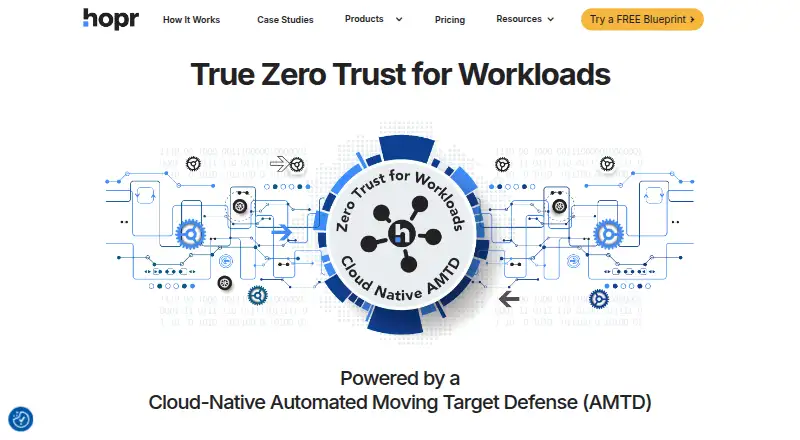
What Hopr is
Hopr provides Zero Trust access control for workloads and APIs using Cloud Native Automated Moving Target Defense. Its lightweight Workload Security Proxy is built on open-source Envoy and can be deployed with legacy virtual machines or container systems such as Kubernetes. Machine Alias ID gives each workload a frequently rotating identity credential. Hopr says its SEE protocol creates a bidirectional, end-to-end encrypted channel for each session without a key exchange, while Runtime Microsharding divides the application-layer attack surface into small, dynamic shards. Lane7 Blueprints are preconfigured Kubernetes networks that Hopr says can be deployed in under 30 minutes. Blueprint downloads are free, but using them requires a Hopr license; a 30-day trial license is offered. The Korvette-S WoSPs plan costs $35.00 per month per active WoSP and includes 1 billion sessions per WoSP and unlimited workloads. Hopr says it uses security scanning and external assessments, and encrypts data at rest and in transit with FIPS-approved libraries. Licensing is restricted in some countries by export regulations.
Good
- Proxy supports legacy VMs and Kubernetes environments.
- Machine Alias ID rotates workload identity credentials frequently.
- Blueprint downloads are free.
- Free email and chat support are listed.
Watch out
- Blueprint use requires a Hopr license.
- Licensing is restricted in some countries.
- Enterprise Ultra pricing requires contacting sales.
Who it suits
Hopr is aimed at security leaders, DevOps teams, and platform engineers managing workloads across legacy and container environments. It is available for Linux and self-hosted deployment.
Verdict
Hopr combines workload identity, encrypted sessions, and dynamic application-layer segmentation for workload and API access control. Check country licensing restrictions and the required license for Blueprint use before choosing it.
Plans and prices
From Hopr's own pricing page, checked 4 Oct 2026.
| Plan | Price | What it gives you |
|---|---|---|
| Lane7 Blueprints | Free | Set by Blueprint · Hopr license required · Always free |
| Korvette-S WoSPs | $35 a month | 1 billion sessions per WoSP · unlimited workloads · per active WoSP per month |
| Enterprise Ultra | Priced on request | Unlimited sessions · unlimited workloads · Contact Sales |
The facts
Each one read from Hopr's own pages, with the date it was checked.
What it does
- Attack surface
- Runtime Microsharding breaks the application-layer attack surface into small, dynamic shards.checked 4 Oct 2026
- Blueprint licensing
- Blueprint downloads are free, but use requires a Hopr license; the site offers a 30-day free-trial license.checked 4 Oct 2026
- Blueprints
- Lane7 Blueprints are preconfigured Kubernetes networks, and the maker says they can be deployed in under 30 minutes.checked 4 Oct 2026
- Deployment
- WoSPs can be deployed with legacy VMs or modern container systems such as Kubernetes.checked 4 Oct 2026
- Encryption
- Hopr says its SEE protocol creates a bidirectional end-to-end encrypted channel for each session without a key exchange.checked 4 Oct 2026
- Encryption at rest and in transit
- Hopr says data at rest and in transit is encrypted with FIPS 140-2 and 140-3 approved libraries.checked 4 Oct 2026
- Export restriction
- Hopr says export regulations restrict licensing to some countries.checked 4 Oct 2026
- Intended users
- Hopr describes its solution for security leaders, DevOps teams, and platform engineers.checked 4 Oct 2026
- Purpose
- Hopr provides Zero Trust access control for workloads and APIs using Cloud Native Automated Moving Target Defense.checked 4 Oct 2026
- Security controls
- Hopr says it uses SAST, DAST, container and dependency scanning, and periodic external vulnerability assessments and ethical hacking.checked 4 Oct 2026
- Support
- The pricing page includes free email and chat support.checked 4 Oct 2026
- Workload proxy
- Its Workload Security Proxy is a lightweight proxy built on open-source Envoy.checked 4 Oct 2026
The company
- Headquarters
- Columbia, Maryland, United Stateschecked 28 Sep 2026
Where it runs
- Machine identity
- Machine Alias ID provides a high-frequency rotating identity credential for each workload.checked 4 Oct 2026
The full review of Hopr
Hopr is a Zero Trust control layer for workloads and APIs, designed for security leaders, DevOps teams, and platform engineers running mixed environments. It suits organizations willing to operate Linux or self-hosted infrastructure and to manage identity at the workload level. The strongest case is its combination of rotating machine credentials, encrypted sessions, and Kubernetes-aware segmentation; licensing constraints and paid session limits narrow its fit.
Overview
Hopr’s Workload Security Proxy is a lightweight proxy built on open-source Envoy. It applies identity-based rules to workloads and APIs across hybrid cloud deployments, with enforcement for Kubernetes as well as legacy virtual machines. That makes it more targeted than a broad network-security suite: policy follows workload identity rather than relying only on network location.
Machine Alias ID assigns each workload a frequently rotating identity credential. Runtime Microsharding then divides the application-layer attack surface into small, changing shards. Together, these controls are relevant to teams trying to reduce the exposure created by persistent identities and large, static service boundaries. The requirement for Linux or self-hosted deployment, however, will exclude teams seeking a primarily managed, cross-platform service.
Key features
Encrypted workload sessions
Hopr says its SEE protocol creates a bidirectional end-to-end encrypted channel for every session without a key exchange. It also says data in transit and at rest uses libraries approved under FIPS 140-2 and 140-3. Those properties are useful where formal cryptographic requirements matter, although they do not eliminate the operational work of deploying and governing the proxies.
VM and Kubernetes coverage
Workload Security Proxies can run with legacy VMs or container platforms such as Kubernetes. Lane7 Blueprints provide preconfigured Kubernetes networks that Hopr says can be deployed in under 30 minutes. This is the most practical entry point for Kubernetes-focused platform teams; organizations with neither Kubernetes nor self-hosted infrastructure have less reason to choose Hopr.
Security engineering and support
Hopr says its development process includes SAST, DAST, container and dependency scanning, periodic external vulnerability assessments, and ethical hacking. Free email and chat support are included on the pricing page. These controls and support channels add reassurance for teams evaluating a security-sensitive platform, but they do not change the need to verify architecture and operational responsibilities internally.
Pricing
Hopr uses a freemium model, with a 30-day trial and paid plans starting at $35/mo.
- Lane7 Blueprints: free, billed Always free. Blueprint downloads cost nothing, but a Hopr license is required to use them. A 30-day free-trial license is offered, so this plan is best for evaluating the preconfigured Kubernetes networks rather than running them indefinitely without licensing.
- Korvette-S WoSPs: $35 a month, billed per active WoSP per month. Each WoSP includes 1 billion sessions and unlimited workloads. It is the clearest fit for production teams that can size usage around active proxies; session-heavy deployments must account for the per-WoSP quota.
- Enterprise Ultra: custom pricing, billed through Contact Sales. It provides unlimited sessions and unlimited workloads, making it the plan for larger or less predictable estates that would outgrow the Korvette-S allowance.
Export regulations restrict licensing in some countries, so eligibility should be confirmed before a purchase or Blueprint rollout.
Platforms
Hopr supports Linux and self-hosted deployment. Its agent-based model covers mixed workloads, hybrid cloud environments, identity-based policy, and Kubernetes enforcement. That combination favors infrastructure teams comfortable operating their own deployment components rather than buyers seeking native desktop or mobile clients.
Who it's for
Security leaders can use Hopr when workload identity and application-layer segmentation are central to a Zero Trust program. DevOps and platform engineers are the natural operators, particularly those managing both VMs and Kubernetes clusters. It is less suitable for teams that need a fully managed service, broad end-user platform coverage, or licensing unrestricted by export controls.
Pros and cons
- Pros: Frequently rotating Machine Alias IDs reduce dependence on static workload credentials; SEE provides bidirectional encrypted sessions without a key exchange; Runtime Microsharding narrows the application-layer attack surface; VM and Kubernetes deployment supports mixed estates; Korvette-S includes unlimited workloads per active WoSP.
- Cons: The $35.00-per-WoSP plan is capped at 1 billion sessions per WoSP; Blueprint use still requires a Hopr license despite free downloads; Linux and self-hosted deployment demand operational expertise; export restrictions can prevent licensing in some countries; Enterprise Ultra requires a sales process and custom pricing.
Alternatives
For a broad directory of comparable segmentation tools, see Microsegmentation Software.
- VMware Workstation Pro is a free Linux or Windows-hosted option with no subscription or license key, but it does not provide Hopr’s workload access-control model.
- Choose Zscaler Private Access when you need a paid private-access service spanning Android, iOS, Linux, macOS, web, and Windows.
- Antrea is free and Apache-licensed for Kubernetes users prepared to run a cluster and Open vSwitch on every node.
- Calico Open Source is free, supports unlimited clusters, and is maintained by a community.
- Istio is a free open-source service mesh for Linux, macOS, and self-hosted environments.
- Cilium is free open source for Linux systems with kernel 5.10 or equivalent on AMD64 or AArch64.
- ColorTokens Xshield is a paid alternative with a free trial and support for API, desktop, web, and self-hosted environments.
- Trellix Data Loss Prevention is a paid enterprise suite covering endpoint, email, web, network, and storage data protection, managed on-premises or as SaaS.
Verdict
Choose Hopr if you need identity-centric access control for workloads and APIs across VMs and Kubernetes, and your team can run Linux or self-hosted components. Its rotating identities, encrypted sessions, and dynamic microsharding give it a focused Zero Trust architecture. Look elsewhere if your estate requires a managed, broadly cross-platform service, exceeds the 1-billion-session WoSP allowance, or falls under Hopr’s export licensing restrictions.
Alternatives to Hopr
- 1
Antrea
Free planOpen sourceAPILinuxSelf-hostedWindows7.2Free plan - 2

Akamai Guardicore Segmentation
WebAPILinuxSelf-hosted6.4 - 3

ColorTokens Xshield
WebAPILinuxmacOS6.3 - 4
Cisco Catalyst Center
WebAPILinuxmacOS6.2 - 5

Istio
Free planLinuxmacOSSelf-hosted6.2Free plan - 6

Calico Open Source
Free planLinuxSelf-hostedWindows6.1Free plan